- Place
- Kaniava eldership, Varėna District Municipality
- Region
- Dzūkija National Park
- Type
- route through Lynežeris ethnographic village and the Lake Lynas landscape
- Coordinates
- 54.06200, 24.56900
Lynežeris ethnographic village, Lynežeris
What the Lynežeris trail means
The user-facing list names this place Lynežeris Nature Trail, but during research the most clearly confirmed object in authoritative sources was Lynežeris ethnographic village, not a separate official trail. This page therefore describes a responsible walk through the village, the Lake Lynas shore, and the surrounding Dzūkija National Park landscape.
That distinction matters because it avoids inventing infrastructure. If an officially marked route with a separate name appears, this page should be updated according to new park information.
Lynežeris by Lake Lynas
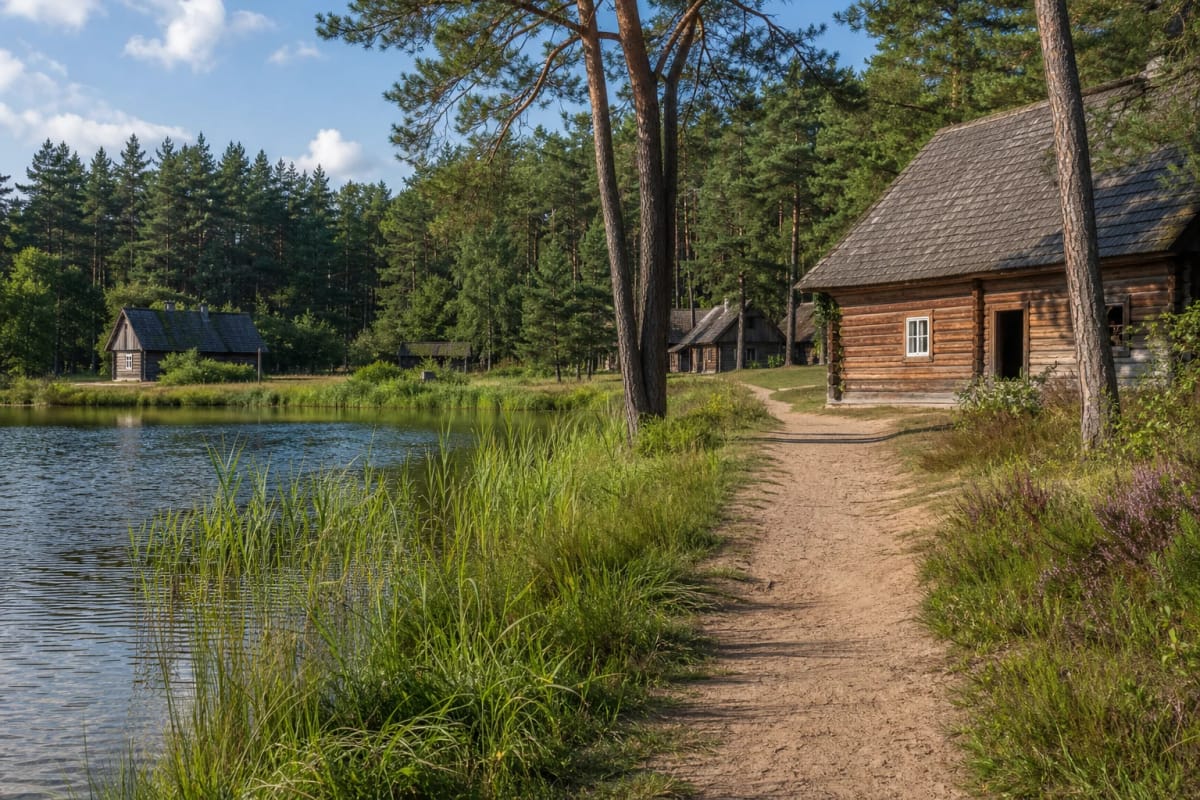
VLE states that Lynežeris is in Varėna District, Kaniava eldership, about 12 km east of Marcinkonys, in Dzūkija National Park, on the southwestern shore of Lake Lynas. The Beržupis flows through the village, while the Lynupis, a left tributary of the Ūla, runs along the northeastern edge. This means the village is part of a lake and stream system, not beside a random body of water.
VLE also notes inland dunes around the village and Čepkeliai Reserve to the south. Even a short walk here is therefore not only about the lake: it shows sandy Dzūkija relief, a forest village, and water connections in one small area.
History and village development
VLE notes that homesteads existed here already in the mid-sixteenth century, and that the village, then called New Lynežeris, was first mentioned in 1765. That history lets visitors see Lynežeris as a long-developing forest village, not just a present-day summer stop by a lake.
VLE also provides population change: 90 residents in 1795, 145 in 1905, 199 in 1931, 112 in 1959, 71 in 1979, 36 in 2001, and only 19 in 2021. When visiting, remember that every yard is a sensitive living space in a shrinking village, not only a heritage backdrop.
Architectural traits
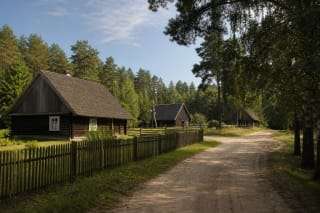
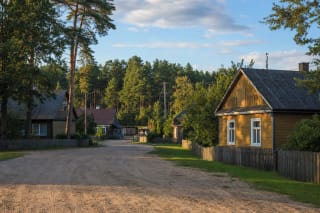
VLE describes Lynežeris as a scattered-plan village with naturally formed sparse street-village traits in the eastern part. Valuable late nineteenth and early twentieth-century homesteads and individual buildings survive, and the village plan has changed little since the mid-twentieth century.
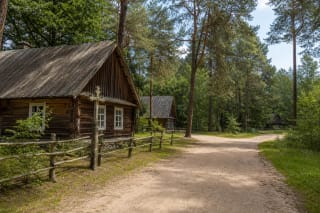
VLE states that the houses, mostly one-ended, and granaries were built from hewn logs joined with saddle notches and had gabled rafter roofs. Farm buildings are small, built from unhewn logs joined at the corners; cowshed roofs are often twice as high as the walls, and all buildings stand on stones or timber offcuts. These details are best seen by walking slowly and looking at the homestead as a whole.
How to walk and what not to expect
Do not expect extensive trail infrastructure in Lynežeris unless the current official park information shows it. Plan a short walk on public roads and paths, looking at the lake shore, sandy relief, and wooden homesteads from a respectful distance.
No separate ticket or opening hours are listed for the village. Before travelling, check Dzūkija National Park route information, because markings, seasonally wet places, or private property can affect the most comfortable walk.
Lynežeris in a wider Dzūkija route
Lynežeris is remote, so it is best combined with other Dzūkija National Park points such as Marcinkonys, Zervynos, or Musteika. Seeing several villages together helps show the difference between scattered and street-plan forest villages and why sandy Dzūkija preserved such old wooden architecture.
The surrounding pinewoods belong to the region's mushroom and forest culture, so Lynežeris should be understood not only as a set of buildings but as a way of life by lake and forest. Respect residents and protected-area rules.