- Place
- Biržuvėnai area, Telšiai District Municipality
- Region
- Telšiai District
- Type
- spring with a mythological name
- Coordinates
- 55.89800, 22.45400
Laumės Pėda
A small spring with a strong name
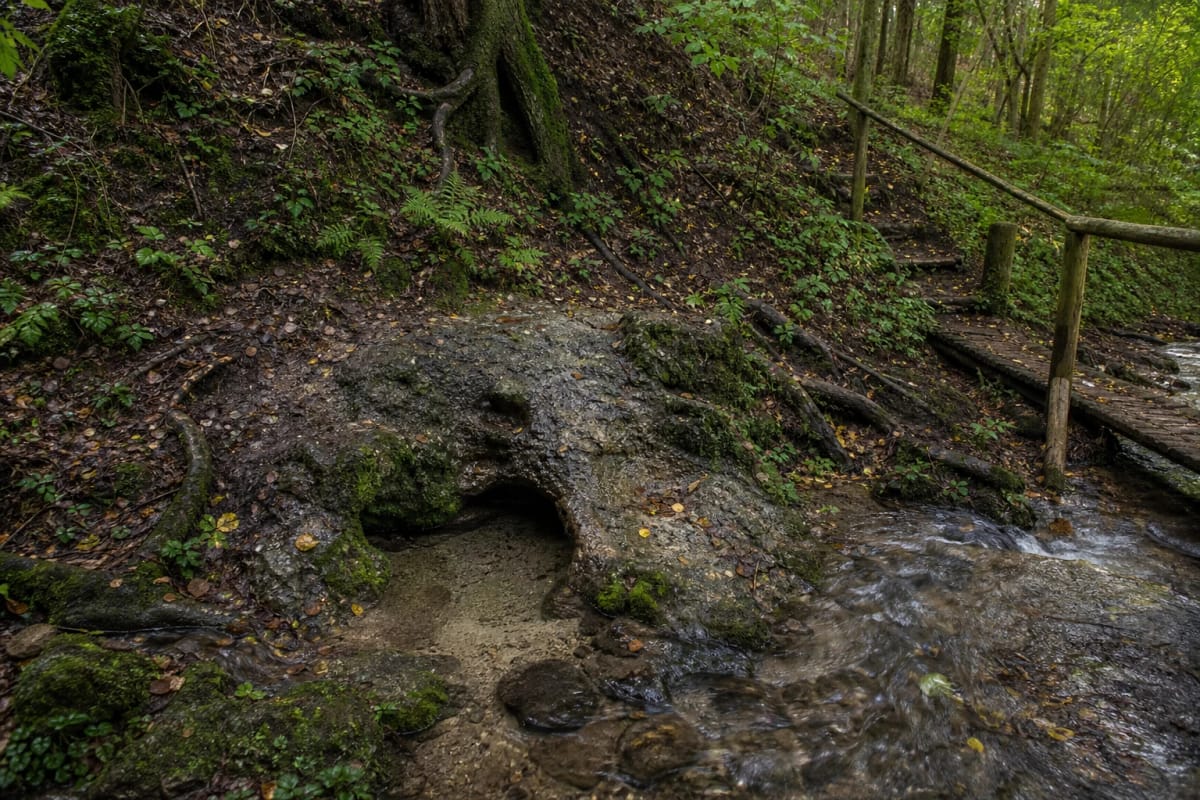
Laumės Pėda is not a large spectacle. It is a spring flowing in the forest at the foot of a hill slope, where water, roots, damp soil, and a hollow reminiscent of a foot create a very concrete experience of place. The effect comes not from scale but from closeness.
Saugoma.lt presents the object as Laumės Pėda Spring. The springlets flow in the forest at the foot of the hill slope and then reach the Virvytė River; according to Saugoma.lt, the springy hollow resembles a foot, which may be one of the images behind the name. The site belongs to the Biržuvėnai area, the natural setting of the Virvytė Valley, and the Žąsūgala cycling route, so for most visitors it works best as a short stop within a broader Biržuvėnai and Telšiai-region route.
A place near Biržuvėnai Manor and the Virvytė
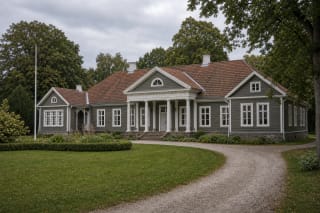
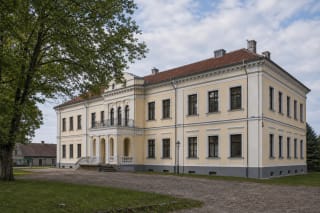
Saugoma.lt states that the spring is near Biržuvėnai Manor, on the other bank of the Virvytė River. That helps locate it precisely: Laumės Pėda belongs to the same Virvytė Valley as one of Samogitia's best-known wooden manor ensembles, so it is natural to visit the spring together with the manor estate.
Saugoma.lt also notes that in the 20th century the place was cared for by the Gorskiai, owners of Biržuvėnai Manor. This is a rare detail: it shows that the spring was not only a folklore object but also a consciously maintained landscape point embedded in manor memory.
Why a foot: legendary name and sacred springs
The foot motif in Lithuanian spring, stone, and hollow names often marks a place where a natural form invites a story. Here the foot-like hollow and flowing springlets allow the site to be read as a legendary sign, while in Lithuanian mythology laumės are often connected with water, damp places, and washing cloth by rivers.
VLE gives the wider context: sacred springs belong to the old Baltic alkas, or sacred-site, group together with sacred hills, groves, lakes, rivers, and ritual stones. Such springs were believed to give luck, increase harvest, and protect from thunderstorms. This helps explain why a natural forest spring could receive a mythological name linked with a laumė, though the name should be treated as a narrative layer rather than proof of a documented historical event.
Protected landscape and visitor responsibility
Places like this are especially sensitive to visitor behaviour. Spring water, wet soil, and slope vegetation are easily damaged, so it is best to stay on existing paths, avoid stepping into the source itself, and not try to shape the hollow or depressions by hand.
Laumės Pėda is a state-protected natural heritage object listed in protected-area records, not recreational infrastructure. Visiting is directly tied to preservation: the less the spring environment is disturbed, the longer the foot-shaped spring hollow can remain.
How to visit Laumės Pėda
Usually 15-30 minutes is enough. Come slowly, because the spring is not a large object: it reveals itself only when you approach the water and look closely at the slope shape and the outline of the hollow. Spring and autumn are best, when the slope is moist but the paths are still easy enough to pass.
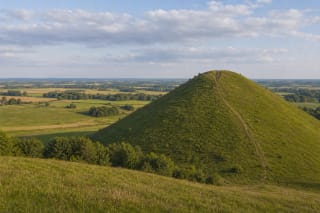
The spring has no opening hours or ticket office. If you travel by bicycle on the Žąsūgala route or combine the stop with Biržuvėnai Manor, check museum-style objects and their hours separately, because the spring itself is an outdoor natural place. The easiest route combines it with Biržuvėnai Manor Estate, the Virvytė Valley, Šatrija Hill, and the Varniai area.