- Place
- Kintai, Šilutė District Municipality
- Region
- Pamarys
- Type
- natural monument - a western red cedar (Thuja plicata)
- Address
- By the Kintai forestry office, Kintai, Šilutė District
- Coordinates
- 55.42386, 21.25735
The Great Thuja, Great Kintai Thuja
Kintai Great Thuja - Lithuania's tallest thuja
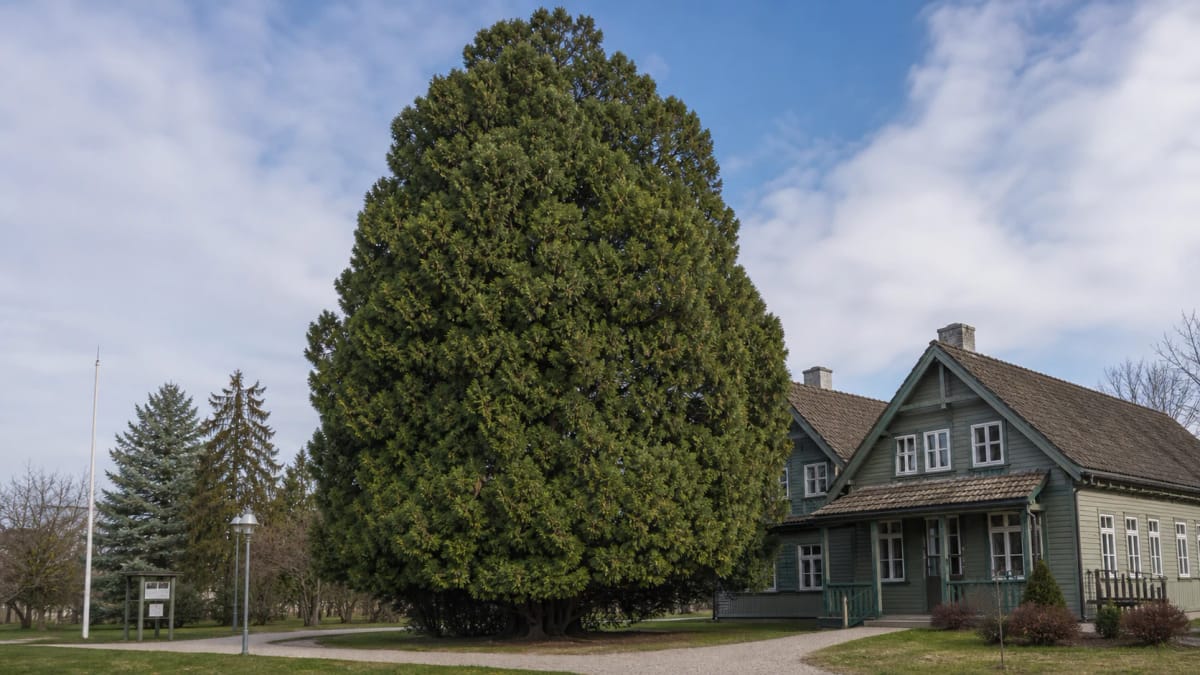
Kintai Great Thuja is a place that only needs a dozen or so minutes, yet it fits the Kintai route well. The tree grows by the Kintai forestry office and is described as the tallest western red cedar in Lithuania and one of the tallest in all of Europe - according to Šilutė District Municipality, the second-largest on the continent.
A site like this is not a large museum or a long trail, but it helps you feel the scale of a place. At the Great Thuja, the main point is to stop where the tree's height, crown width, and relationship to a person and the forestry building can all be seen.
The tree's species and dendrological dimensions
This is a western red cedar (Thuja plicata), a cypress-family conifer native to North America and planted in Lithuania as an ornamental tree. The Kintai specimen stands out for its unusual height: measurements over recent decades show that the tree is still growing - it was about 18.2 m in 2004 and about 19.5 m in 2021.
The trunk diameter at roughly 1.3 m above ground is about 1 m, and the crown is about 10-12 m wide. The exact age is hard to determine, but given its size and the history of the forestry yard, the thuja was most likely planted in the late nineteenth or early twentieth century.
A natural monument of national significance
The Universal Lithuanian Encyclopedia's article on Kintai lists the Great Thuja as a natural monument, and Šilutė District Municipality notes that since 1987 it has been recognised as a natural monument of national (republican) significance. That status is a reminder that protection can apply not only to old buildings or hillforts but also to individual trees that have become a sign of local identity.
The natural-monument status also brings a certain responsibility for visitors. It is best not to force your way into the crown or trample the root zone - the tree makes its strongest impression through a calm walk around it, not aggressive photography right against the trunk.
The thuja and the Kintai forestry yard
Together with the forestry building, the tree shapes the character of the old Kintai forestry yard. Forestry has deep roots here: according to the Encyclopedia, a state forestry enterprise was established in Kintai in 1820, while the lagoon-side settlement itself began forming as early as the sixteenth century.
Planting an exotic thuja in a forestry yard reflects the nineteenth- and twentieth-century dendrological fashion of raising rarer conifers, brought from other continents, beside estate and administrative buildings. That is why the tree is interesting not only as a botanical record but also as a witness to the region's forestry history.
What to combine in Kintai
Kintai Great Thuja works best as one short stop. On the same day, it is worth visiting Kintai Evangelical Lutheran Church, the Vydūnas Cultural Centre, and, if you have more time, continuing toward Ventė Cape or the Nemunas Delta Regional Park.
This is especially convenient for families: the tree is a clear, easy-to-understand object, after which you can move on to history, culture, or nature observation elsewhere around Kintai.