
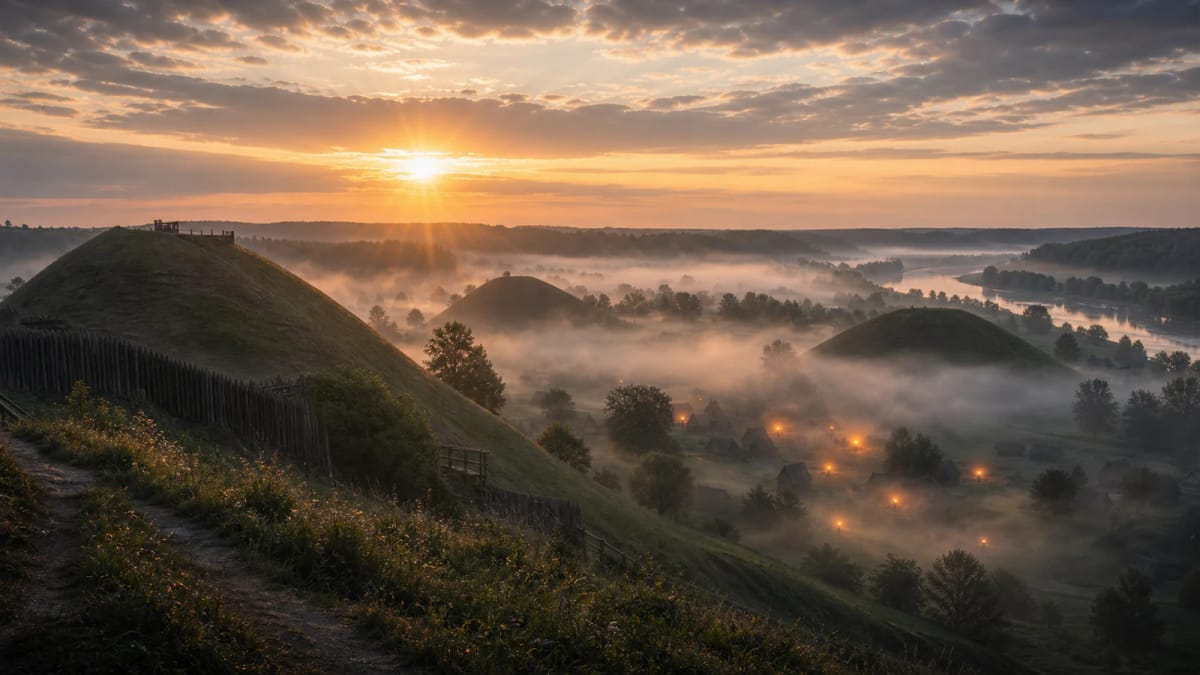
- Genre
- Hillforts legend
- Source status
- historical memory of the old capital and local legends
- Motifs
- old capital, underground roads, Lizdeika, Pajauta, Neris
Kernavė legends, Pajauta Valley legend, Lizdeika Hill
The Legend of the Kernavė Hillforts
In Kernavė, people say the hillforts are not merely hills. Each has a name, purpose, and memory: Aukuras Hill, Mindaugas's Throne, Lizdeika Hill, Castle Hill, and other slopes look over Pajauta Valley like an old capital that has not yet fallen asleep.

People used to speak of hidden roads leading from Kernavė to other important places, of cellars, treasures, and a town left in the earth: covered over by time, but not destroyed.
In the legend, Kernavė is land with memory. It appears quiet, yet beneath the turf lie a town, rulers' courts, craftsmen's quarters, and the name of the priest Lizdeika.
Interpreting the Kernavė Hillforts Legend
Kernavė legends work through the image of layers. The past has not vanished; it is hidden under the ground. That is especially fitting for a place where archaeology truly opened an old settlement.
The motif of underground roads connects Kernavė with the broader imagination of Lithuanian capitals and castles. Such roads symbolize not physical infrastructure but links between power, memory, and regional centers.
The name of Lizdeika gives Kernavė mythical authority. Even when a specific plot is associated with Vilnius, the Kernavė hillforts retain the intuition of a high priest, an altar, and an old capital.
History of the Kernavė Hillforts Legend
VLE describes the Kernavė hillforts as one of the centers of the formation of the Lithuanian state. UNESCO notes that the Kernavė archaeological site bears witness to roughly 10,000 years of human habitation.
Kernavė Reserve sources emphasize the site's world-heritage value, while Orbis Lituaniae notes that Kernavė and its surroundings are wrapped in legends and local stories.
For that reason, the Kernavė page must be written carefully: not by inventing one artificial plot, but by gathering local motifs about the old capital, underground spaces, and living memory in the earth.
In genre terms, this is a place legend: a type of narrative folklore that explains the origin of a specific place, here a hillfort complex, or links it with past events. It differs from a mythic legend because it is always tied to a real named locality. Kernavė Archaeological Site was inscribed on the UNESCO World Heritage List in 2004. Lithuanian place legends were collected in Žemės atmintis: Lietuvių liaudies padavimai (Vilnius, 1999) and classified in Bronislava Kerbelytė's catalogue, Lietuvių pasakojamosios tautosakos katalogas, volume 3 (2002).