- Place
- Kaunas City Municipality
- Region
- Kaunas
- Type
- Kaunas City Museum folk music branch and collection
- Address
- L. Zamenhofo g. 12, Kaunas
- Coordinates
- 54.89528, 23.89262
- Visit duration
- 45-60 minutes for a booked educational session; independent exhibition visits are currently unavailable
- Best time
- Tuesday-Friday, 9:00-18:00, only for a pre-arranged educational session; check the exhibition status before travelling
Lithuanian Folk Music Instruments Museum, Povilas Stulga Museum of Lithuanian Folk Music Instruments
Current identity and closure status
The current institution is the Folk Music Museum, a branch of Kaunas City Museum, not a separate independent museum. Kaunas City Museum is a budgetary institution of Kaunas City Municipality, and this is one of its five branches. The permanent exhibition has been closed for renovation since November 8, 2025, but the museum states that most pre-booked educational activities continue.
The renewal project runs in 2025-2027, but the end of the project is not a published reopening date. As of July 15, 2026, no regular hours for independent exhibition visits and no confirmed reopening day had been announced. Visitors must first register by telephone on +370 687 23 456 or email j.goscevicius@kaunomuziejus.lt.
The Google Maps card independently checked that day was named 'Kauno miesto muziejaus padalinys Tautinės muzikos muziejus', carried a 4.8/5 rating, and had Place ID ChIJ8yHzPg4i50YRG4n8ciN0GIY. Its point is 54.8952848, 23.892619 and its address line shows L. Zamenhofo g. 4, while the official visitor address is L. Zamenhofo g. 12 and the entrance is through the gate on that street. Because of this mismatch, the coordinates are recorded as a representative point for the museum complex.
From the 1969 collection to today's branch
The folk music collection began in 1969. In 1985 the Folk Museum of the Lithuanian SSR opened the Lithuanian Folk Music Instruments Museum as a branch in Kaunas. It separated from that institution in 1989, was named after Povilas Stulga in 1995, and became a branch of Kaunas City Museum in 2013. Its current official English name is the Folk Music Museum. The Povilas Stulga museum is therefore a historical name for the same collection and institution, not another active museum at this address.
Kaunas City Museum reports that the collection holds more than 10,000 objects. Its scope extends beyond old rural instrument types: it documents traditional and professional music-making, non-professional musical activity, changes in instrument construction, the transmission of music, folklore collectors and researchers, Lithuanian musical life abroad, and contemporary expressions of folklore. That breadth explains why skudučiai and kanklės appeared alongside domestic, school, church, and urban music in the exhibition.
What the now-closed exhibition presented
Before closure, the wind-instrument displays interpreted their subjects through shepherding and the world of sutartinės. They included small birbynės, reed pipes, whistles, skudučiai, and daudytės, with recordings of their sounds and sutartinės karaoke for trying one part of the multipart song. The kanklės room compared regional instruments by body shape, decoration, and string counts ranging from four to more than twenty. It included twentieth-century and diaspora kanklės, recordings, a quiz, and copies intended for touch. These features describe the exhibition before reconstruction and are not currently available for independent visits.
An interactive traditional-dance area offered games titled 'Dance', 'Play', and 'Feel the Rhythm'. Visitors could follow virtual dancers, mix instrumental sound, identify timbres, and repeat a frame-drum rhythm. Another curatorial layer connected heritage with documented post-folk festivals, including Suklegos, Mėnuo Juodaragis, Kilkim žaibu, Jotvos vartai, and Saulėtosios naktys. This was a specific museum narrative, not a claim that every displayed instrument or festival represents all of Lithuania.
Urban music and the history of two buildings
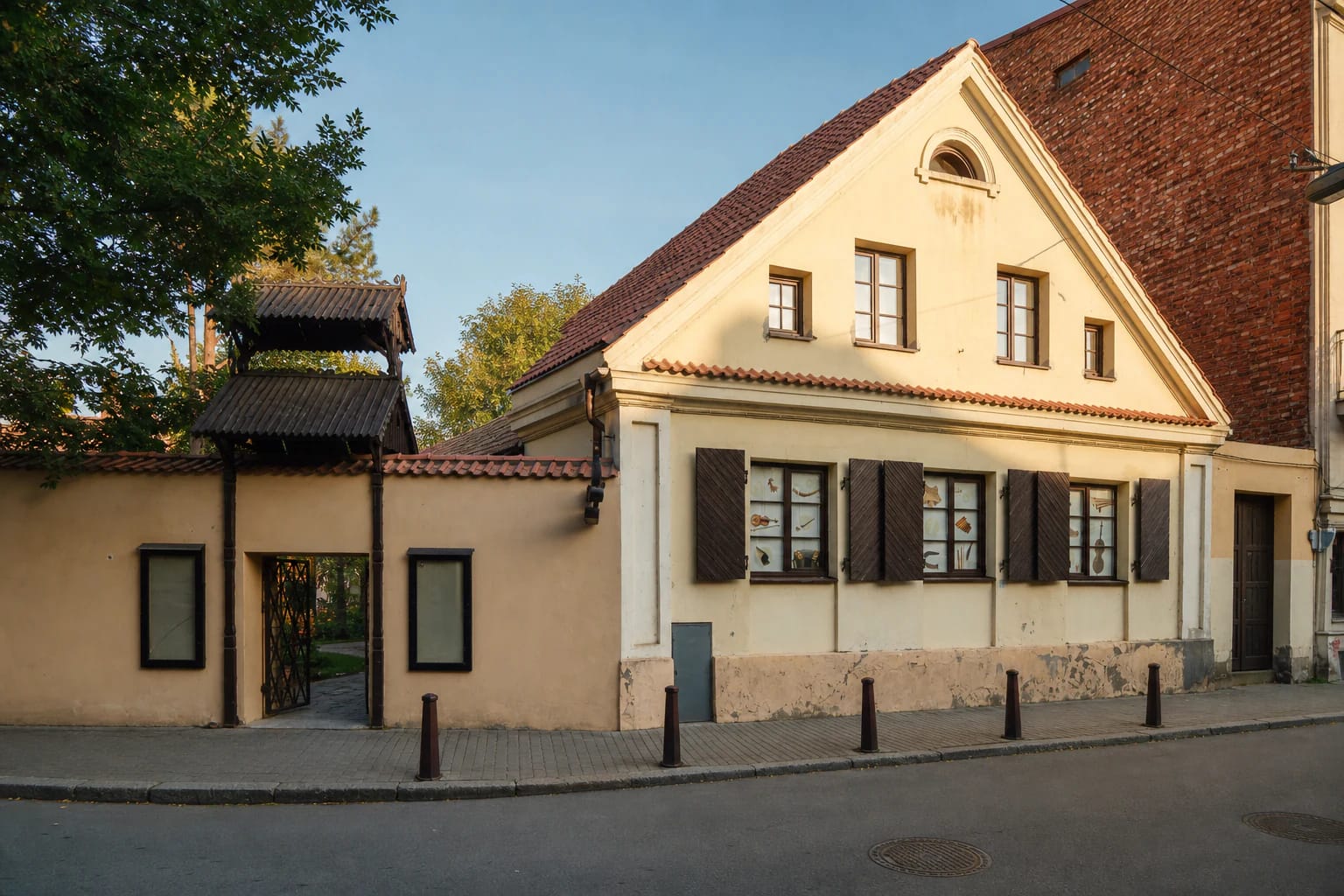
The museum occupies a complex of Old Town buildings and a courtyard. The state-protected Gothic dwelling at Kurpių g. 12, Cultural Heritage Register unique code 818, is a site of regional significance built in the second half of the sixteenth century, altered in the eighteenth century, and restored in 1975. The building at L. Zamenhofo g. 12 dates from 1876. The museum exhibition opened in these buildings in 1985, and the Tututis music school operated here from 1985 to 2003.
Before closure, the sixteenth-century house presented church, school, and domestic music through pedal harmoniums, pianos, electronic organs, gramophones, and recordings. A later-tradition section included diatonic accordions, bandoneons, concertinas, accordions, fiddles, basetlės, and cymbals. The courtyard also matters to the branch's living identity: Lithuanian dance evenings, a street dance event, and the Kanklės in My Hands festival grew around it, although dates for any current event must be checked separately.
Education, prices, accessibility, and photography
There are no regular visiting hours while the exhibition is closed. The pre-booked In the Land of Folk Music Instruments programme for grades 1-12 is currently advertised Tuesday-Friday from 9:00 to 18:00, lasts 45-60 minutes, and takes 5-25 participants. It uses recordings and sutartinės karaoke and lets groups try grass skudučiai, wooden trumpets, a daudytė, drum, and tabalai. A place for a preschool child or pupil in a group costs EUR 2 and an adult place EUR 4; students, seniors, and people with disabilities receive a 50 percent reduction, and one accompanying person is free. Advance arrangement is required.
The official visit page still publishes the general exhibition tariff of EUR 4 for an adult and EUR 2 for a student or a person of state pension age. Its free categories are preschool children; pupils and their group supervisors; orphans and children without parental care; social-assistance recipients; people with disabilities and one companion; visitors aged 80 or over; foreign nationals displaced from Ukraine because of military action by the Russian Federation; Lithuanian museum employees; ICOM members; and guides from contracted travel agencies accompanying groups. A 50 percent reduction is also listed for occupation victims, independence defenders and victims of aggression, resistance participants, compulsory-service soldiers, volunteer soldiers, and members of the Lithuanian Riflemen's Union. Free admission is also published for February 16, March 11, July 6, Museum Night events, the Saturday of Kaunas City Birthday, and openings of free events or exhibitions. Publication of these tariffs and concessions does not mean the closed exhibition can currently be entered.
The general practical page identifies the gate on L. Zamenhofo Street as the entrance and describes a lift, tactile room plans, some Braille information, and a Lithuanian Sign Language version of the TI TA TO film. However, the current educational-programme listing explicitly warns that sessions are not adapted for visitors with mobility disabilities during reconstruction, so access and assistance must be agreed by phone before booking. Kaunas City Museum rules allow free photography and filming for personal use but prohibit tripods and flash; confirm any activity-specific limits with staff.