- Place
- Klaipėda District Municipality
- Region
- Lithuania Minor
- Type
- flooded former gravel quarry with Common Tern breeding islands in a Natura 2000 site
- Address
- 21 Tvenkinio St, Ketvergiai, Klaipėda District
- Coordinates
- 55.64037, 21.29014
Quarry Lake, Kalviai Quarry, Kalviai Restoration Plot
Where Quarry Lake meets the protected area
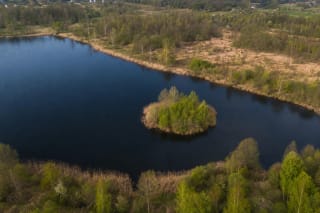
The map listing called Quarry Lake by Tvenkinio Street is not a separate lake but the northern shore of Kalviai gravel quarry between Ketvergiai and Kalviai. Lithuania's official River, Lake and Pond Cadastre registers the waterbody as Kalviai Gravel Quarry, which explains why navigation apps and conservation documents use different names for the same place.
UETK geometry gives the whole waterbody an area of approximately 40.46 hectares. Saugoma.lt lists the Kalviai Restoration Plot at 36 hectares, while the LIFE Terns site gives 36.74 hectares. The figures describe slightly different boundaries and recording methods: the largest is for the registered waterbody, while the smaller values refer to the protected territory.
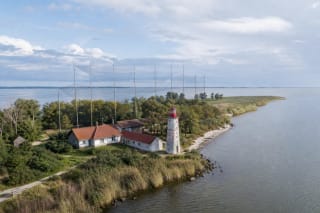
Banks are low and broken by reedbeds, open and vegetated islets sit across the water, and a level band of forest closes the horizon. This is not a conventional park lake with a promenade. Its character comes from broad water, shallows, gravel, reeds, and the sound of birds.
How an exhausted quarry became tern habitat
After gravel extraction ended, groundwater filled the workings and unexcavated ridges and shallows became small islands. LIFE Terns counted seven islets, the largest only 0.1 hectare. Open gravel separated from land predators by water created suitable nesting conditions for Common Terns.
The site received Special Protection Area status for Common Terns in 2005 and now belongs to the Natura 2000 network. Historical LIFE monitoring recorded between 50 and 260 breeding pairs in different periods, followed by a decline to 10 pairs as the islands became overgrown. These numbers describe past change, not how many birds a visitor is guaranteed to see today.
A former industrial hollow did not become valuable habitat permanently without help. Reeds, tall grasses, and scrub eventually remove the clear sightlines and bare nesting substrate that terns require, so the site needs continuing management.
Why the islands are managed in winter
The LIFE Terns project restored old gravel-and-sand islands and created additional ones. Its closing information records two new islands and four restored islands at Kalviai, expanding the area of open breeding habitat.
In January 2026, the Directorate of Protected Areas of Lithuania Minor removed reeds, scrub, and other tall vegetation from six islands across more than 3 hectares. The work is timed for winter, before birds breed and when frozen water makes the islands easier for staff and equipment to reach safely.
Common Terns winter in southern Africa and usually return to Kalviai in late April or early May. The bare islands then become nesting territories again, so even a brief landing, a loose dog, or a close approach for a photograph can flush the colony and leave eggs or chicks exposed.
What to watch, and when
In May and June, look for Common Terns with white bodies, grey wings, and black caps. They hover over the lake, plunge for fish, and return to low islands. Observe from far back with 8x or 10x binoculars; a better photograph never justifies approaching a nest.
Black-headed Gulls, Black-necked and Horned Grebes, Northern Shovelers, and other rare waterbirds have also been recorded here. The species list describes the site's importance, not a one-day checklist: season, water level, weather, and disturbance all shape what appears.
In autumn the lake becomes a migration stopover. Earlier LIFE Terns counts recorded more than 1,000 Eurasian Coots, around 200 Mute Swans, and over 500 ducks of various species. Treat those historical peaks as evidence of the migration's scale, not as a permanent flock.
The April-July rule protects nests
The current regulations for the Kalviai Restoration Plot prohibit visiting the lake's islands or approaching within 10 metres of them from April through July. The rule applies to every visitor, whether arriving in a small boat, on a paddleboard, or intending to step ashore only briefly for a photograph.
Ten metres is the legal minimum, while a sensitive colony may require much more space in practice. If birds leave their nests, call loudly, dive at you, or circle in agitation, retreat: their behaviour shows that you are already too close.
Watch only from a clearly accessible shore, never feed the birds, do not fly a drone at the colony, and prevent dogs from entering reeds or swimming towards the islands. Signs and temporary instructions issued by the protected-area authority always take precedence over an older online guide.
Access, swimming, and a responsible visit
Navigate to 55.6403717, 21.2901363 near 21 Tvenkinio Street in Ketvergiai. This is an orientation point on the northern shore, not a visitor centre. No dedicated signed car park, toilet, or universally accessible path could be confirmed, so never block local roads or drive across private plots.
The quarry has no gate, published visiting schedule, or admission ticket. Come in daylight, wear footwear suitable for wet ground, and remain on firm shore: reed margins can be boggy, while the islands are for birds rather than picnics.
Kalviai quarry does not appear in Klaipėda District Municipality's published 2026 protocols for monitored bathing waters, so current water quality and lifeguard supervision cannot be confirmed. Do not treat a map category as permission to swim, never dive into unfamiliar quarry water, and check the latest municipal and protected-area information before travelling.