- Place
- Palanga City Municipality
- Region
- Palanga
- Type
- free, nearly two-hectare contemporary interactive sculpture park inspired by Lithuanian folklore
- Address
- 24A S. Daukanto Street, Palanga
- Coordinates
- 55.91281, 21.05822
Palangos pasakų parkas, Lithuanian Fairy-Tale Park, Interaktyvus lietuviškų pasakų parkas
Seven artworks, not an ordinary children's playground
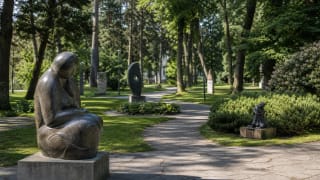
The park occupies almost two hectares of pine grove at 24A S. Daukanto Street, between S. Daukanto and S. Dariaus ir S. Girėno streets, beside Birutė Park and the Antanas Mončys Art Museum. Main paths connect seven sculptures, so the exhibition requires no long hike, but it makes more sense as a compact open-air contemporary-art show than as a park of standard climbing frames or rides.
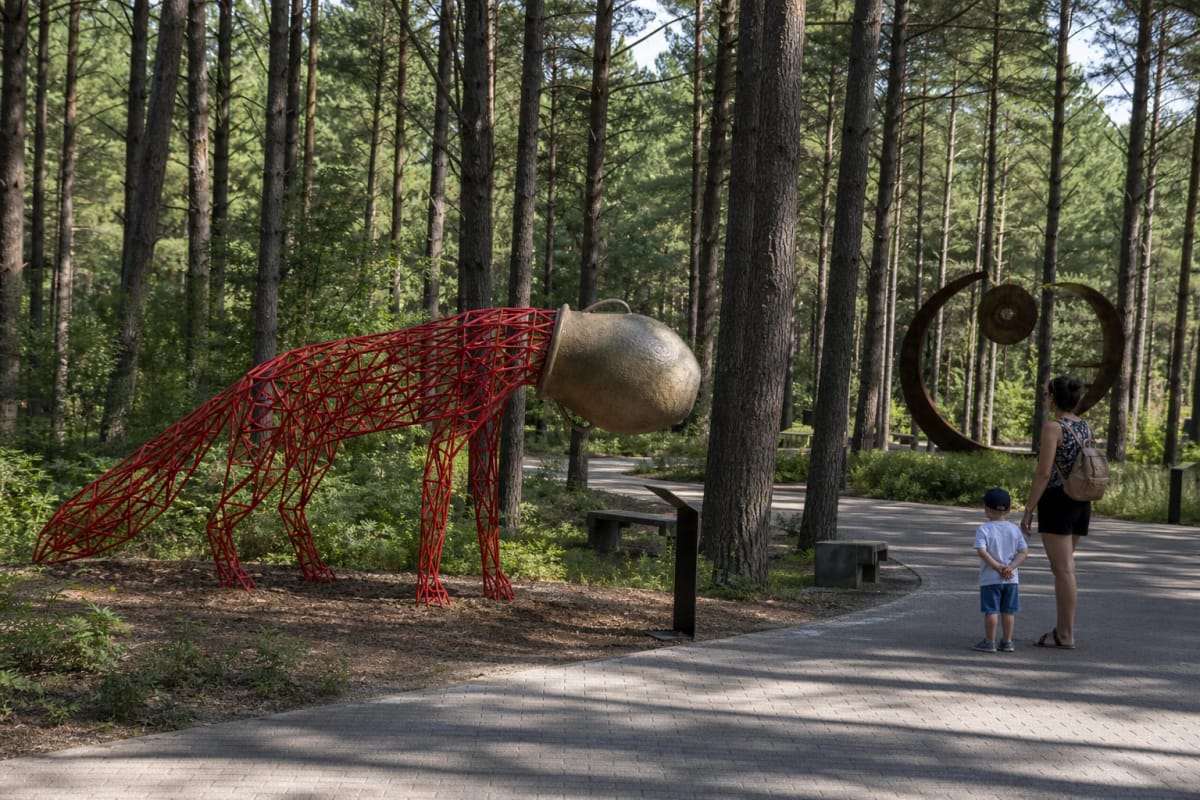
Four Lithuanian artists created the original core. Andrius Petkus made the red wireframe Fox and the Jug, Algis Kasparavičius welded stainless-steel wolf jaws around an articulated fishbone for Seku seku pasaką, Gediminas Mažintas built the artificial-granite playhouse The Bean, and Rolandas Šmitas made the wind-driven Sun and Moon.
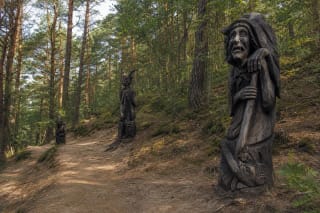
Three later works brought the collection to seven: Eglė and the Grass Snake by Latvian artist Agnese Rudzīte, The Sky Is Falling by Latvia's Krists Zariņš, and Povilas Butkevičius's lilac-coloured wooden goat for Granny Had a Grey Goat. Seven is the present collection count. Not every future sculpture discussed in the 2016 plans was realised.
How the sculptures tell stories, move, and invite play
Each artist interpreted interaction differently. Wind turns a weather vane and rocks the celestial forms in The Sun and the Moon. Inside The Bean, a net replaces the floor, a beanstalk and white cloud break through the roof, and the original design included three turning pods that made distinct sounds.
The Fox and the Jug lets the pine grove remain visible through its open lattice, while the oversized vessel over the fox's head captures the tale's decisive moment in one image: after drinking the milk and becoming trapped, the angry fox tries to drown the jug and destroys herself with it. Seku seku pasaką avoids a literal character portrait, using giant jaws and fishbone segments that a visitor can turn.
Visitors may sit on the wooden goat, while other works incorporate intended places for swinging, climbing, or turning a component. Permission to touch does not turn every surface into sports equipment. Check wet or sun-heated materials, joints, and on-site signs before a child climbs. Never force a component that is fenced off or does not move freely.
Fairy-tale texts and voices in Lithuanian and English
A panel beside each sculpture carries the story in Lithuanian and English. Pressing the language button should play narration in Inga Valinskienė's voice. This turns the park from a visual collection into a small listening-and-reading trail that can also engage children who do not speak Lithuanian.
The audio system has operated outdoors since 2016 and should not be treated as a permanently guaranteed service. Google reviews from 2025-2026 report that some buttons or language options occasionally fail. Begin with the written panel and treat sound as an enhancement. Report a fault to Palanga Municipality or the tourist information centre instead of repeatedly forcing the button.
A simple family ritual works well: guess the tale from the sculpture first, read or hear it next, then find the material detail that expresses its central event. The seven objects become more than a quick photo checklist, and folk narrative connects with texture, motion, and cause and effect.
The 2016 opening and growth of the collection
Palanga Municipality opened the park on 6 August 2016 after renewing the former recreation space with new paths, lighting, benches, and other street furniture. Mayor Šarūnas Vaitkus initiated the idea, sculptor Andrius Petkus curated the artistic programme, and municipal companies and local businesses sponsored the works.
The opening weekend presented the first four works: The Fox and the Jug, Seku seku pasaką, The Bean, and The Sun and the Moon. Three further sculptures arrived by 2017, turning the park into a small international collection in which five Lithuanian and two Latvian artists interpret Lithuanian folk tales.
In 2022, the municipality installed additional lamps both inside the park and along neighbouring A. Baranauskas Avenue. Lighting makes it easier to cross the space after dusk, but does not make climbing uniformly safe at night, during freezing rain, or after a storm. Daylight remains best for seeing art, reading panels, and supervising children.
Free entry, paths, and honest expectations
This is an open municipal space without gates or a ticket office, so entry is free and its Maps listing gives 24-hour access. No attendant stands at each work and daily scheduled storytelling sessions are not part of the standard visit. The accompanying adult remains responsible for children, the chosen interaction, and considerate behaviour in the pine grove.
Hard-surfaced paths and benches installed in 2016 support pushchairs and wheelchairs, but not every interactive sculpture or play element is step-free. Official descriptions do not identify an adapted toilet, tactile map, or permanent assistance service. Discuss specific needs in advance and do not mistake the park for a staffed indoor museum.
A useful route enters from S. Daukanto Street, loops slowly past all seven works, and ends by the Antanas Mončys museum or Birutė Park. In July 2026, the specific Google Maps pin showed 4.7 out of 5 from approximately 878 reviews. The high score fits a free cultural stop, but assess the audio buttons by their condition on your visit.