- Place
- Bubiai, Šiauliai District Municipality
- Region
- Šiauliai Region
- Type
- Samogitian hillfort with a foothill settlement
- Address
- Bubiai village, Bubiai eldership, Šiauliai District
- Coordinates
- 55.86190, 23.12990
Pilalė
Bubiai Hillfort by the Dubysa
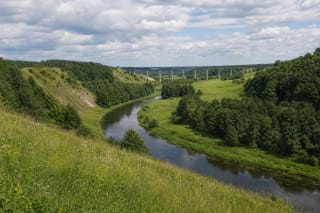
Bubiai Hillfort, called Pilalė by local people, stands on the left bank of the Dubysa, about 14 km south-west of Šiauliai. The Dubysa valley surrounds it on three sides, and today Bubiai Reservoir, also known as the Bubiai or Šiauliai Sea, lies nearby; it was created in 1978 by damming the Dubysa.
The steep 10-14 m slopes and fortifications show that this was an important defensive place in the land of Šiauliai. The river-and-reservoir landscape makes the hillfort attractive not only to historians but also to leisure visitors.
A Samogitian castle and the Dobicenas question
The hillfort's cultural layer is about 1 m thick and preserves eleventh- to fourteenth-century finds. It is thought that the Dubysa castle, called Dobicenas in Teutonic Order chronicles and destroyed by the Order in 1348 and 1358, may have stood here. This link should be treated as a scholarly hypothesis, not a proven fact.
Tourist narratives sometimes mention earlier dates or connections with the Battle of Saulė, but encyclopedic sources do not confirm them. The reliable statement is that this was a strong thirteenth- to fourteenth-century Samogitian castle on the Dubysa bank.
Dimensions and fortifications
The hillfort platform is oval, about 80 x 35 m. On the south-eastern edge stands a rampart about 35 m long and 4.5 m high; behind it a ditch 14 m wide and 5 m deep separates the platform from the neighbouring height. Remains of a lower rampart survive in the north-west.
An ancient settlement stood at the foot of the hill. Together these elements point to a well-planned defensive system typical of important Samogitian castles of the period.
Research and finds
The hillfort was investigated in several stages: in 1902-1911 by Polish archaeologist Ludwik Krzywicki, in 1967 through survey research, and in 2008 by a complex expedition. In total, about 100 sq. m were excavated.
In the roughly 1 m cultural layer, researchers found remains of stone paving and a hearth, charred logs, and eleventh- to fourteenth-century artefacts: iron arrowheads, knives, keys, spindle whorls, thrown pottery, and animal bones. The finds are kept in the Vytautas the Great War Museum and Šiauliai Aušra Museum.
How to visit Bubiai Hillfort
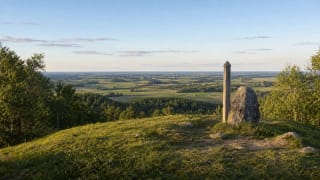
The hillfort is an open site that can be visited freely. About an hour is usually enough to see it together with views of the Dubysa valley and the reservoir; on a clear day the panorama from the hill is broad.
A visit combines well with Kurtuvėnai Regional Park and other Šiauliai-region places. After rain the steep slopes may be slippery, so wear suitable shoes and use existing paths.