- Place
- Klaipėda District Municipality
- Region
- Klaipėda District
- Type
- World War II victims' memorial with monumental oak folk sculptures
- Address
- Ablinga, Endriejavas Eldership, Klaipėda District
- Coordinates
- 55.74173, 21.68793
Ablinga tragedy memorial, Ablinga oak sculpture ensemble
Ablinga Memorial: a field of memory by Žvaginiai Hillfort
Ablinga Memorial is not an entertainment stop. It is a place of memory where landscape, wood sculpture, and a World War II tragedy form one story. The ensemble stands on the western slope of Žvaginiai Hillfort, in an open rural setting, so it immediately feels like part of the land rather than an enclosed museum.
The site belongs to Ablinga State Geomorphological Reserve, and Žvaginiai Hillfort above the memorial is the highest place in Klaipėda District, 148 m above sea level. The sculptures stand outdoors, tall and quietly figurative, like guardians of village memory. Ablinga is best visited slowly: read the context, walk around the ensemble, and do not let the view become only a photograph.
The Ablinga tragedy of 23 June 1941
According to Visuotinė Lietuvių enciklopedija, on 23 June 1941, the second day of the German-Soviet war, German soldiers shot 42 people in three places: 33 residents of Ablinga (20 men and 13 women), 6 men from Žvaginiai village, and 2 men and 1 woman who had come from elsewhere. The stated pretext was that Soviet soldiers had fired on a German cyclists' unit and weapons had been found in some residents' homes. After the shootings, the Germans burned Ablinga; about 20 villagers survived.
The number 42 matters not as dry statistics but as the scale of a community's destruction: families, neighbours, and people of different ages were killed. The graves of those shot are on the southern slope of the hillfort, and some are even on its top platform. The sculptures therefore speak not about an abstract war, but about a specific village and its people.
The 1972 oak sculpture ensemble: 30 monuments
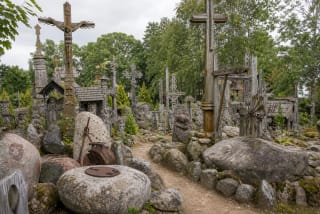
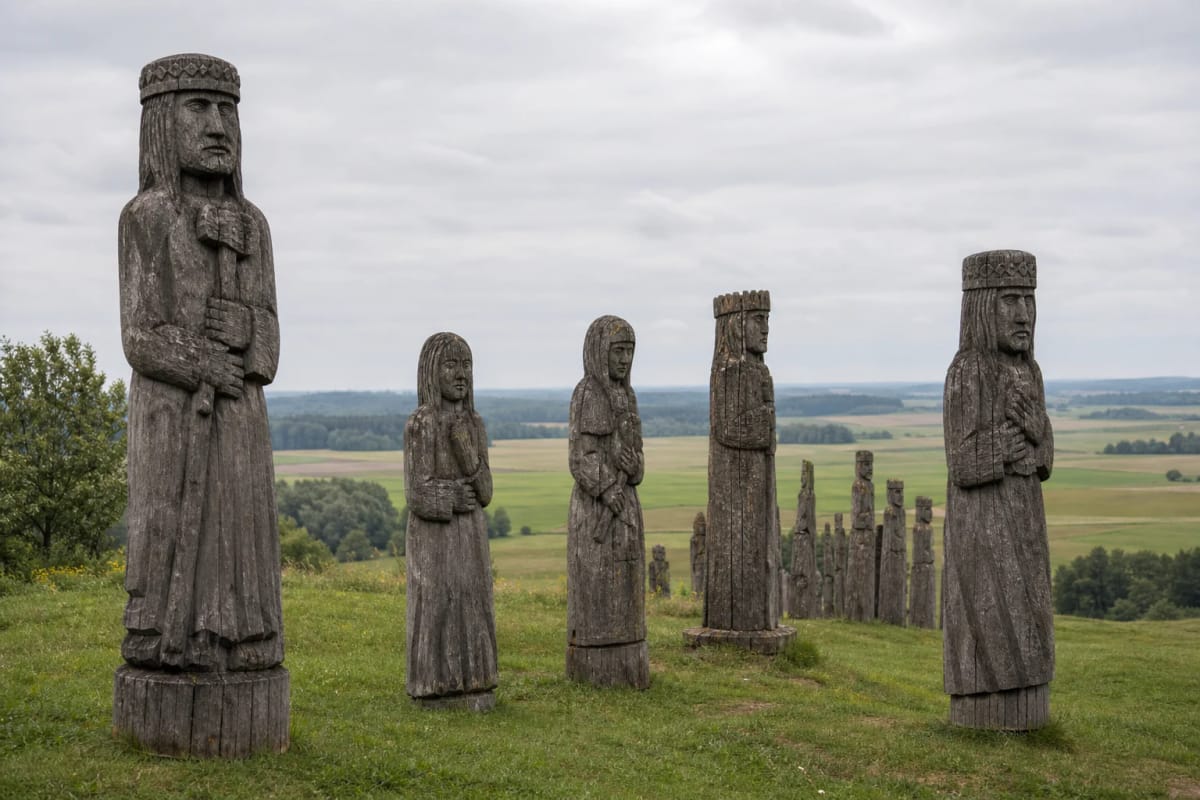
The memorial ensemble was built in 1972 on the western slope of Žvaginiai Hillfort. It consists of 30 oak sculptures created by 25 Lithuanian woodcarvers and blacksmiths, most of them from Samogitia. The pillar-shaped monuments are 5-8 m high and carry carved relief figures, narrative scenes, symbols, and inscriptions; the sculptures are grouped by theme and style and freely placed across the slope.
VLE emphasizes that this was Lithuania's first collectively created monument of monumental folk sculpture. Ablinga is therefore important both as a tragedy site and as an event in the history of Lithuanian wood sculpture. In 1984-1993 the Ablinga Memorial Museum operated here, and in 1985 the Ablinga Lourdes grotto was restored through the efforts of A. Šiaulytis.
Why oak matters at Ablinga
The material of the memorial is not accidental. In Lithuanian memorial and cross-crafting tradition, oak carries associations of strength, endurance, and sacredness. The pillar-like figures continue the form of the stogastulpis and koplytstulpis while also becoming human images and signs of village memory.
Over time the wood ages, greys, cracks, and absorbs the weather. That is not a defect; it is part of the memorial experience. The sculptures show that memory is not glossy and sealed off. It lives outdoors, changes with the seasons, and requires care. Maintenance of the memorial and nearby cultural heritage objects is organized by Klaipėda District Municipality.
How to visit Ablinga Memorial
Allow 30-60 minutes for Ablinga Memorial, but do not rush the place. Visit in daylight, wear comfortable shoes, and be ready for an open, windy slope. The memorial is about 4 km north of Endriejavas in Klaipėda District.
Because the memorial is tied to murdered people, tone matters here: no noise, no picnic among the sculptures, no superficial photo stop. With children, briefly explain that this is a memorial to victims of war.
What to combine nearby
Ablinga Memorial stands beside Žvaginiai Hillfort, so it is possible to connect an archaeological landscape with a twentieth-century place of memory. The Curonian castle Ablinga (Amelinge), mentioned in the 4 April 1253 division act of the Curonian land of Ceklis, is localized at the hillfort, so very different historical periods meet on one slope.
In a longer route, Ablinga can be combined with Klaipėda District hillforts, Endriejavas or Kretinga direction sites, and Orvidai Homestead. Still, Ablinga deserves its own unhurried stop.