- Genre
- Chronicle myth
- Source status
- late written source
- Motifs
- Sovijus, dead, cremation, afterlife, burial, myth
Sovijus, Story of Sovijus, Sovijus myth of cremation
The myth
The Sovijus myth tells of a figure who, after death, finds the proper form of burial. According to the text, Sovijus hunted a wild boar and gave its nine spleens to his children to roast; after they had eaten them, the angered Sovijus descended through nine gates into hell. From there his son brought him back and buried him three times in succession: first he laid him in the earth, then placed him in a tree, and only after being cremated did Sovijus remain content—he said he slept as peacefully as a child in a cradle. For this reason he is associated with the justification of the custom of cremating the dead.
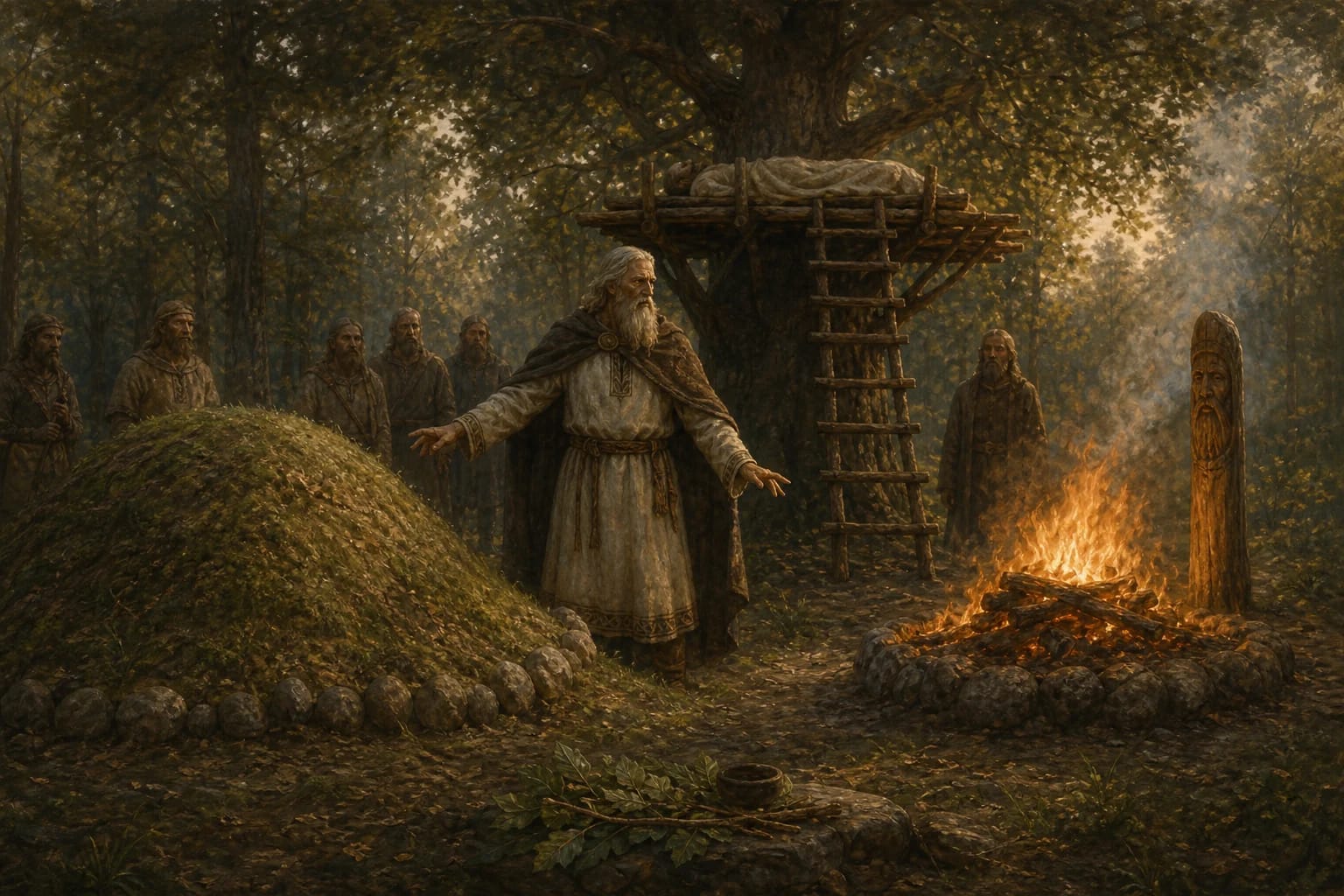
The text describes three burial methods known in old Lithuania and singles out cremation as the fitting one. The repeated attempts matter: they show why one ritual is chosen over others.
The plot is not an ordinary adventure tale. It explains ritual order: how the dead should be sent onward to reach the proper state beyond life.
Interpretation: what does the Sovijus myth mean?
The myth is about discovering a ritual. A mythic figure does not merely die; he shows others which burial method is right.
Cremation works as transformation. Fire destroys the body but opens passage to another condition. It is not only an end but a transition.
The structure of the search also matters. When several methods fail, the fitting one is emphasized all the more. This lets the myth not only say that cremation is important but also show why it is set apart from the other possibilities.
For modern readers, Sovijus is a good example of caution in reading Baltic mythology: one fragment can be very important without representing the whole belief system.
History, source, and interpretations
The Sovijus myth was recorded in a 1261 interpolation of the Russian redaction of John Malalas' chronicle. It is therefore one of the oldest written testimonies of Baltic mythology, preserved through a chronographic tradition.
VLE presents it as a major source connected with the custom of cremating the dead, but scholars disagree about individual meanings. Many read it as a justification of cremation. Jonas Basanavičius saw Sovijus as a cremation reformer; Vladimir Toporov proposed a more cosmological reading in which the hunted boar means the Sun and Sovijus himself is the Sun's creator, linking cremation with the cult of the gods centred on Perkūnas; Algirdas Julius Greimas read a religious reform—a shift toward the worship of the heavenly gods; and Norbertas Vėlius stressed the contrast between cremation and other burial forms and a parallel with the Prussian story of Videvutis and Brutenis.
Gintaras Beresnevičius read the word for hell in a Hades-like sense and compared Sovijus with Indian myths about Yama and Siberian shamanic stories of a first journey to the other world.
Those scholarly reconstructions should be named as interpretations, not as direct statements of the short surviving text.
Why Sovijus matters
Sovijus matters because early sources for Lithuanian and Baltic mythology are rare. The myth lets us discuss cremation not only archaeologically but mythologically.
At the same time it teaches restraint: the window into old religion is narrow, late, and mediated by written tradition.