- Genre
- Celestial-body myth
- Source status
- folkloric and reconstructive tradition
- Motifs
- Saulė, Mėnuo, Aušrinė, Perkūnas, celestial family, dawn
Myth of the Sun and Moon, Myth of Aušrinė, Celestial family myth
The myth
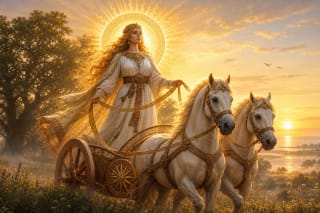
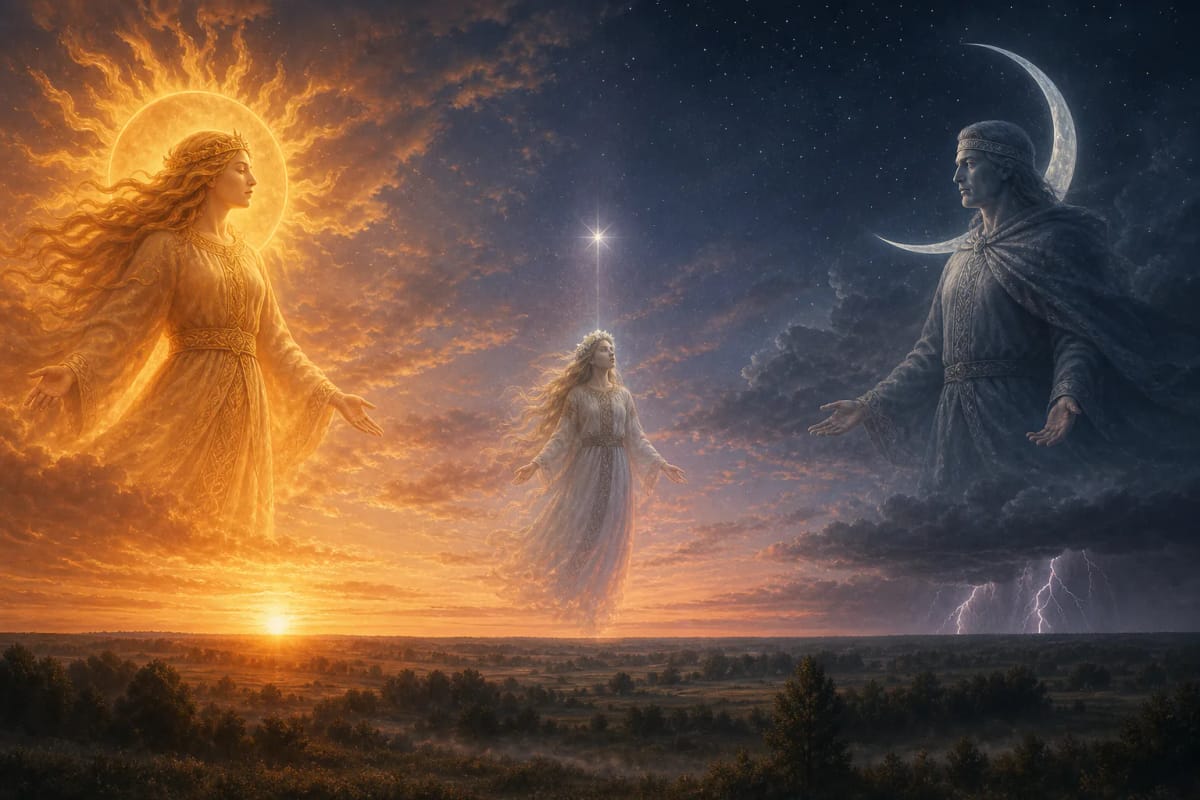
In Lithuanian songs, tales, and mythological research, Saulė, Mėnuo, and Aušrinė are often read not only as astronomical bodies but as figures in relationships. Saulė may be a feminine light figure, Mėnuo a changing night figure, and Aušrinė a sign of dawn and beauty.
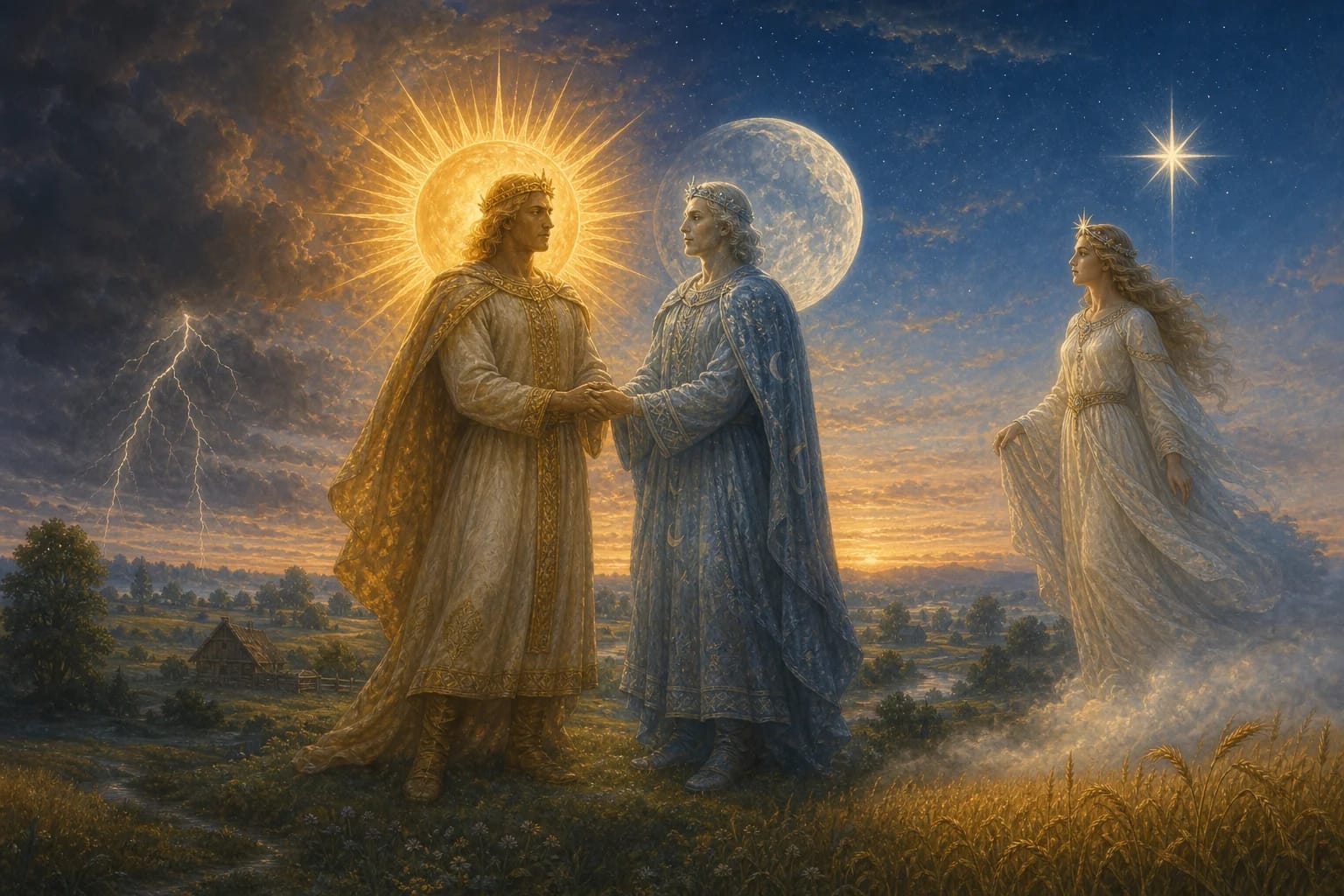
In one widely discussed type, called the myth of celestial wedding, Saulė and Mėnuo form a heavenly pair, but the relationship is broken when Mėnuo falls for Aušrinė, the Morning Star (the planet Venus). Perkūnas or Saulė then intervenes and the punished Moon is cut, giving moral language to lunar phases.
This is not one easily quoted canonical ancient text. It is reconstructed from songs, tales, names, and recurring motifs.
Interpretation: what does the myth mean?
The myth lets people understand the order of the sky through family and relationship. Celestial bodies move by astronomical rhythms, but folklore can make them love, betray, anger, and punish.
Saulė often means stable, life-giving light. Mėnuo changes with phases and night. Aušrinė appears at transition, when night turns toward day, making her suited to a liminal and alluring role.
Perkūnas' intervention, where it appears, restores order. The sky drama explains not only love but cycles, separation, and moralized cosmic rhythm.
There is also an etiological and astronomical reading. Researchers connect the Moon's unfaithfulness and punishment with visible lunar phases, especially the move from full moon to waning moon, and connect the Moon's relation with Aušrinė to periodic nearness of the Moon and Venus in the sky.
Comparative mythology gives the motif a wider frame. The celestial-wedding motif is thought to have possibly been known already to the Indo-Europeans, with parallels found not only in Baltic but also in ancient Indian and Slavic traditions. That does not mean the Lithuanian version was simply borrowed; it points to an old shared inheritance.
Modern readers should keep the attractive popular version separate from scholarly reconstruction. The celestial-family myth is meaningful, but its details depend on fragmentary sources and interpretation.
Sources, songs, and reconstruction
VLE's separate articles on Saulė, Mėnuo, and Aušrinė show that all three are well known in Lithuanian mythology and folklore, but their joint plot must be reconstructed from several source groups.
Folk songs often humanize heavenly bodies: they travel, marry, quarrel, and look upon human life. Such formulas allow researchers to discuss an older layer of sky myth.
Reconstructive status does not mean baseless invention; it means there is no single complete ancient text telling the entire story from beginning to end.
Why this theme matters
The theme joins mythology with song. It shows that sky images in Lithuanian songs are not merely decorative; they may preserve older interpretations of world order.
It also explains why heavenly bodies in Lithuanian culture often have human faces. The sky is not a cold mechanism but a story of relationships, time, and order.