- Genre
- Sea and amber legend
- Source status
- literary tradition
- Motifs
- amber, palace, Jūratė, Baltic Sea, Perkūnas, shards
Jūratė's Amber Palace, Amber halls, Shattered Amber Palace
The legend
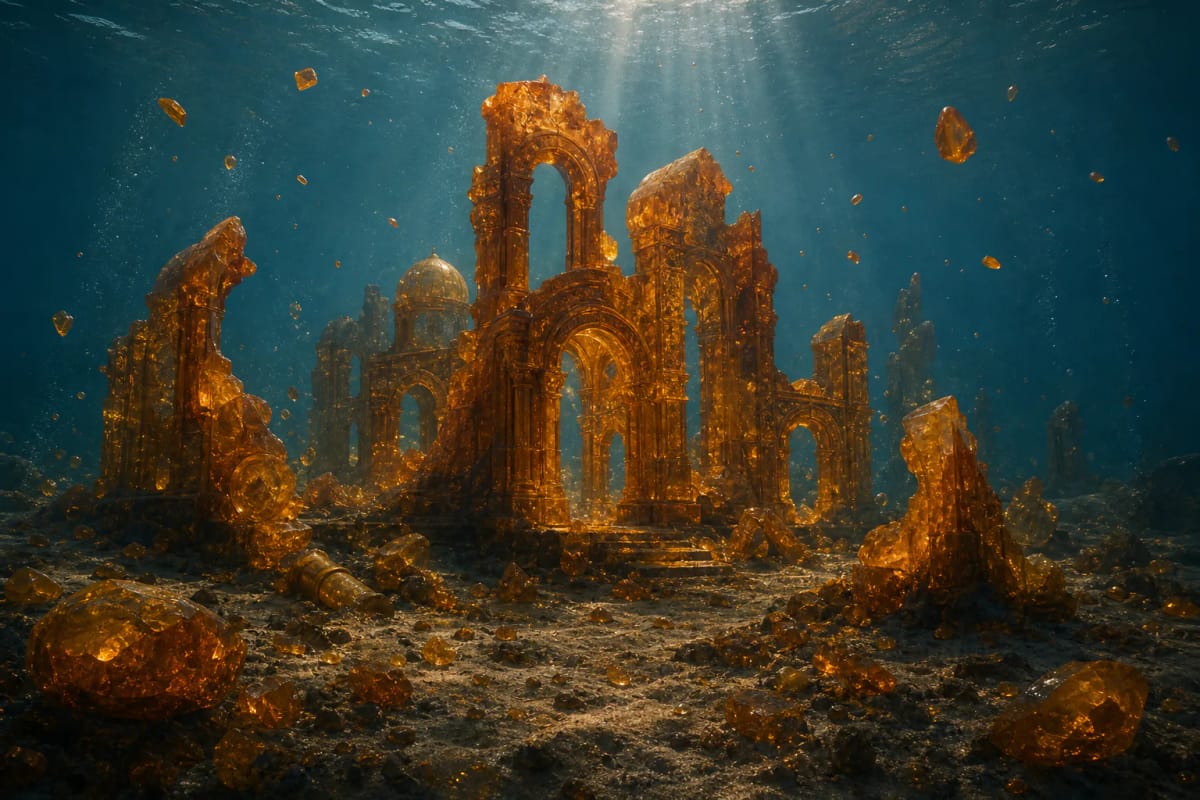
The Amber Palace stood in the depths of the sea, in Jūratė's world. It was not made of stone or timber but of amber: glowing, fragile, and precious. Its light belonged to the sea, not to the human shore.
When Jūratė loved the fisherman Kastytis, the palace became the meeting place of two worlds. A human entered the sea goddess's space, where daily fishing life briefly met mythical splendour.
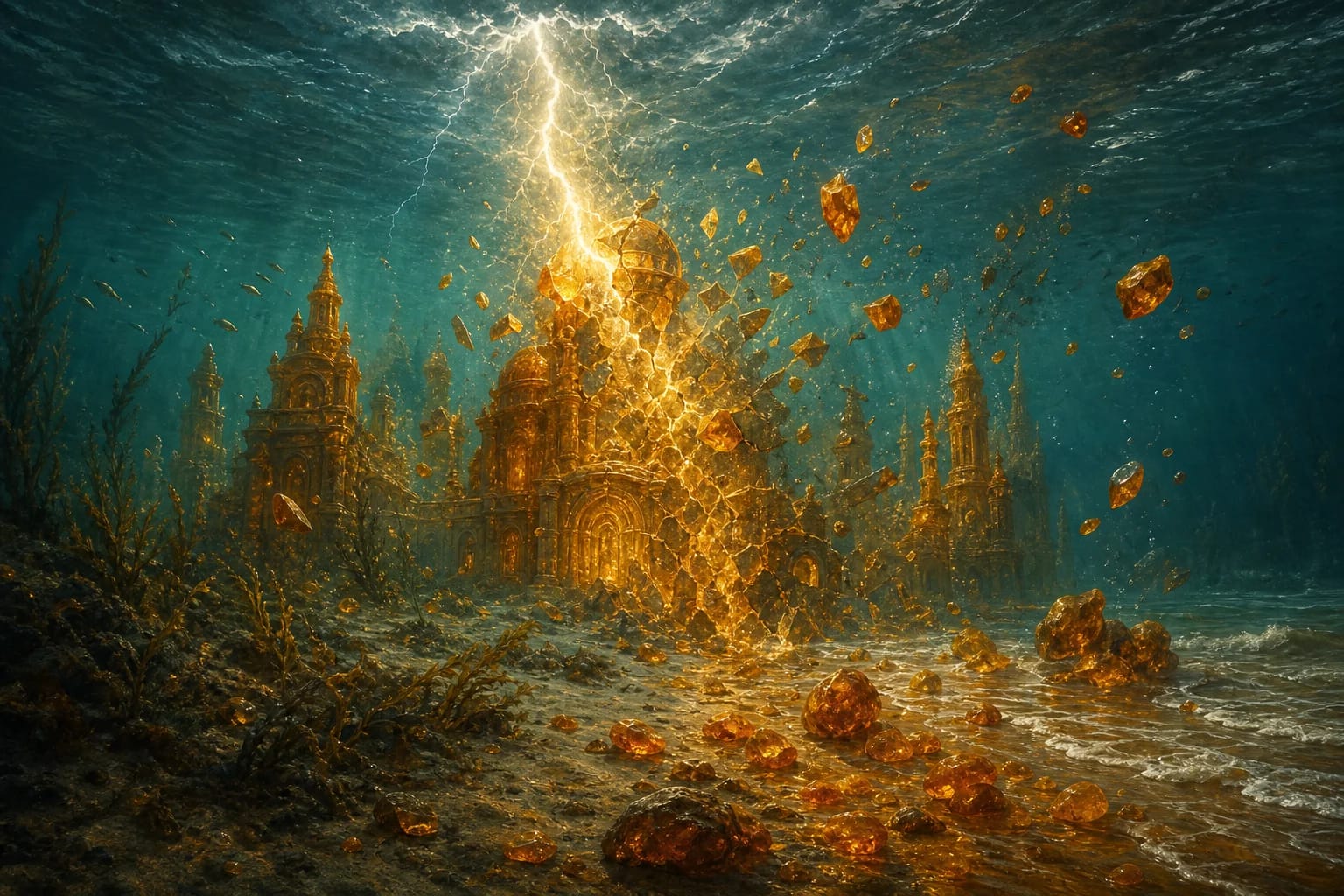
Perkūnas' punishment shattered the palace. Lightning broke it into pieces, and the sea began carrying amber to the shore. The legend thus explains why shining amber fragments are found along the Baltic coast.
Interpretation: what does the Amber Palace mean?
The Amber Palace is an image of fragile happiness. It is radiant and rich, but its material is already associated with fragments; it carries the possibility of breaking.
The palace also transforms amber from a natural find into a narrative object. Amber becomes sea memory, a piece of legend that can be picked up on the coast.
Because the palace is underwater, it marks the border of another world. A human may cross that border briefly, but not without consequence. The shattering of the palace is therefore not only a closing scene; it is the restoration of the boundary.
Today the Amber Palace makes it possible to speak of Baltic amber not only scientifically or touristically, but also culturally. It is one of the strongest images of the Lithuanian coast.
History and literary context
The Amber Palace motif is best known through the Jūratė and Kastytis story, strongly popularized by Maironis' ballad. It should therefore be read as a motif strengthened by literary tradition, not as one fixed ancient folk text.
In the cultural context of the Palanga Amber Museum, Jūratė's palace is one of the most convenient ways to explain amber to visitors: a natural material gains a story of love, punishment, and the mystery of the sea. The museum's research emphasizes that it was literature that shaped the romantic image of amber in the early 20th century.
The scientific explanation is different: according to the Visuotinė Lietuvių enciklopedija, amber is the resin of Paleogene conifers (cedars), formed about 50–60 million years ago in the area of present-day southern Scandinavia and the Baltic Sea, and, washed out by the waves, it accumulates along the coast and in the deposits of the Curonian Lagoon. The legend does not replace geology; it gives amber an emotional and cultural layer.
Why does the palace shatter?
The shattering marks the cost of forbidden love and a crossed boundary. Perkūnas destroys not only a building but the place where a human and sea goddess world had joined.
The palace becomes lasting precisely because it breaks. If it remained whole underwater, people would never see it; shattered, it appears on the shore as amber.