- Category
- Work and Craft Buildings
- Type
- Textile-processing production workshops
- Context
- Karšykla, wool carding workshop, spinning workshop, milo fulling mill, water mill, textile processing, wool, milas
- Source status
- regional and small-town tradition
Wool carding workshop, Carding-spinning workshop, Spinning workshop, Milo fulling mill
Wool Carding Workshop and Milo Fulling Mill: types and elements
Wool carding workshop: A workshop for preparing wool for spinning.
Carding-spinning workshop: A combined workplace for preparing textile fiber and spinning.
Milo fulling mill: A workshop for fulling, densifying, and processing woolen cloth.
What are a karšykla and milo fulling mill?
A karšykla is a wool-preparation workshop where wool is carded before spinning. A milo fulling mill is a place where woolen cloth is fulled, densified, and processed.
These buildings are not typical structures of every farmstead. They belong more to small towns, manors, mills, and small-scale production settings.
Connection with mills
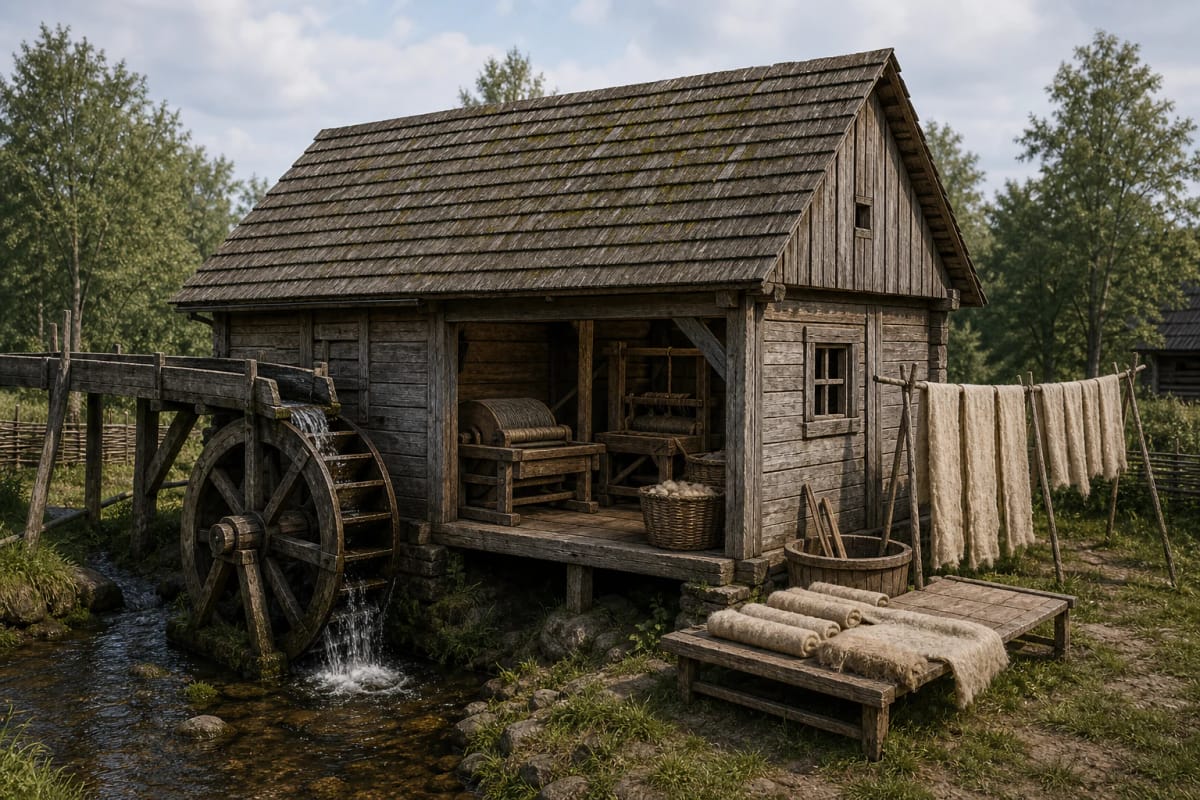
From the nineteenth century, such workshops were often established by mills, where there was power, water, roads, and movement of people. The mill setting acted as a local technological center.

For this reason the karšykla and milo fulling mill expand the image of traditional architecture: alongside farmstead buildings appear communal production structures.
Architectural character
Carding workshops and fulling mills needed work space, equipment space, water or mechanical power, storage, and convenient access. The building had to be functional and often modest. According to VLE, milas was fulled by fulling devices driven by a mill drive: older pestle fullers beat the cloth in a hollowed trough with pestles lifted by a rotating shaft, while cabinet-type fullers spread from the late nineteenth century; the fulling mill also had a stove for heating water and drying fulled milas, and by the mid-twentieth century most fulling mills had disappeared.
Their heritage value lies not in decoration but in the relationship among equipment, technology, and place. Without this relationship the building is difficult to read.
Textile culture context
Lithuanian rural textiles did not appear only at home beside the loom. They needed a chain of wool preparation, spinning, weaving, fulling, and dyeing.
The karšykla and milo fulling mill show that chain in architecture: these are buildings where cloth quality depended on a technological process. According to VLE, archaeologists have found fragments of thick woven milas from as early as the ninth-twelfth centuries, and sixteenth-seventeenth-century written sources mention peasants wearing rudinės made of thick milas.