- Category
- Plants of Protection and Purification
- Domain
- Purification, fumigation, protection, eternity, verbos, funerals, plague
- Source status
- well attested
common juniper, kadugys, juniper berries, juniper smoke
What does juniper mean?
In Lithuanian tradition juniper is above all a plant of purification and protection. Its smoke was used to fumigate people, homes, barns, and livestock in order to remove illness, evil, and impurity, both literally and ritually.
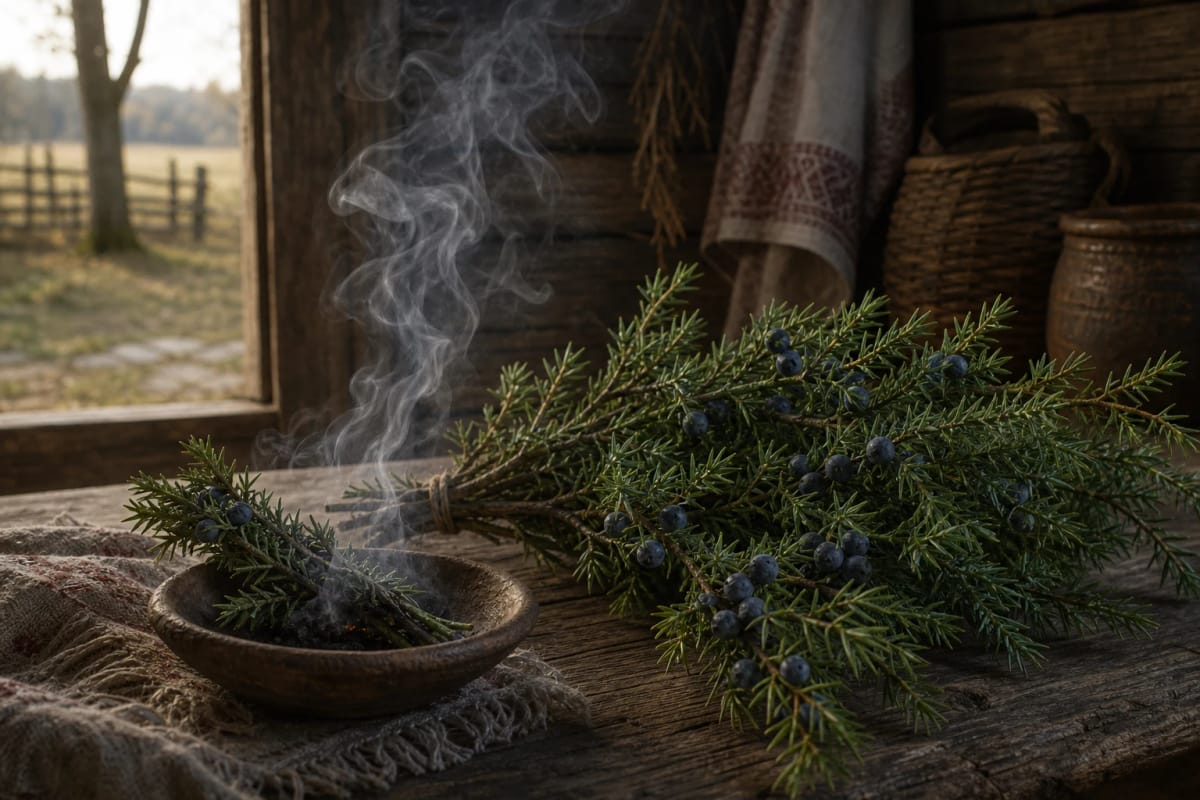
Juniper's meaning grows from its nature. It is an evergreen, prickly shrub or tree with a sharp smell, and its burning needles and berries release thick, pungent smoke. Such a plant easily becomes a sign of cleansing, defense, and unbroken life.
Only one species grows naturally in Lithuania, the common juniper. It is found in forests, forest edges, and sandy dry places, so it was familiar and easily available for everyday and ritual use.
Fumigation and purification
Juniper's most important role is fumigation. Burning branches or berries release thick smoke, with which people walked through homes, living spaces, and farm buildings. The smoke was believed to cleanse space, drive out illness and evil, and refresh the air.

Fumigation also has a practical basis: pungent smoke disinfects, repels insects and parasites, and suppresses mold and foul air. In folk consciousness practical cleaning and ritual purification merge into one action.
Livestock and barns were also fumigated with juniper, especially when disease or misfortune affected the herd. Such fumigation was understood as protection for the health and success of the farm.
Juniper after death and in funerals
A special sphere of juniper fumigation is death and funeral space. After a death, juniper smoke was used to fumigate the room where the person had died or been laid out, cleansing the home so the air again became suitable for the living.
This fumigation has a double meaning. Practically, it cleans and refreshes the air in a room touched by death; ritually, it helps separate the space of the living from the deceased and properly send off the soul so it does not remain bound to the home.
Here juniper acts as a boundary between two states: sickness and health, death and continuing life. Its smell and smoke mark that the space is purified and returned to everyday order.
Juniper as a verba
A juniper branch is an inseparable part of the Lithuanian verba. On Palm Sunday, where warmer climates use palm branches, Lithuania uses local plants; the green, prickly juniper naturally becomes the base of the bouquet, especially in Suvalkija and Dzūkija.
As an evergreen, juniper in the verba marks life that resists winter and death. A blessed verba is kept in the home and used for protection and ritual, so juniper enters the yearly cycle and the sacred field of the household.
The juniper of the verba joins a Christian feast with older respect for herbs and evergreen plants. It is a good example of how a plant keeps its protective meaning even when the ritual frame changes.
Juniper, disease, and plague
Juniper was considered an important means against disease and epidemics. Fumigation with juniper smoke was one of the main ways to cleanse air and rooms when contagious disease threatened.
Historical sources confirm this. On December 5, 1708, in Lithuania Minor, during the fight against the great plague, official instructions named incense among the key measures, especially from juniper, oak, and ash, as well as juniper berries, tobacco, and vinegar. Juniper fumigation was thus included even in government plague-control instructions.
This example shows that juniper's purifying power was not only ritual belief. It also rested on observation that sharp smoke helped cleanse a polluted, disease-touched environment.
Evergreen plant and sign of eternity
Juniper is evergreen: it stays green throughout the year, even in winter when many plants die back or lose their leaves. For that reason it naturally becomes a sign of undying life, endurance, and continuity.
This feature links juniper with death and remembrance rites. An evergreen plant in the setting of death reminds people that life continues and that a properly sent-off dead person does not break the life of lineage and home.
Juniper is therefore not only a practical fumigation plant. It joins purification, protection, and a sense of eternity, three related meanings that explain why it was used at crucial moments of human life.
How should juniper be read today?
Today juniper is often known as a culinary and medicinal plant: its berries flavor foods and drinks, and it is valued as ornamental and drought-resistant. Older customs associate it with fumigation, purification, and protection.
Juniper is best connected with concrete contexts: verbos, funerals and Vėlinės customs, protection of barn and home, and the fight against disease. Then it remains a living purification symbol rather than only a botanical or culinary plant.