- Instrument family
- Wind instruments
- Type
- Long wooden lip trumpets, sutartinės, signals, northeastern Lithuania
- Source status
- well attested
daudytė, wooden trumpets
What are daudytės?
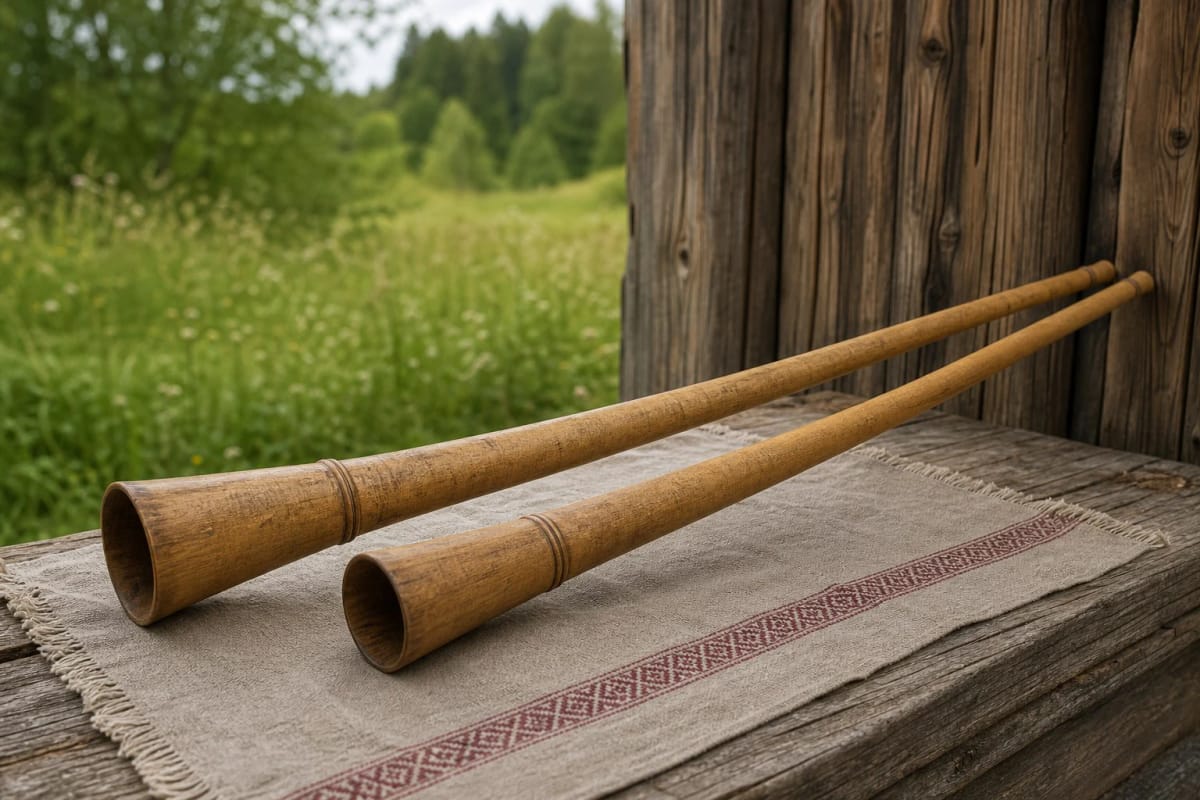
Daudytė is a Lithuanian lip aerophone, a long wooden trumpet. It is one of the most solemn old Lithuanian wind instruments: its sound is strong, full, and far-carrying, so it can be heard across large outdoor spaces.
Daudytės are not small domestic instruments. Because of their length and powerful tone, they have always been public sound objects closely tied to the northeastern Lithuanian tradition of sutartinės and signals.
Construction and sound
A daudytė is a straight wooden tube, usually ash, 140-250 cm long and 3-4 cm in diameter, wrapped in birch bark, with a conical 8-12 cm bell and a cup-shaped mouthpiece. The birch-bark wrapping strengthens the tube and keeps air from leaking.
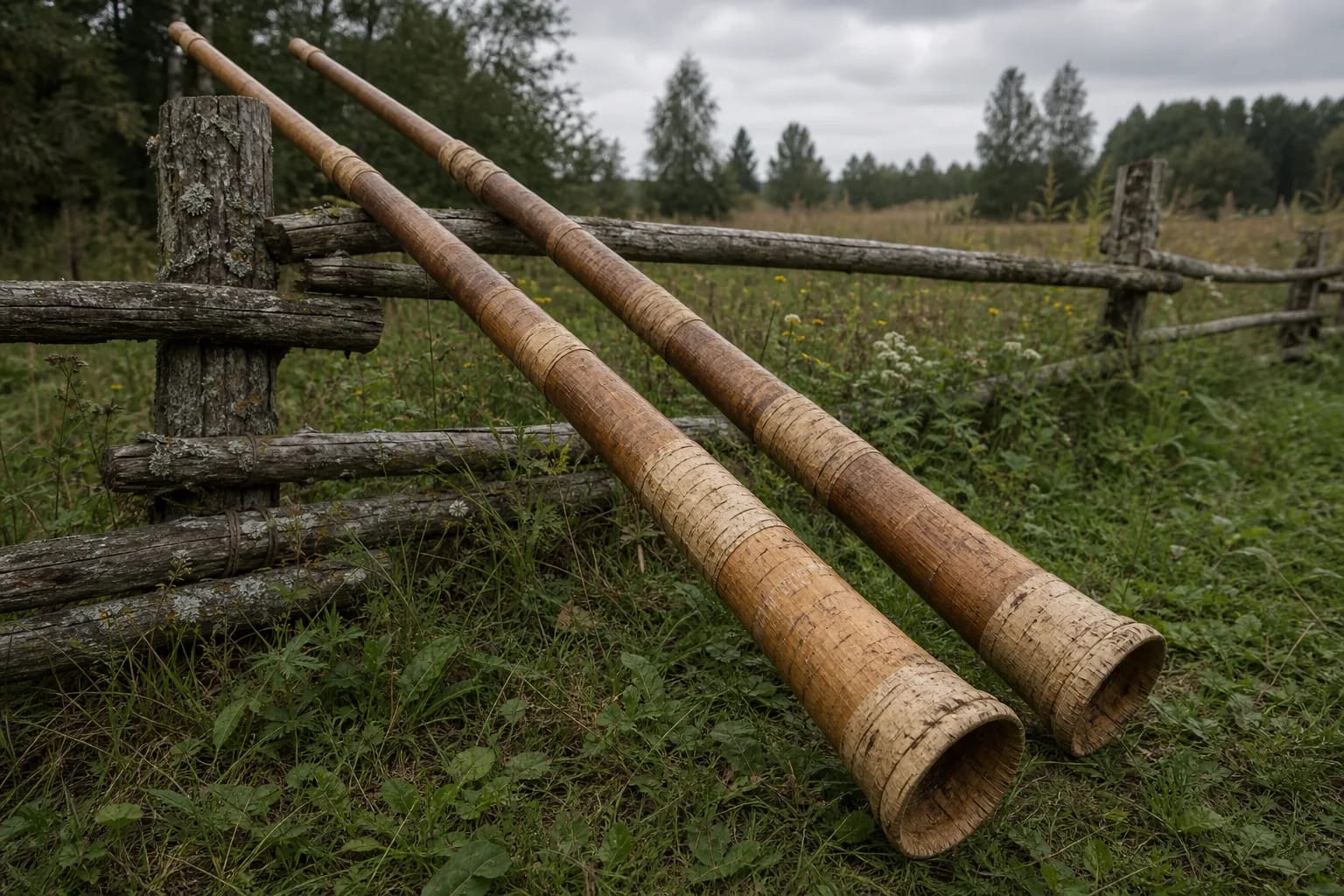
One daudytė produces four or more natural-scale tones. Because a single instrument gives only a few tones, two daudytės together create an interwoven dialogue close to sutartinės. The sound is deep, solemn, and very strong.
History and tradition
From old times until the early twentieth century, daudytė was used in northeastern Lithuania in the same environment as skudučiai and ragai. Men played vocal sutartinės on two daudytės; one daudytė was used for herding signals and monophonic sutartinė and talalinė melodies.
Daudytės show how group music and signaling merge in Lithuanian blowing culture: the same instrument fits both a herding message and a solemn archaic polyphony.
Daudytės today
Folklore ensembles use traditional daudytės, while folk-instrument orchestras use modified versions whose tube is made from 2 or 3 joined parts, with an inserted mouthpiece and tunings in C, D, E, F, G or C, F. This adapts the old sound to the stage ensemble.
Daudytė has many relatives: the Alpine horn, Latvian taure, Estonian karjapasun, Belarusian surma, and Polish and Ukrainian trembitas. Long wooden trumpets are a broad part of Central and Northern European pastoral culture.