- Field
- Knitted and beaded wrist warmers in Lithuanian clothing
- Type
- textiles
- Heritage status
- living tradition
- Context
- riešinės, knitting needles, wool, glass beads, seed beads, wrist, cuffs, national costume, geometric patterns, flowers, stars, knitwear reconstruction
Knitted wrist warmers, Beaded wrist warmers, Wrist heaters, National-costume riešinės
Wrist Warmers forms and objects
Plain woolen wrist warmers: Practical knitted wrist warmers without abundant decoration, used for warmth and protection of the cuff area.
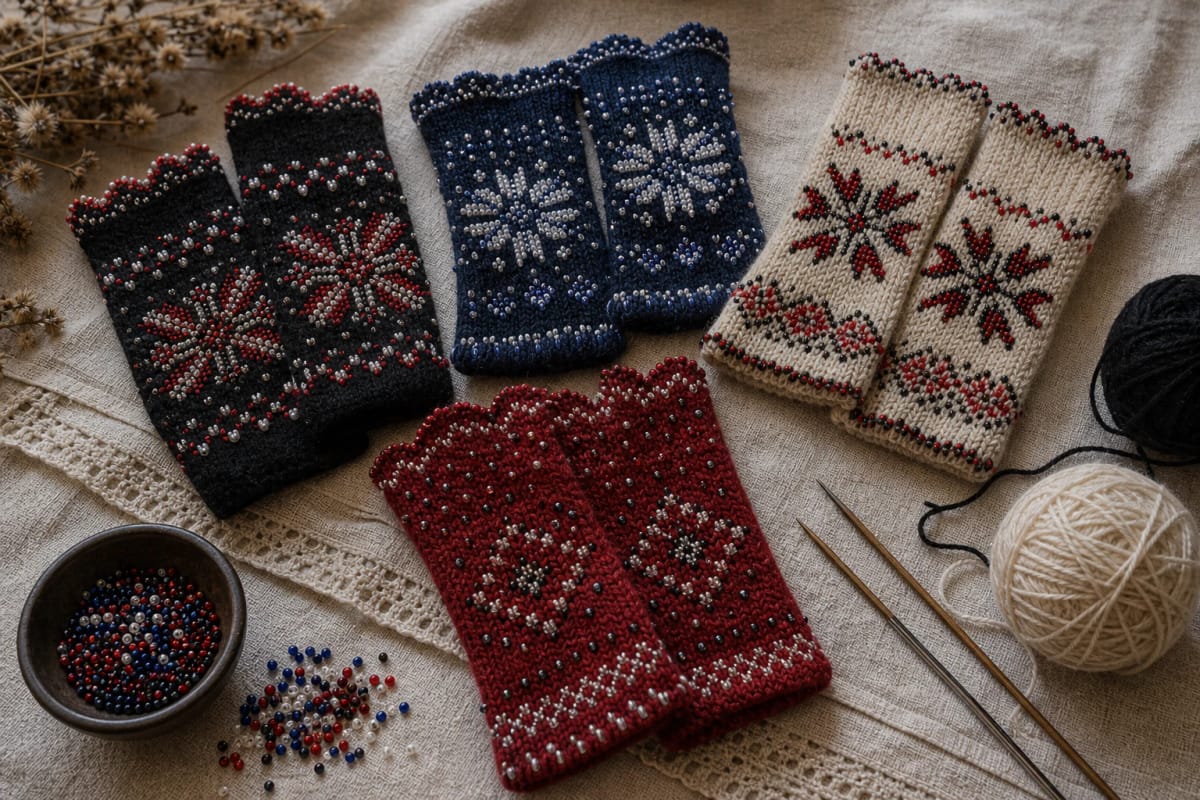
Beaded wrist warmers: Riešinės with knitted-in glass beads whose patterns form stars, rhombi, flowers, crosses, or band ornaments.
National-costume wrist warmers: Wrist warmers matched with regional costume, complementing shirt cuffs, waistcoat, shawl, and other garments.
Contemporary interpretations: Wrist warmers knitted according to traditional principles and worn with everyday clothing while preserving beading and fine-knitting logic.
What are riešinės?
Riešinės are small knitted wrist warmers worn between the hand, shirt cuff, and outer garment. They protect the wrist from cold, cover a sensitive join between garments, and become a decorative textile detail.
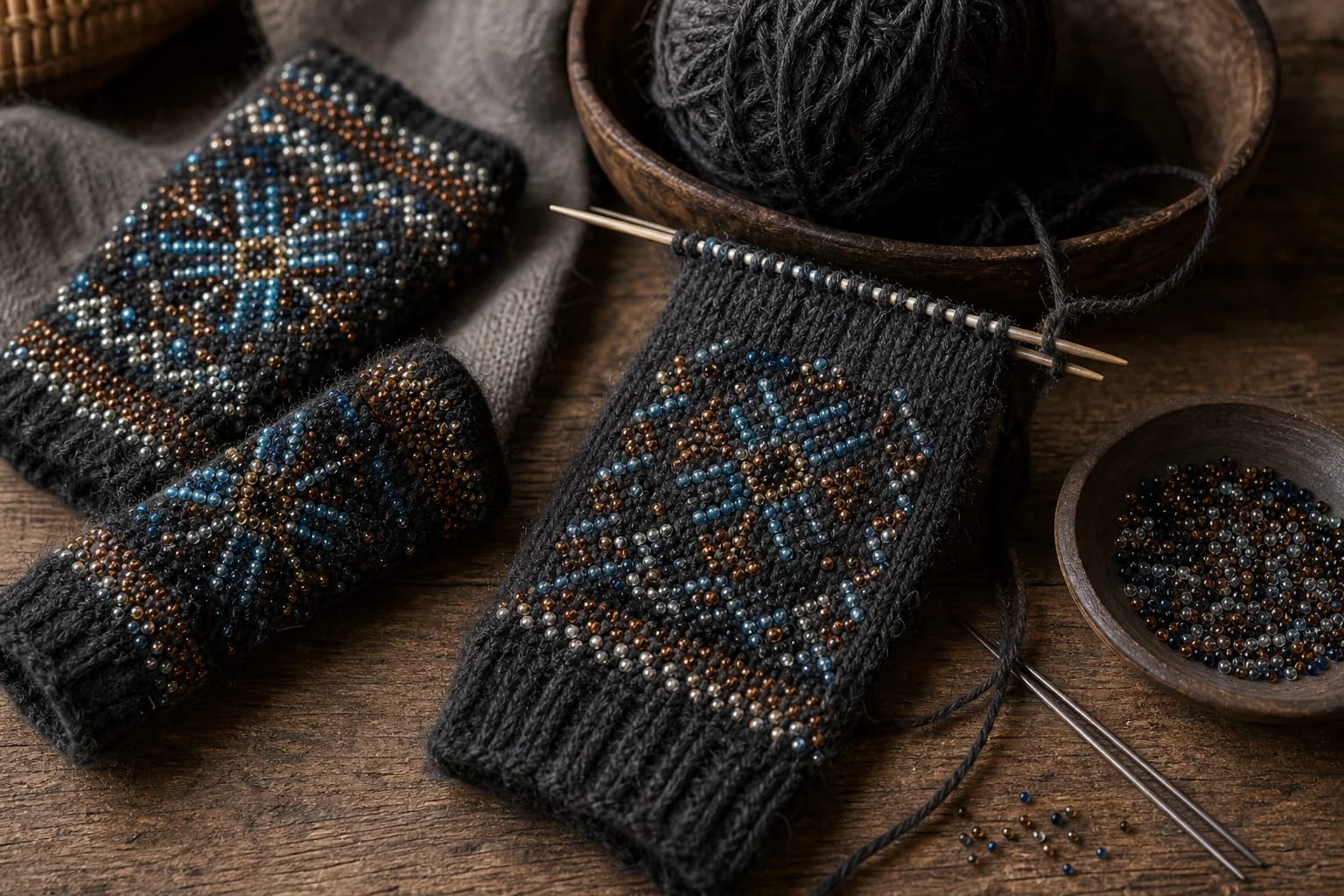
Although small, their cultural meaning is large. Bead-knitted patterns, fine woolen knitting, and their fit with national costume have made them one of the most recognizable Lithuanian knitted objects.
Riešinės are not gloves. They do not cover the palm and fingers but surround the wrist. Because of this narrow function they can be very ornate without interfering with hand work as decorated gloves would.
Practical purpose
The wrist is a place where cold easily enters between sleeve and hand. In traditional clothing the shirt cuff and sleeve of the waistcoat or outer garment did not always seal this zone, so riešinės had a clear warming function.
They also protected shirt cuffs from wear and dirt. This was especially important when shirts were white, linen, and carefully maintained.
A riešinė therefore joins practicality and ornament. It warms, protects, and at the same time shows knitting, color, and bead-pattern skill in a visible place.
Knitting and materials
Riešinės were usually knitted on needles from fine wool or half-wool yarn. Fine knitting is needed so the wrist warmer fits closely, does not slip, and does not look coarse.
Edges matter: the beginning and end must be elastic but neat. If an edge is too loose, the riešinė falls; if too stiff, it presses the wrist and loses comfort.
Colors are often dark, black, dark blue, brown, cherry, or green, because glass beads show clearly on a dark ground. But lighter examples also existed, depending on region, purpose, and maker.
Beads and pattern
Beaded riešinės are made by knitting in small glass beads, often called biseris. The beads are strung on the yarn in advance and moved into the right places during knitting.
Common patterns include rhombi, little stars, crosses, flowers, twigs, small band ornaments, frames, and repeated central motifs. The small format demands a disciplined composition.
Beads give not only color but relief. The riešinė shines as the hand moves, so a small object becomes highly visible.
Riešinės and national costume
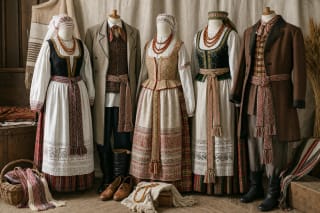
In national costume riešinės are worn at the shirt cuffs. They can emphasize the hand, complement embroidered cuffs, or give dark contrast to white linen.
When matching riešinės, the whole ensemble must be considered: region, shirt ornament, waistcoat, skirt, apron, shawl, and jewelry. Very bright riešinės should not conflict with other costume elements.
They are often presented as a general Lithuanian detail, but historically their spread, patterns, and colors could differ. Precise reconstruction should rely on concrete examples.
Regions and spread
Knitwear was widespread in Lithuania, but the form of riešinės and bead decoration was not equally prominent everywhere. Western Lithuania and Mažoji Lietuva have distinct traits in small knitwear and handmade details, while elsewhere later national-costume practice is more visible. VLE describes riešinės, also called rankovčiai, as cuffs worn on the wrists and knitted with needles or crochet; everyday ones were single-colored, worked in crochet stitch, while festive ones used colored threads and were decorated with white, yellow, or other beads in triangle and rhombus patterns. Worn in all regions until the early twentieth century, they disappeared when gloves began to be knitted with longer wrists.
Some riešinės are simply practical warmers, others an ornate folk-art form. Museum examples show variety, so all riešinės should not be treated as one national model.
The contemporary revival of riešinės often unifies the look: black ground, white or colored beads, clear geometric pattern. This is a beautiful tradition, but historical precision needs a more concrete source.
Riešinės as a gift
Because of their small size and dense work, riešinės became a suitable textile gift. They are personal, inexpensive in materials, but valuable in labor.
A pattern can be chosen for a person, occasion, or costume. In contemporary communities riešinės are often given to folklore participants, family members, or as a sign of Lithuanian heritage.
The gift should not be only a souvenir. A good riešinė must be comfortable to wear, neatly knitted, and clearly explainable: what technique, what beads, and what pattern basis it uses.
How to recognize good riešinės
Good riešinės have even knitting, neat edges, a clear bead pattern, and suitable size. They should fit closely without squeezing.
Beads should be knitted in firmly, not randomly sewn on. The pattern should repeat without mistakes, and the yarn should withstand wearing.
If riešinės are intended for national costume, check whether they fit the region and the shirt. If they are for everyday use, there is more freedom, but the traditional technique should still be clear.
Riešinės today
Today riešinės are a living tradition. They are knitted by folk artists, taught in workshops, worn with national costume, sold as handmade accessories, and used in everyday clothing.
Contemporary interpretations may use new colors, patterns, or materials, but they work best when they keep the basic logic: wrist form, fine knitting, bead pattern, and neat edge.
Riešinės show that large heritage can fit in a small object. They contain warmth, craftsmanship, ornament, body movement, and a very Lithuanian relationship between linen shirt and wool.