- Field
- Textile tradition of woven bedcovers, divonai, and palos
- Type
- textiles
- Heritage status
- well attested
- Context
- bedcovers, divonai, palos, two-shaft, diminis, rinktinės, kaišytinės, rep, woolen and half-wool bed covers, dowry textiles, weaving
Divonai, Palos, Bed covers, Woven bedcovers, Two-shaft bedcovers
Woven Bedcovers forms and objects
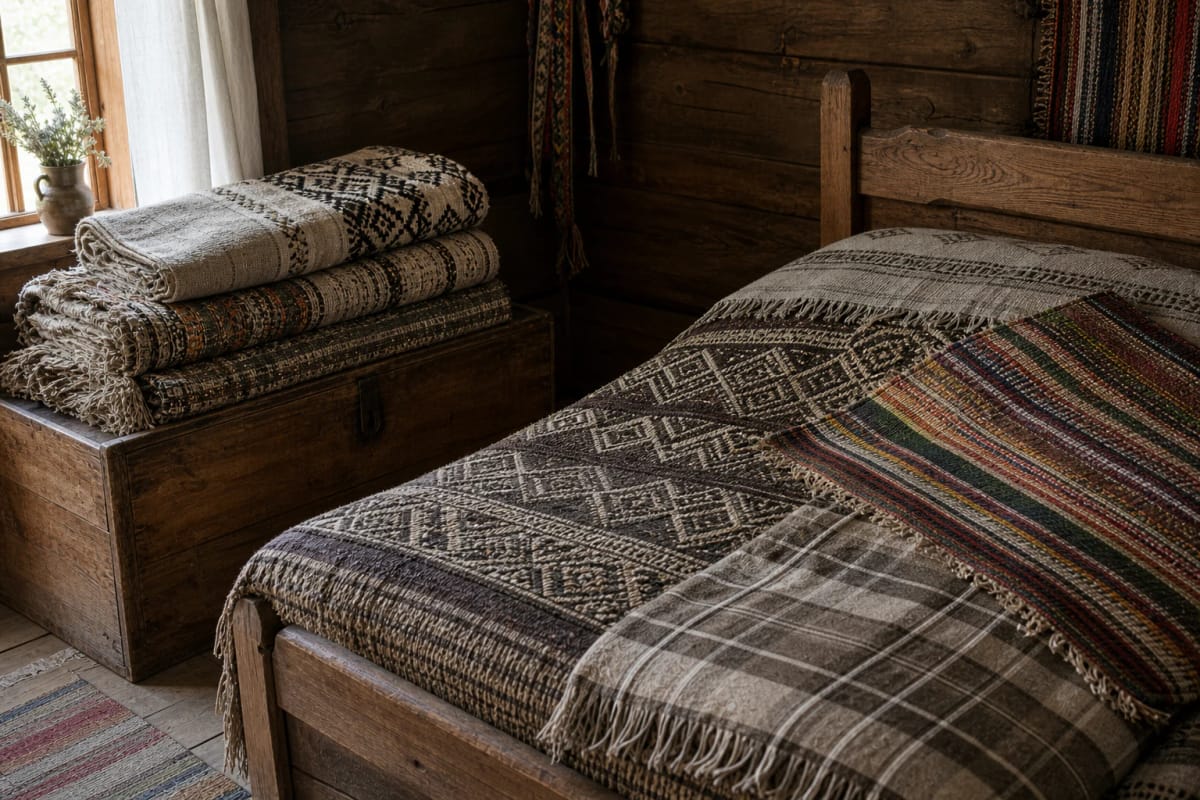
Two-shaft bedcovers: Simpler bedcovers woven in two-shaft weave, often striped or checked, used for everyday covering of the bed.
Diminis bedcovers: Patterned bedcovers whose ornament is created by fabric structure and light-shadow effects rather than color contrast alone.
Rinktinės and kaišytinės: More ornate bedcovers in which patterns are selected or supplemented with colored wefts; they are often connected with festive room display and dowry.
Divonai and palos: Regional or local names for bedcovers, especially important in descriptions of Dzūkian divonai and wider coverlet traditions.
What is a lovatiesė?
A lovatiesė is a bedcover, but in Lithuanian folk textiles it means much more than a simple cover. It is the woven textile with which the bed is neatly covered during the day, the good part of the house or room is decorated, and the weaver's ability is often shown.

Different regions and sources use names such as divonas, pala, cover, two-shaft cover, or simply woven cloth. They are not always exact synonyms: in one place the word names purpose, in another local speech, textile size, material, or ornament.
The bedcover is one of the best objects for understanding Lithuanian household textiles because function, visible beauty, regional taste, dowry value, and loom technology meet in it.
From simple covers to ornate divonai
In nineteenth-century village homes, simpler bedcovers could be two-shaft, striped, or checked. They were strong, practical, and used for everyday bed order when bedding had to be covered during the day.
Later, and in wealthier homes, more complex diminis, rinktinės, rep, napkin-pattern, or kaišytinės bedcovers spread. In them the pattern became clearer, colors richer, and the surface of the fabric representative.
In Dzūkija the name divonas is often connected with a more ornate, more strongly patterned bed cover. But a divonas should not be described as one strict type; it is a living coverlet category in regional textiles.
Materials and colors
Bedcovers were often woven from wool, linen, hemp, or mixed threads. Wool gave warmth, thickness, and richer color; linen gave strength and a lighter ground; mixed fabrics allowed durability and decoration to be combined.
Colors depended on period, dyes, region, and the weaver's taste. Older bedcovers could be more restrained, later ones brighter, with factory-made threads and a broader palette.
It is important not to overstate color stereotypes. Distinctive combinations do appear in Žemaitija, Aukštaitija, Dzūkija, or Suvalkija, but each bedcover should be evaluated by its specific place, time, and technique.
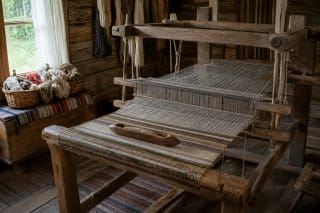
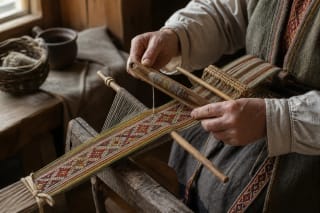
Weaving methods
A two-shaft bedcover is based on simpler interlacing and often creates pattern through colored stripes or checks. Such textiles were durable and clearly readable even from a distance.
In diminis bedcovers the ornament is created by the structure of the cloth: the surface changes light, and rhombi, windows, little stars, crosses, or other geometric rhythms appear. Here not only color matters, but also the order in which threads are lifted.
Rinktinės and kaišytinės bedcovers require more work. The pattern is selected or additionally inserted, allowing stronger motifs, contrast, and denser ornament. Such bedcovers were often kept as better textiles. According to VLE, kaišytinės bedcovers with inserted patterns on a dark ground were especially woven in Suvalkija and Dzūkija in the late nineteenth and the first two decades of the twentieth century.
The bedcover in household space
In the traditional house, the bed was not hidden in a separate bedroom as it often is today. It was visible in the living space, so a covered bed showed order, the housewife's diligence, and the respectability of the home.
For holidays, guests, weddings, or photography, the bed could be covered with a better bedcover. It became a color center of the room, much like a tablecloth on a table or a towel on a towel rack.
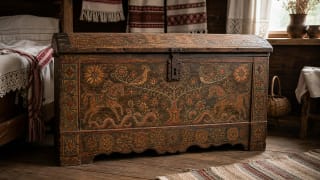
Bedcovers were also used not only on beds. They could cover benches, chests, or wagons, be spread as coverlets, or temporarily serve as warm blankets. Use depended on the textile type and household need.
Dowry and social value
Bedcovers were an important part of dowry. Girls and families prepared textiles for future life: sheets, towels, tablecloths, pillowcases, bedcovers, sashes, and other woven goods.
In dowry, a bedcover showed not only quantity but quality. A beautiful pattern, regular edges, good fabric density, and color harmony spoke of diligence, household resources, and textile skill.
For that reason museum bedcovers are often objects of family memory. They are preserved not only as things, but as witnesses to women's work, dowry, weddings, and household history.
Regional traits
According to VLE, in the first half of the nineteenth century bedcovers were woven in two-shaft weave, often checked, while rep examples were striped: lengthwise-striped in Žemaitija and cross-striped in Aukštaitija; most bedcovers were woven with diminis geometric patterns. Aukštaitija often shows crosswise stripes, lighter rhythmic combinations, while Žemaitija shows richer colors and woolen textiles.
In Dzūkija the name divonas and ornate covers are especially important, with brighter colors, finer patterns, and rinktinė or kaišytinė techniques. In Suvalkija, orderly pattern precision and clear ornamental solutions are valued.
These descriptions are guides, not rigid rules. Regional textiles changed, and weavers borrowed patterns, saw market goods, had different threads, and sometimes created very individual combinations.
How to read a bedcover pattern
First look at the construction: whether the cloth is two-shaft, diminis, rinktinė, kaišytinė, rep, or another type. This determines whether the pattern is made by color, thread lifting, added weft, or surface texture.
Then notice scale. Some bedcovers work through large checks and stripes, others through small rhombi, stars, fir-tree motifs, or repeated band ornaments.
Finally, ask what the textile was meant for. An everyday bedcover, dowry bedcover, festive divonas, and contemporary folk-art interpretation may look similar, but their purpose and value differ.
Bedcovers today
Today bedcovers are preserved in museums, woven by folk artists, reconstructed from regional examples, and used in homes as heritage textiles. A well-made bedcover is still a serious proof of weaving skill. In the mid and late twentieth century bedcovers were woven by folk artists and by weavers in Dailės kombinatas workshops; in the early twenty-first century by Panevėžys Tulpė from 1998 to 2002 and Šiauliai Comco from 1993.
In contemporary interior language a traditional bedcover easily becomes decoration, but its essence is not only pattern. It is connected with the loom, the weaver's work, material preparation, dowry memory, and the bed as a visual center of household order.
When creating or buying a bedcover, it is therefore worth asking not only whether it is beautiful, but which region, which technique, which period, and which example it follows. That keeps the tradition precise rather than merely stylized.