- Field
- Lithuanian straw chains, garlands, and linear festive decoration
- Type
- folk art
- Heritage status
- living tradition
- Context
- Straw garlands, straw chains, spatial chains, diamonds, triangles, cubes, Christmas-tree garlands, window decorations, straw threading
Straw garlands, Straw chains, Spatial straw chains, Straw threaded ornaments, Christmas-tree straw garlands
Straw Garlands forms and objects
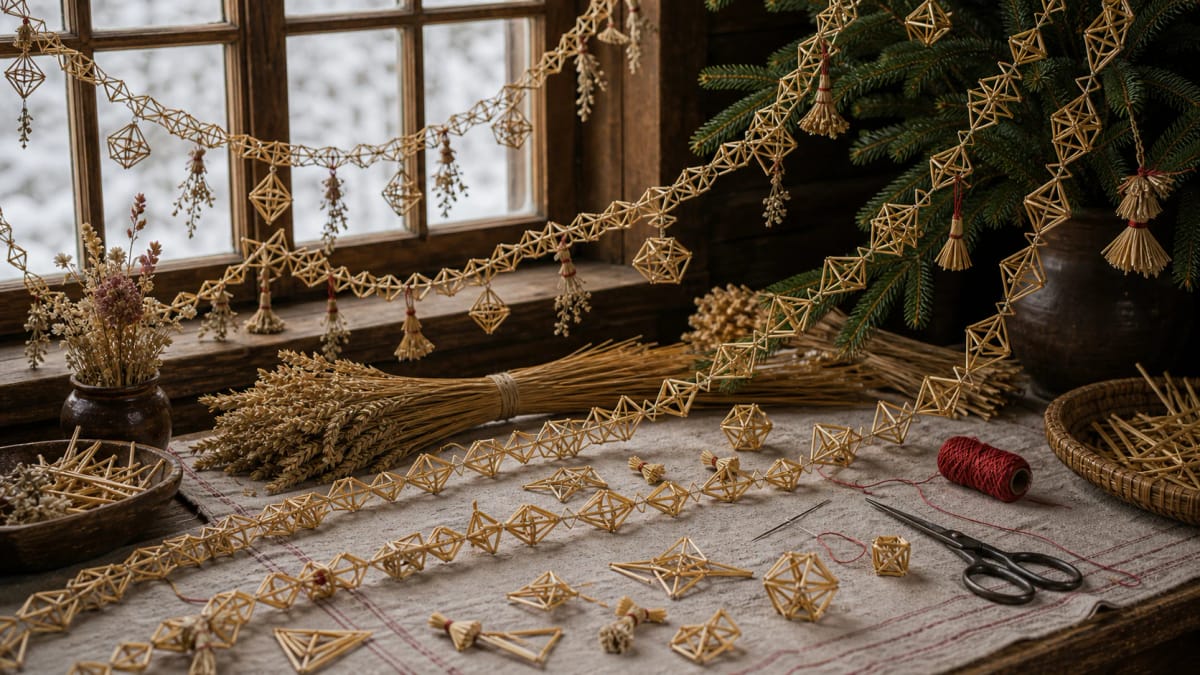
Diamond chain: A repeating chain of diamond-shaped forms threaded from equal straw segments, suitable for a window, wall, or Christmas tree.
Triangle garland: A linear composition of triangular modules, sometimes supplemented with small tassels, dried plants, or red thread.
Cube and reketukas garland: A spatial chain of small cubes, reketukai, or diamond modules that recalls miniature structures from straw-garden geometry.
Mixed festive garland: Straw modules combined with dried plants, small bells, or figurative straw ornaments while keeping the natural material at the center.
What Are Straw Garlands?
Straw garlands are linear decorations made from straw segments and modules. They are threaded into chains of diamonds, triangles, cubes, stars, small reketukai, or other small forms and hung in a window, on a spruce tree, above the table, or along a room wall.
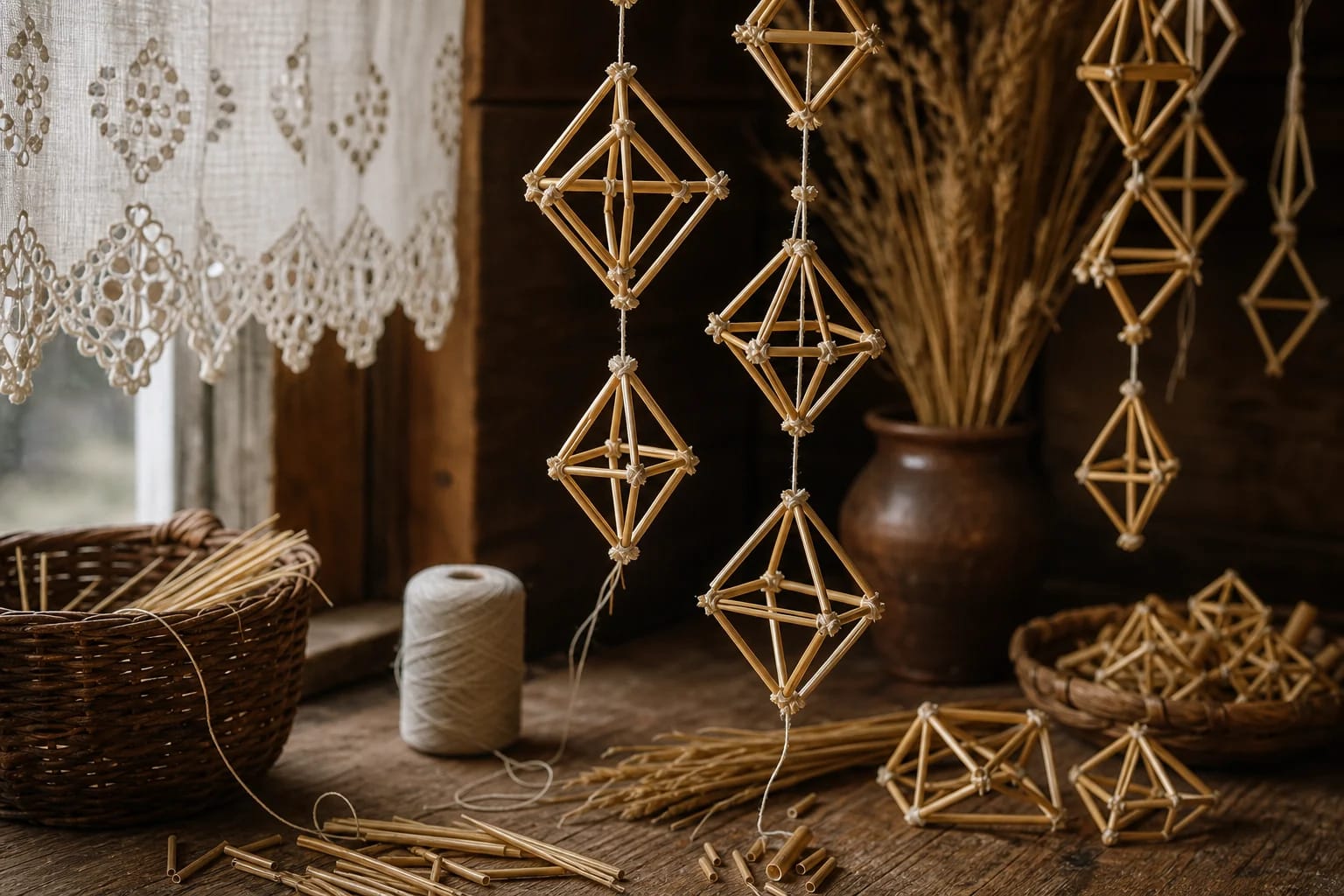
They belong to the same field of straw decoration as straw ornaments, straw stars, and sodai, but their construction logic is different. A garland is a line, a rhythm, and a repetition rather than one central hanging object.
For that reason garlands are especially useful in festive interiors: they can frame a window, connect several points in a room, or fall lightly from Christmas-tree branches.
Modules: Diamonds, Triangles, Cubes
A garland is usually built from repeated modules. A diamond gives the chain a clear rhythm, a triangle creates a light angular movement, and a cube or reketukas adds spatial shadow.
The size of the module determines the whole garland. Small modules look subtler, but many more are needed. Larger modules create an effect more quickly, yet they must remain light so the chain does not sag or snap.
Equal segments are essential. If one part of the garland is longer or heavier, it hangs unevenly and the sequence of modules loses its rhythm.
How Is a Straw Garland Threaded?
First the straw is prepared: it is sorted, cut into equal lengths, and briefly soaked if needed. Modules or separately tied forms are then threaded onto a string.
The spacing between modules matters as much as the modules themselves. Forms may be set close together, joined by short straw segments, or separated by lengths of thread, tassels, or dried plants.
At the end, the hanging line has to be checked. A garland should keep its line, avoid twisting to one side, and remain intact at the knots.
Windows, Christmas Trees, and Room Decoration
In a window a straw garland works beautifully because of light: the straw glows and the geometric modules cast small shadows. The decoration is light, so it suits older frames and natural interiors.
On a Christmas tree, a straw garland can replace a plastic or glittering chain. It pairs well with straw ornaments, stars, apples, nuts, linen ribbons, and other natural decorations.
Above a table or across a room, the garland creates a horizontal festive line. It is not as symbolically central as a sodas, but it helps bring a space into one festive composition.
Difference from Straw Gardens
A straw garden, or sodas, is a larger spatial construction, often with a center, top, bottom, and interpretations of cosmic order. A straw garland is a linear chain based on repeated modules.
A garland may use the geometric principles of sodai, but its purpose is simpler: to encircle, hang, connect, and decorate. It does not need to be presented as a separate cosmic model.
This distinction helps avoid duplicated content and overly broad symbolic claims. The garland belongs to straw decoration, handwork, and festive interior practice.
Dried Plants, Thread, and Color
Dried plants, small straw tassels, red thread, or other natural details are sometimes tied or woven into garlands. They should not weigh the chain down or overwhelm the straw.
Red thread can be both practical and decorative: it is visible, emphasizes knots, and adds festivity. Still, color should not become a substitute for plastic decoration.
The natural color of straw is part of the appeal. It ranges from pale yellow to brownish tones depending on the grain, drying, and age.
Contemporary Workshops
Garlands work well in workshops because the principle is clear: one module is repeated many times. The process teaches precision, rhythm, segment counting, thread tension, and planning.
Children can begin with simple diamonds or triangles, while more complex spatial chains are better for older participants. It is important to show that straw is fragile and requires patience.
Contemporary garlands can be new while still respecting the logic of the material. Not everything needs to be called ancient: a living tradition may adapt when it recognizes its roots clearly.
Storage and Repair
Straw garlands are harder to store than individual ornaments because they are long and tangle easily. It is best to wind them very loosely or place them in broad loops in a box, separated with paper.
If the thread breaks, it is not enough simply to tie the ends. The tension of the module must also be checked: a place pulled too tightly will break the straw, while a place left too loose will distort the chain.
Moisture, mold, and rodents are the main hazards. A garland should be stored dry, ventilated, and not pressed under heavy objects.