- Field
- The craft of traditional straw, reed, and kūlinis roofing
- Type
- traditional craft
- Heritage status
- well attested
- Context
- Straw roofs, reed roofs, kūlinis roofs, reeds, rye straw, bundles, thatcher, battens, rafters, ridge, čiukuras, eaves, Pamarys, Lithuania Minor, traditional wooden architecture, fire safety
Šiaudinis stogas, Nendrinis stogas, Kūlinis stogas, Stogų dengimas šiaudais, Stogų dengimas nendrėmis
Thatching with Straw and Reeds forms and objects
Rye Straw: The traditional material for straw roofs, especially when the stalks are long, strong, dry, and unbroken.
Reeds: Stems of water plants used for reed roofing, especially in watery lowlands, lagoon landscapes, and the Pamarys region.
Kūlis: A tied bundle of straw or reeds from which the thick, water-shedding roof layer is built.
Ridge: The top line where two roof slopes meet; on straw and reed roofs it is one of the most vulnerable places.
Thatcher’s Beater: A board-like or rake-like tool used to even, compact, and shape the straw or reed layer.
What Is Thatching with Straw and Reeds?
Thatching with straw and reeds is a traditional roofing craft in which the roof covering is built from plant stems, usually rye straw or reeds. It is not a thin decorative layer but a thick, compact surface that sheds water and dries after rain.
In Lithuanian rural architecture such roofs grew from local materials. Rye straw belonged to the farming economy, while reeds belonged to wetlands, lakes, river lowlands, the Curonian Lagoon area, and other waterside landscapes.
Today straw and reed roofs are most visible in heritage homesteads, museums, ethnographic buildings, and some new buildings using traditional expression. They must be built not only attractively but technically and safely.
The Straw Roof
Traditional straw roofs needed long, strong rye straw. The stalks had to be dry, straight, and unbroken so they could be tied into kūliai, roof bundles that form a dense water-shedding layer.
A rye-straw roof continues the logic of the grain field. Grain fed the household, while straw could cover the buildings.
A real straw roof should not be confused with modern decorative straw mats. It requires long ordered stalks, dense laying, and a thatcher’s experience.
The Reed Roof
Reed roofs are made from reeds, whose stems are strong, long, hollow, and well suited to a thick water-shedding covering. They are especially important in watery regions where reeds are plentiful.
Descriptions of Lithuania Minor and the Pamarys landscape often identify reed roofs as a major architectural marker. In such places reeds could be easier to obtain than quality roofing timber or long grain straw.
A reed roof is not simply a straw roof under another name. Reed stems are stiffer, age differently, and create a different surface, even though both belong to the wider logic of bundled plant roofing.
Bundles, Tying, and Layering
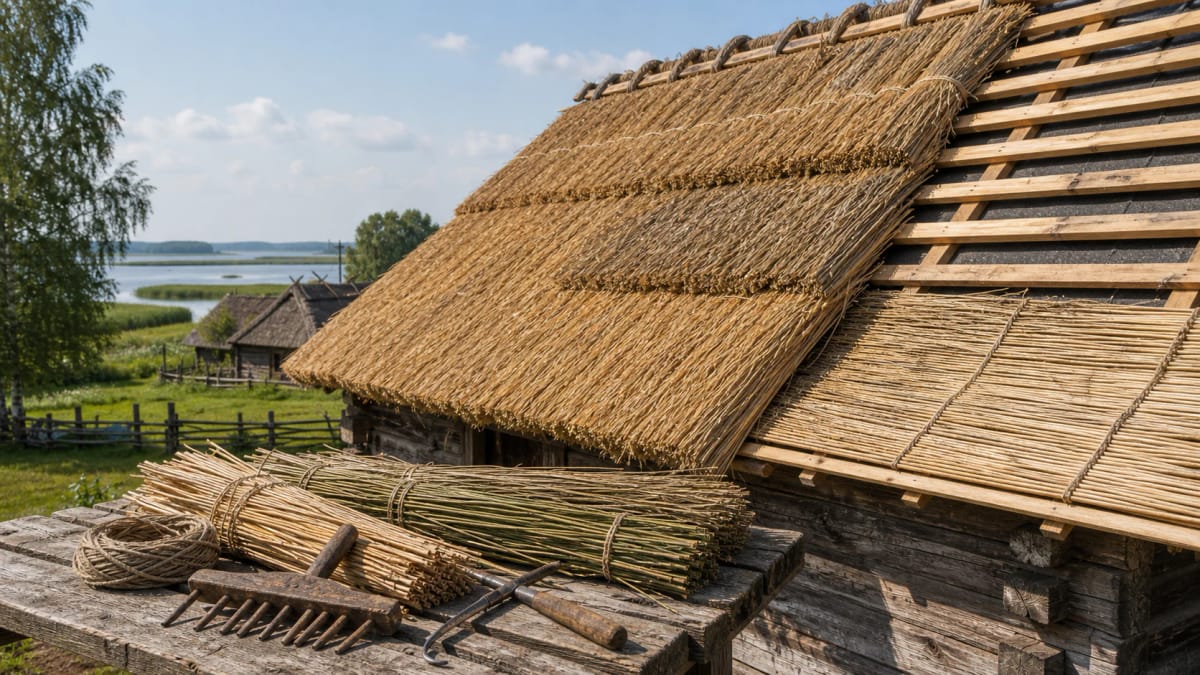
Straw or reeds are first tied into kūliai. On the roof they are laid in rows from the eaves upward, each row covering the previous one so rain runs down the stems.
The thatcher evens and compacts the layer with beaters, needles, hooks, cord, wire, or other fasteners depending on the method. The goal is a consistent thickness, orderly surface, and secure attachment to battens.
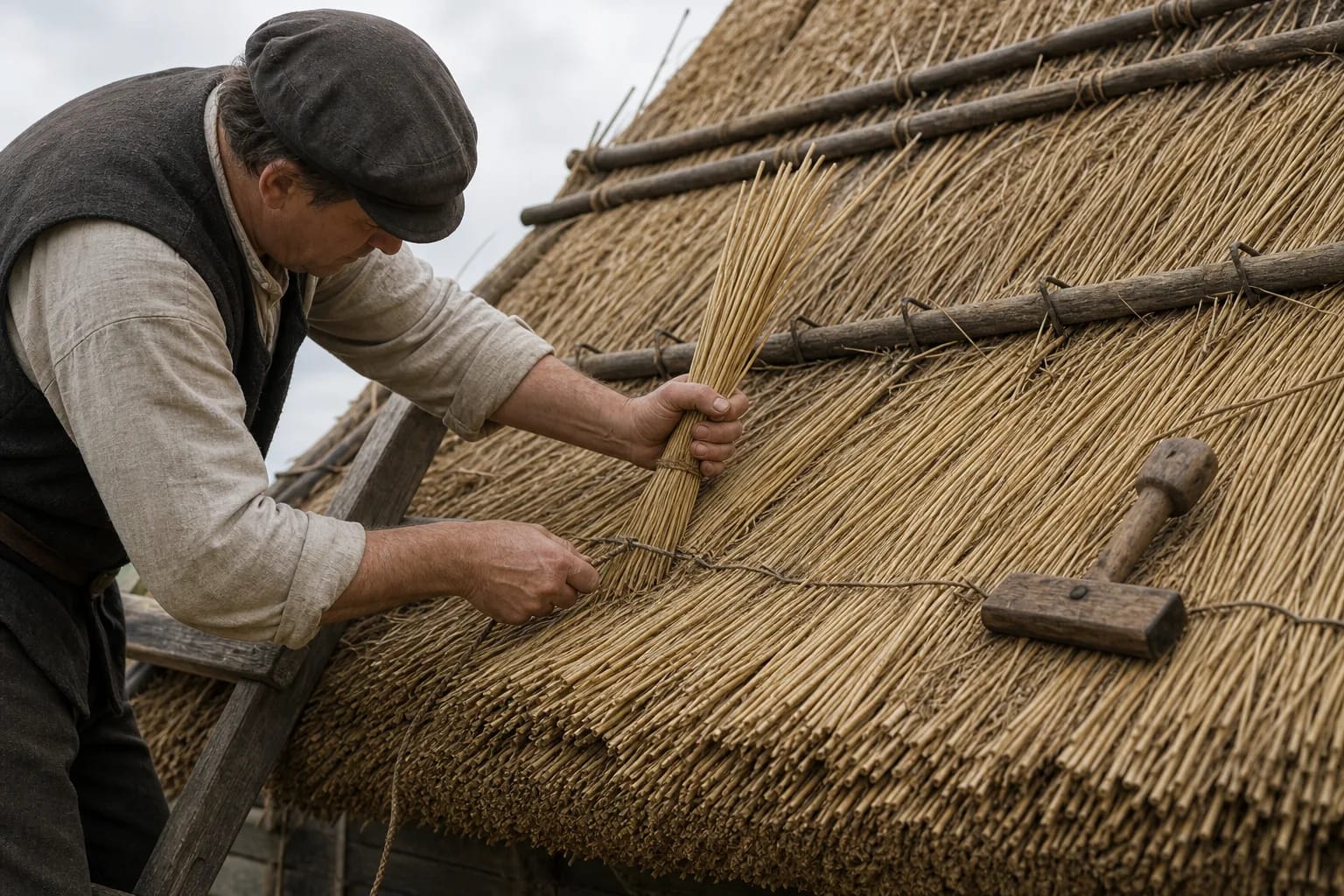
The ends, direction, and density of the stems must work together. A sparse, badly tied, or uneven covering quickly leaks, is pulled loose by wind, and loses its shape.
Pitch, Battens, and Structure
Straw and reed roofs need a sufficiently steep pitch. If the slope is too low, water lingers, the covering dries slowly, and decay begins sooner.
Battens, rafters, and the whole roof frame must carry a thick covering. Such a roof may look soft, but its structural demands are serious: weight, wind, snow, and moisture all have to be considered.
A traditional thatcher does not separate roof covering from building form. Pitch, eaves, ridge, chimney opening, wall protection, and water runoff are one system.
The Ridge and Vulnerable Places
The ridge is one of the hardest parts of a straw or reed roof. Two slopes meet there, so wind, rain, and snow most easily find weakness.
The ridge can be made with additional bundles, turf, wooden elements, special weighting, or regional solutions. It must be tight enough to protect the roof while allowing the thatch to function.
Eaves, corners, roof windows, chimneys, and roof breaks also require skill. A simple slope teaches the principle, but difficult places reveal the thatcher’s competence.
Regions and Landscape
Straw roofs made sense where grain and long straw were part of the agricultural system. Reed roofs naturally developed where reeds were abundant: by lagoons, lakes, river lowlands, and marshes. From the 16th to 19th centuries, Lithuanian rural roofs were often hipped, of post or rafter construction, and covered with rye straw, while coastal and lagoon areas used reeds; gabled roofs with tiles, shingles, or shakes began to appear only in the 19th century, first in Aukštaitija and Suvalkija.
In the Pamarys region and Lithuania Minor, reed roofing helps define the local landscape, matching water, wind, fishing and farming homesteads, and wooden buildings.
This regional difference matters. Reeds are not straw, and a reed roof on the lagoon edge has its own material, form, and environmental logic.
Maintenance and Longevity
A straw or reed roof can last a long time if it is correctly built and maintained. The ridge, eaves, chimney areas, wind-damaged spots, moss, and leaf buildup need regular attention.
The greatest enemy is trapped moisture. Heavy shade, falling leaves, poor pitch, and bad water runoff shorten the life of the covering.
Maintenance does not mean constant rebuilding. Often the key is repairing damaged places in time, keeping water from standing, and maintaining the chimney and surrounding area.
Fire Safety
Straw and reed roofs carry clear fire risk. Any modern heritage or building project has to meet fire-safety requirements, chimney maintenance rules, setback distances, and permitting requirements.
Such roofs should not be presented only as a romantic village image. Stoves, chimneys, lightning protection, electrical wiring, sparks, fireworks, and open fire must be treated seriously.
Responsible craftsmanship is part of heritage. The tradition survives when adapted safely, not when copied in a dangerous way.
Difference from a Shingle Roof
Straw and reed roofs are plant-stem coverings. Shingle, shake, and gont roofs are wooden board or split-wood coverings. That material difference creates the technical differences.
Layer thickness, surface form, fastening, water runoff, fire risk, aging, and maintenance all differ. Both belong to traditional roofing, but they are not the same craft.
A good understanding starts with the material itself: rye straw, reed, bundle, knot, and the layered surface left by the thatcher’s hand.