- Field
- Woven runners, small rugs, floor and bench textiles in Lithuanian homes
- Type
- textile
- Heritage status
- well attested
- Context
- Carpets, runners, narrow runners, small rugs, floor textile, bench covers, woven carpets, knotted carpets, jacquard carpets, chenille carpets, Lentvaris carpets, folk weaving
Woven runners, Runners, Small rugs, Floor runners, Bench covers
Carpets and Runners forms and objects
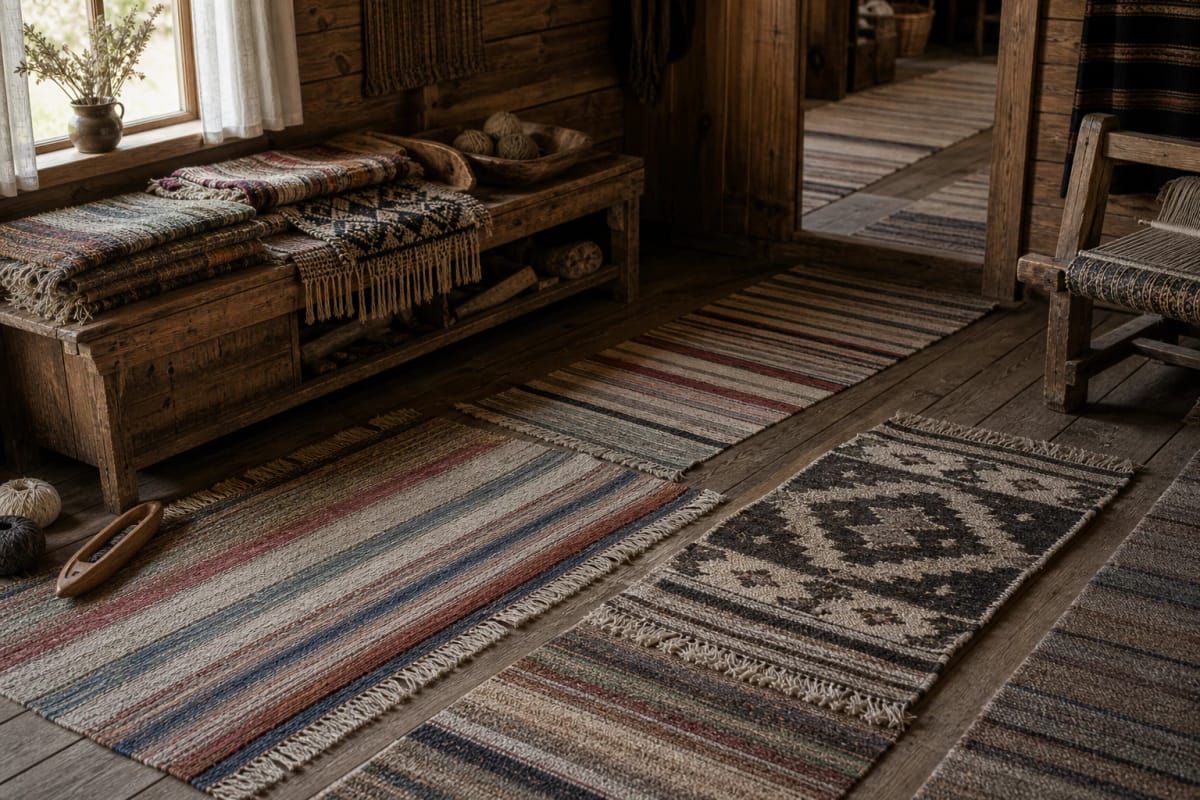
Woven runners: Long narrower runners for floors, benches, vestibules, or to emphasize the route through a room, often striped or geometric.
Small rugs: Smaller covers by a bed, bench, threshold, or work place, often thicker and meant for real wear.
Knotted and woven carpets: More complex handmade carpets in which ornament is created by knotting, weaving, layers of color, or texture.
Workshop and industrial carpets: A later town, manor, workshop, and factory layer, including the history of carpet production in Lentvaris.
What are carpets and runners?
Carpets and runners mean covers for floors, benches, thresholds, and home spaces: long runners, small rugs, thicker woven textiles, and later handmade or workshop carpets.

Not everything should be rushed under the single word carpet. In Lithuanian rural homes we often see runners: narrower practical textiles woven from wool, linen, rags, or mixed yarns. Large decorative carpets also belong to another layer of workshops, manors, and industry.
The tradition therefore has two connected layers: folk textile runners and small rugs in everyday homes, and the broader carpet-making context of manufactories, Lentvaris, and urban interiors.
Runners in rural homes
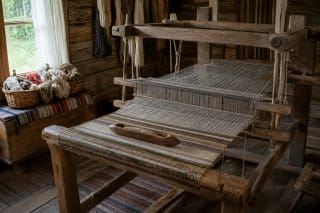
A runner is a long narrower textile laid on a floor, bench, beside a bed, or along a walking route. It protected floors, warmed feet, softened sound, and gave order to a room.
A runner could be woven from wool, linen, hemp, cotton, rags, or mixed materials. Everyday runners wore quickly, so their materials were often practical, reused, and strong.
In a room, a runner acts like a path. It marks movement and connects door, bed, table, bench, and stove; textile shapes not only beauty but spatial rhythm.
Small rugs and bench textiles
Small rugs were covers placed by a bed, bench, threshold, or work spot. They could be thicker, shorter, and more tied to a specific place than a long runner.
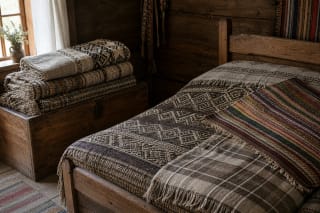
Bench covers are an important intermediate group: they are not floor carpets, but they are not bedcovers either. They softened wood, protected from cold, and decorated the seat.
These textiles show that traditional home textile was not only treasure stored in a chest. It directly changed bodily experience: how people sat, walked, lay down, worked, and welcomed a guest.
Materials and reuse
Runners and rugs used wool, linen, hemp, cotton, factory yarn, rags, and leftovers. VLE's survey of Lithuanian folk textile mentions carpets and runners among household fabrics woven in the seventeenth-nineteenth centuries from linen, woolen, and hemp yarns; from the second half of the nineteenth century cotton also appeared. Reuse was natural in rural textile, because old clothing or cloth could become a new runner.
Rag runners show practical weaving especially well. Strips of old cloth become weft and turn into a colorful, durable floor textile.
Woolen runners are warmer and stronger; linen or hemp runners are more restrained and harder. Material depended on purpose, season, and household resources.
Patterns and colors
Runners often use stripes, checks, banded rhythms, diamonds, fir-tree forms, small color repeats, and border edges. The long format naturally encourages linear composition.
Small rugs and thicker textiles may have larger geometric fields, central motifs, fringes, or frames. In practical floor textiles, very fine decoration quickly disappears in use.
In folk runners, beauty often comes from the rhythm of materials: colors of old fabrics, repeated threads, the relationship of stripes, and a handwoven surface that is uneven but alive.
Woven, knotted, and other carpets
Carpets may be woven, knotted, jacquard, chenille, or made by other technologies. More complex carpets are often connected with workshops, manors, urban interiors, and later industrial production.
A knotted carpet requires different work than a simple runner: each knot or fiber attachment creates a pile surface. Such carpets are more decorative and more expensive.
This distinction matters because a folk runner and a large workshop carpet should be judged by different criteria. One is the economy of everyday household textile; the other is specialized carpet production.
Lentvaris and the industrial layer
In Lithuanian carpet history, Lentvaris is important as a later center of industrial production. This is no longer a village-loom runner but part of factory, urban, and Soviet-period textile history.
Lentvaris and other workshops widened the idea of the carpet in Lithuania: standardized patterns, larger editions, urban interiors, and a different buying culture appeared.
When speaking about folk art, the layers should not be mixed carelessly but connected responsibly: village runners, manor carpets, workshops, and factories are different but complementary parts of textile history.
Where were runners laid?
Runners could be laid by a bed, from door to table, along the stove, on benches, by a chest, in a festive room, or in the vestibule. They often marked the direction of movement.
For feasts or guests, better and cleaner runners might be brought out. Everyday floor textiles wore faster, so the better ones were protected like other good household textiles.
Laying runners was also practical hygiene: dirt and cold from wooden floors affected feet and room order less directly.
How to assess an old runner or carpet
When assessing a runner, look at material, weaving density, edges, wear, color rhythm, and purpose. Old wear is not a defect if it shows real domestic life.
When assessing a carpet, technique matters: woven, knotted, jacquard, chenille, factory-made, or handmade. This determines how to understand pattern, value, and care.
A contemporary runner can be a strong heritage-inspired textile if its technique and purpose are named honestly. Tradition is strengthened not only by copying a pattern but by understanding function.