- Field
- Baltic bronze, brass, and copper-alloy jewelry from archaeological and living craft traditions
- Type
- traditional craft
- Heritage status
- well attested
- Context
- Neck-rings, brooches, pins, bracelets, spiral rings, temple ornaments, headbands, pendants, spirals, status, garment fastening
Baltic ornaments, Brass ornaments, Bronze ornaments, Copper-alloy ornaments, Archaeological ornaments
Bronze and Brass Ornaments forms and objects
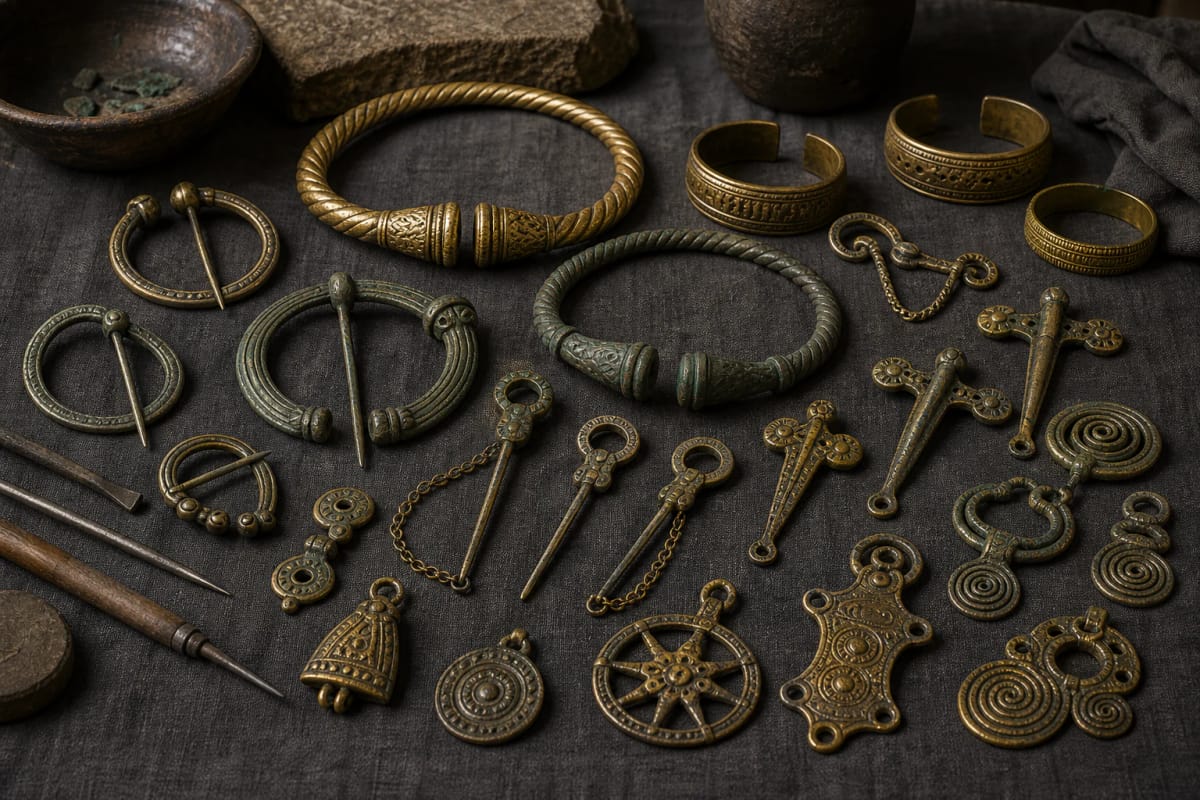
Neck Rings: Neck ornaments made from rods, twists, or heavier terminals, serving as signs of status, region, and dress system.
Brooches: Fastening and decorative ornaments such as penannular, bow, plate, and other forms, often with ornamented surfaces.
Pins and Chains: Single or paired dress pins, sometimes joined by chains, used for fastening clothing and decorating the chest.
Bracelets and Rings: Band, spiral, massive, or ornamented bracelets and rings showing the variety of metalwork and ornament.
What Are Brass Ornaments?
In everyday language, Lithuanian “brass ornaments” usually means old Baltic-style metal ornaments: neck rings, brooches, pins, bracelets, rings, pendants, chains, head ornaments, and modern reconstructions. Archaeological writing needs more precision.
Old ornaments were made from various copper alloys. Depending on period, composition, and research tradition, sources may use bronze, brass, or copper alloy. The popular Lithuanian term žalvaris often covers a broader group than strict metallurgy would allow.
These ornaments were not only beautiful objects. They fastened clothing, held textiles, showed status, age, gender, wealth, local tradition, sometimes carried amuletic meaning, and today help reconstruct Baltic dress systems.
Brass, Bronze, and Copper Alloys
Bronze usually means an alloy of copper and tin, while brass means copper and zinc. Old finds can have varied compositions, and in Lithuanian heritage and reconstruction the word žalvaris is often used more broadly than a strict metal definition.
Here the phrase “brass ornaments” works as a cultural and popular label, while historical finds are better understood as copper-alloy ornaments. This matters when comparing archaeological originals with modern reconstructions.
A good maker or museum should indicate whether an object is a copy of a find, an interpretation, a bronze casting, a brass jewel, or a decorative Baltic-style piece. Clarity strengthens the tradition.
When Did Metal Ornaments Appear in Lithuania?
The first metal ornaments were imported, while local production in western Lithuania appears in the second period of the Bronze Age, around 1600-1400 BCE. Metal began as rare and valuable material.
The first local forged objects around the 5th century BCE included spiral copper-alloy wire ornaments such as temple ornaments, bracelets, and pins. In the Iron Age copper-alloy ornaments became a major part of dress, and by the 9th-13th centuries Baltic forms such as neck rings, brooches, pins, bracelets, and spiral rings were often massive and technically complex.
Metal ornaments matter because organic materials decay while metal survives. Brooches, pins, and chains help reconstruct how garments were fastened, how layers of dress fell, and where ornaments were worn on the body.
Neck Rings, Brooches, and Pins
Neck rings are among the most impressive Baltic ornaments. They may be twisted, massive, have thickened terminals, coils, or ornamented surfaces. Metal worn at the neck was highly visible and carried strong status and identity weight.
Brooches had both practical and decorative roles. Penannular, bow, plate, and other brooches fastened garments, shawls, cloaks, or other textiles, and their form can show period, region, and technology.
Pins, especially paired pins with chains, are crucial for dress reconstruction. They can show where clothing was fastened, how fabric fell, and how ornament worked together with textile.
Bracelets, Rings, and Head Ornaments
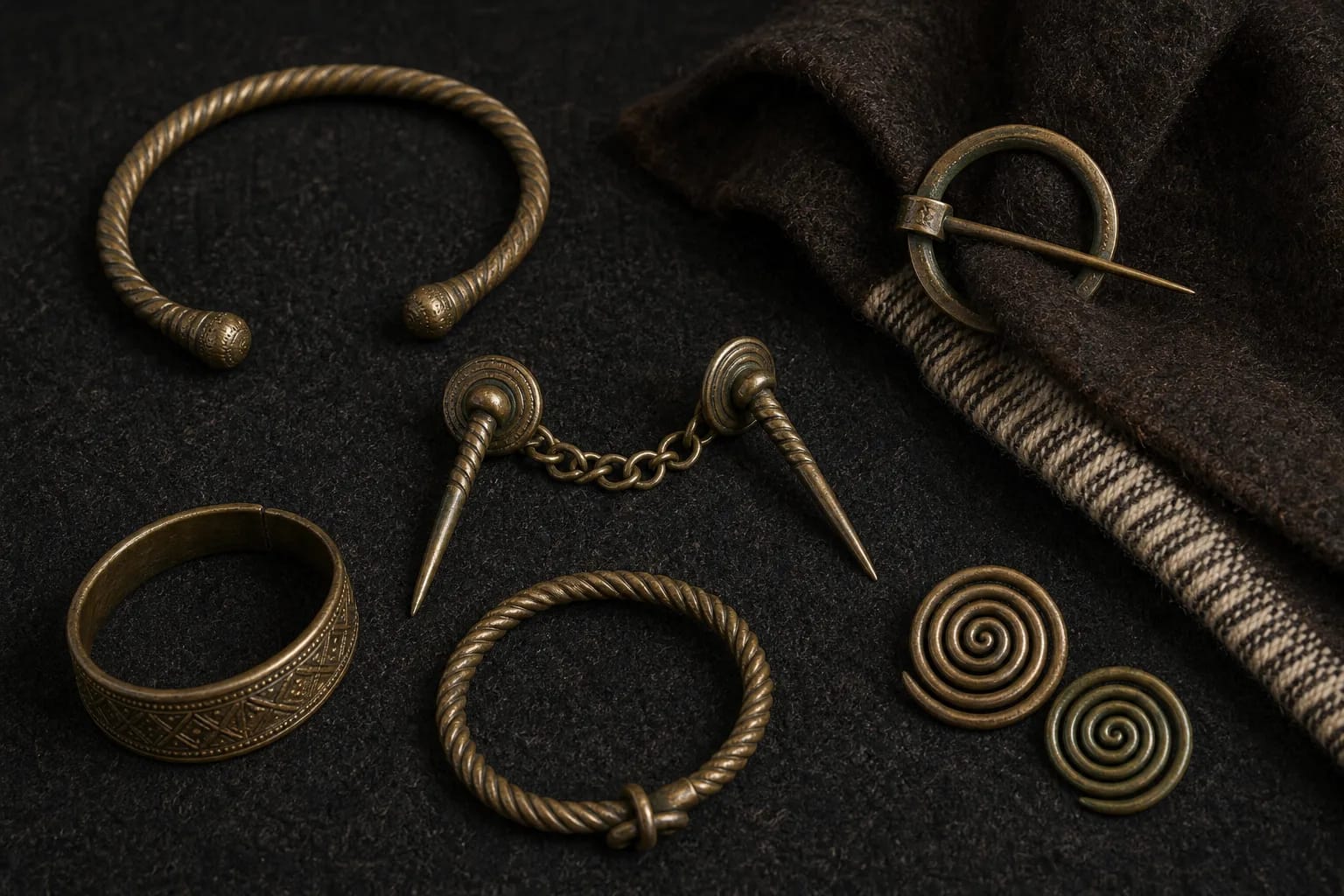
Bracelets may be banded, spiral, massive, triangular-ended, or decorated with stamped or incised ornament. They show beauty and also the amount of metal owned, making them possible signs of wealth.
Rings are often spiral or have a widened front. Spiral rings reveal the decorative power of a simple metal strip or coil.
Temple ornaments, headbands, pendants, and other head or hair ornaments show how metal shaped the whole body image. Baltic ornaments are not just items in a jewelry box; they relate to garment, hairstyle, age, and ritual.
Techniques: Casting, Forging, Twisting, and Ornament
Metal ornaments could be cast, forged, bent, twisted, cut, drilled, riveted, engraved, punched, tinned, or silvered. Each technique leaves its own trace on surface and form.
Casting suits complex forms and heavier objects. Forging thins, widens, and shapes metal. Twisting and wire work create neck rings, chains, coils, and rings. Punching and engraving add ornament.
Modern reconstructions may use modern tools, but a good maker tries to understand historical technology. Otherwise a piece may look “Baltic style” while losing archaeological logic.
Regions and Tribes
Baltic ornaments differ by period, region, and archaeological culture. Curonians, Samogitians, Semigallians, Selonians, Latgalians, and other Baltic groups had distinctive forms, but over-specific claims need concrete finds or research.
Western Lithuanian and Curonian cemeteries are known for rich ornament complexes. Other regions differ in types, quantity, and combinations, helping archaeologists discuss local traditions and contacts.
A strong regional presentation rests on a findspot, museum, or study. Form alone does not always prove that an object belonged only to one tribe, because forms spread through exchange, marriage, makers, and fashion.
Symbolism and Amuletic Meaning
Ornaments could show social rank, wealth, gender, age, marital status, and local belonging. They may also have had protective or amuletic meaning, especially when worn at the neck, chest, hands, or head.
Spirals, circles, dots, lines, plant or animal motifs appear in ornament, but they should not be translated automatically into one fixed symbol dictionary. An archaeological object speaks through form, grave position, wearing method, and the whole find complex.
Careful writing can say that an ornament may have protected, marked status, or belonged to worldview, but should not present every incised sign as a precisely known ancient symbol.
Original, Reconstruction, and Modern Ornament
An archaeological original is a museum find, often from a burial or settlement context. A reconstruction should identify the find, period, region, and how closely it repeats form, material, and technique.
A modern Baltic-style ornament can be an author’s interpretation. That is not a problem if presented honestly. The problem begins when a new fantasy piece is sold as an exact ancient reconstruction.
When buying or wearing one, ask which find it follows, what metal it uses, whether it is a copy or interpretation, and whether the maker names the source. This improves both heritage practice and modern jewelry quality.
Where to See Baltic Metal Ornaments
Important originals are preserved in the Lithuanian National Museum, regional museums, archaeological exhibitions, and displays focused on hillforts and Baltic culture. Museums allow the viewer to see not only one ornament but whole find complexes.
Education about Baltic ornaments is useful because it shows how a brooch actually fastened cloth, how chains joined pins, and how metal worked with textile. Without clothing, an ornament remains only a beautiful object.
Modern reconstructions can be seen among folk artists, jewelers, historical-costume groups, and Baltic culture events. The best work clearly marks where archaeology ends and authorial creation begins.