- Field
- Lithuanian coastal amber catching, nets, storms, and reading seaweed deposits
- Type
- traditional craft
- Heritage status
- living tradition
- Context
- Amber catching, amber collecting, Lithuanian coast, Palanga, Karklė, Giruliai, Melnragė, scoop net, keselis, seaweed, storm, currents, succinite, inclusion, Palanga Amber Museum
Amber collecting, Amber catching, Amber catchers' tradition, Baltic amber collecting
Amber Catching on the Coast forms and objects
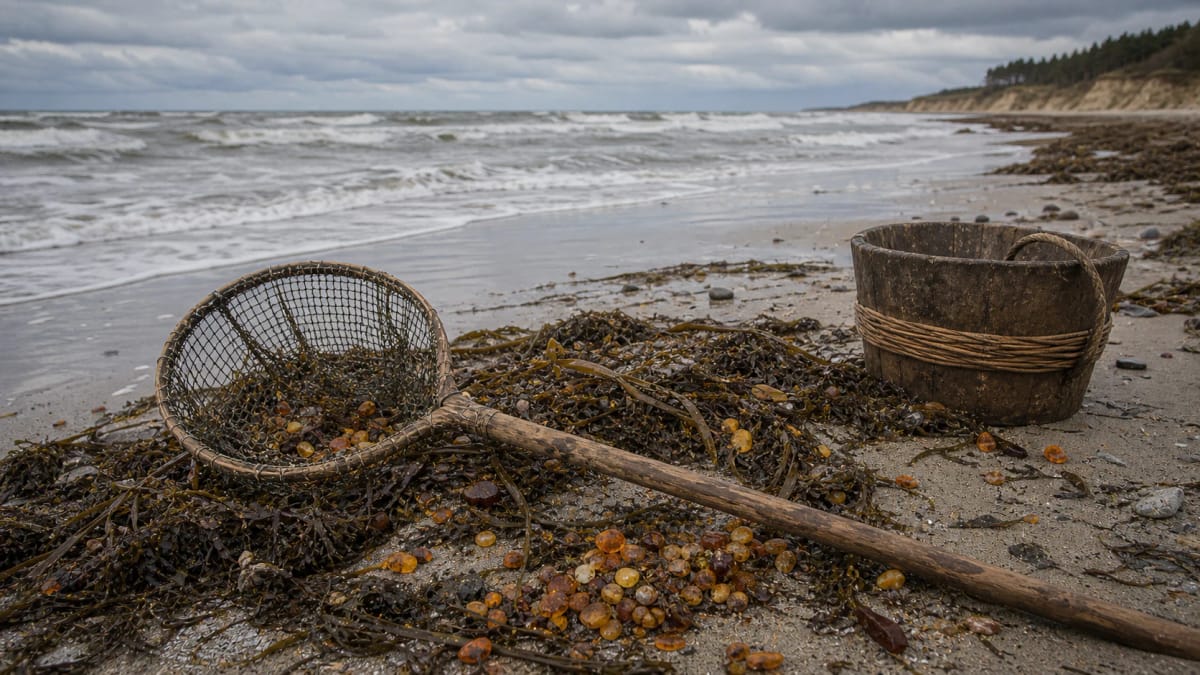
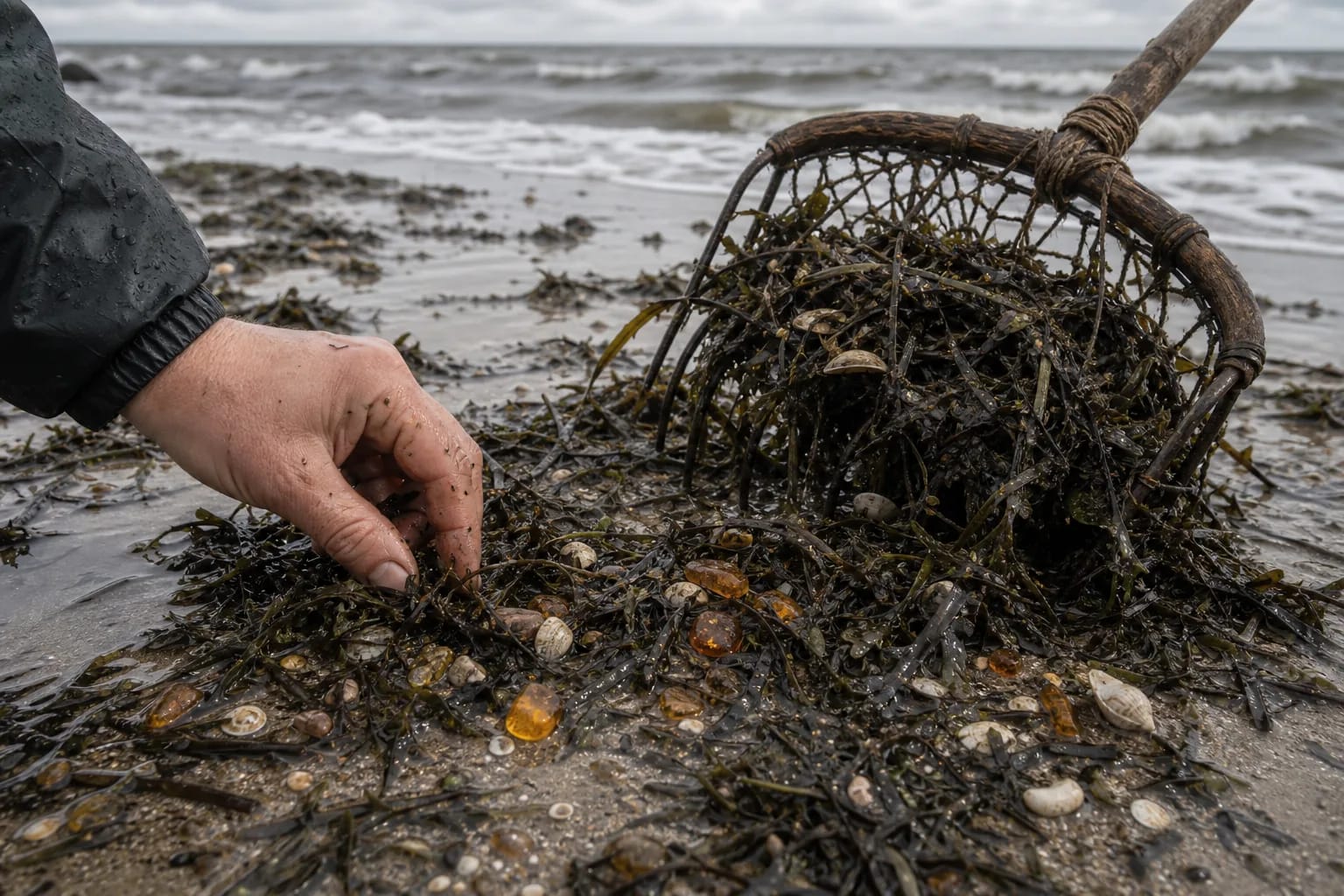
Scoop net or keselis: A long-handled net tool used to catch amber pieces from waves, seaweed, and storm deposits.
Coastal amber deposits: Bands of seaweed, twigs, shells, wood, and small amber pieces thrown up by the sea after storms.
Natural amber pieces: Unpolished Baltic amber whose size can vary greatly, though large finds are rare.
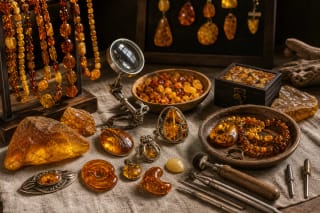
Museum and educational amber: Collections at the Palanga Amber Museum and other institutions that help explain amber's origin, inclusions, and object history.
What is amber catching?
Amber catching on the coast is the practice of searching for and catching Baltic amber thrown up by the sea, often with a scoop net or keselis. It is done not at any time, but when wind, waves, currents, and seaweed deposits create suitable conditions.
This tradition differs from making amber jewelry. The catcher first works with the sea: observing weather, water color, current, seaweed bands, sand, and storm deposits.
The Lithuanian National Culture Centre inventory entry shows that this is a living coastal tradition where knowledge of the shore matters as much as the value of the material found.
When does the sea throw amber ashore?
Amber is most often looked for after storms, stronger winds, or heavy surf, when the sea stirs seabed and coastal deposits. Yet a storm alone does not guarantee finds.
Experienced catchers watch wind direction, currents, returning waves, and accumulations of seaweed and wood. Amber often travels with lighter marine debris, plant remains, and foam.
The core of the tradition is therefore not waiting for luck but reading the coast.
Scoop net, keselis, and deposits
A scoop net or keselis is a long handle with a netted scoop. It is used to catch deposits in waves, lift seaweed, or filter smaller material.
The tool must be light enough to handle in water but strong enough to resist waves and seaweed. The mesh must hold amber pieces while letting water and sand pass through.
Amber is not sought only as shiny little stones. It may hide in seaweed, among twigs, in foam, or in wet sand.
What is Baltic amber?
Baltic amber, or succinite, is fossilized resin. It is not a mineral in the usual sense and not an ordinary stone. Its origin, colors, transparency, and inclusions make it a distinctive symbol of the Lithuanian coast.
Natural amber may be yellow, brownish, reddish, white, transparent, or cloudy. It can be small, rounded, unpolished, and surface-worn. Polished beads are not the same as a freshly found piece on the shore.
VLE states that about 600 kg of sea-thrown amber is collected annually on the Lithuanian coast, while industrial extraction occurred in the late nineteenth century in the Curonian Lagoon near Juodkrantė. The Palanga Amber Museum helps explain amber's scientific, historical, and artistic value, including inclusions and worked objects.
Where is amber caught?
Amber catching is linked with Lithuania's Baltic coast: Palanga, Karklė, Giruliai, Melnragė, Šventoji, and other shore areas. Specific places depend on conditions and local rules.
Protected areas, dunes, coastal regulations, and nature protection must be respected. Amber seeking must not become dune damage, digging, or littering.
The coast is not only a place of finds but a sensitive ecosystem. The tradition has to survive together with respect for the shore.
How to recognize amber
Experienced people recognize amber by color, lightness, warmer touch, surface, and behavior in water. But the modern coast contains plastic, glass, and other misleading materials.
Amber should not be identified by one feature alone. Large, very regular, or suspiciously bright pieces should be treated especially carefully.
Museums and educational programs help teach the differences safely, without dangerous burning or chemical tests.
History and regulation
Amber on the Lithuanian coast had economic, cultural, and political meaning. At different times collecting and trade were regulated, and amber's value encouraged both crafts and control.
Today it is important to distinguish legal coastal collecting from digging, damaging protected areas, or industrial extraction. Traditional catching is not mining.
A heritage page should not encourage risky behavior during storms or unlawful collecting. The sea can be dangerous, and the coast has its rules.
From raw material to object
Found amber can be left natural, kept as a find, given to a master, or later worked. But the amber catcher and amber jeweler are different roles.
Amber objects, such as beads, brooches, amulets, small sculptures, and inclusion specimens, belong to the field of working and folk art. Amber catching is knowledge of raw material, sea, and shore.
This distinction helps place the topics correctly: the coast gives the material, the master turns it into an object.