- Category
- Community cultures
- Sources
- Published museum, community and research sources
People tell their own histories
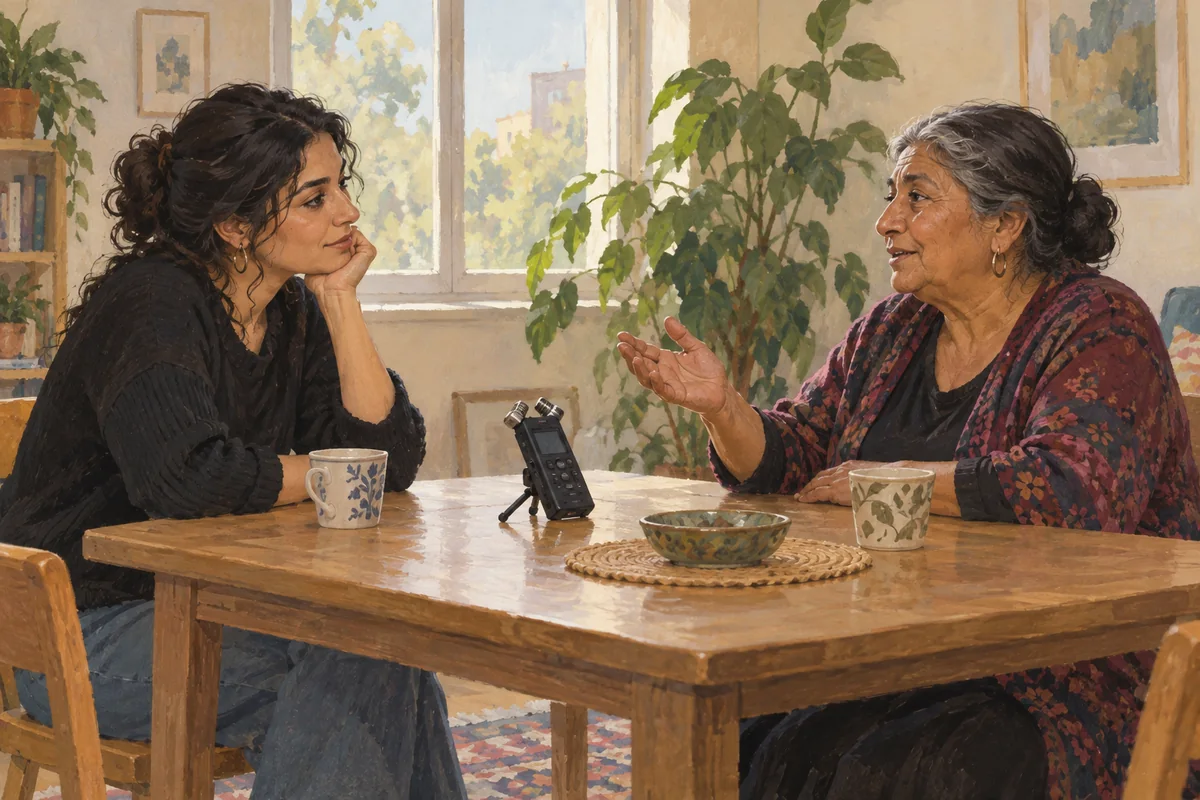
Oral history begins with a person describing a lived experience. Listening to Lithuanian Roma memories introduces particular people, places and relationships. One voice does not summarize an entire community; its individuality is precisely what gives the testimony value.
The Roma Platform presents an archive assembled in 2022 containing eleven accounts, addressing wartime, Soviet-period and everyday experiences. That number describes the collection, not an unchanging total of all Lithuanian Roma histories available today.
Language and translation
The organizers explain that accounts were recorded in the narrators' native language and translated into Lithuanian and English. Young Roma also participated in the work with older interviewees. The archive thus documents both an encounter between generations and the preservation of linguistic experience.
Listen to a selected passage before reading its translation. Note place names, personal names, unfamiliar words and references to time. Translation clarifies content, while pauses, laughter and intonation belong to the interview situation; they should not be used alone to infer a person's emotions.
Recollection and the date of an event
A narrator may move between childhood experience, a parent's story and an interpretation developed later. Keep these layers distinct. Asking whether the person witnessed an event clarifies the nature of the evidence without devaluing inherited family memory.
For a timeline, mark each date as explicitly stated, approximate or established from another source. If a memory differs from a document, first check place and circumstances. A discrepancy may create a further question rather than justify dismissing the whole account.
Wartime experiences and everyday life
The archive presentation gives particular attention to the Second World War. Listening requires recognizing persecution and the genocide of Roma without reducing a person's whole life to trauma. Work, home, faith and relationships also belong within historical understanding.
In a study group, choose one defined question: how does a narrator describe home, who passes knowledge to them, or which places prompt memories? Ask about the selected testimony rather than a supposedly universal Roma character. Support an answer with a precise passage.
Archives can continue to grow
The Roma Community Centre announced three new living-history accounts in 2024. This is a reason to check collection dates and project names. Totals from separate initiatives should not be added without establishing whether some accounts overlap.
The Roma Platform library includes language, song and folktale materials alongside historical publications. These offer different routes into learning. A folktale is not autobiography, and a historical study is not identical to personal recollection; approach each genre according to its purpose.
A listening record
After an account, note its title, narrator, recording or publication date, source link and one question to investigate further. When quoting, identify the timestamp or page and retain enough context to make the speaker's meaning understandable.
This guide creates no new interviews and does not republish the archive. Listen through the organizers' websites. Public listening access does not automatically permit extracting a voice for advertising, reusing images or speaking on the narrator's behalf.