- Place
- Mažeikiai District Municipality
- Region
- Samogitia
- Type
- Eighteenth-century wooden folk-architecture church
- Address
- Vytauto g. 48, Seda, Mažeikiai District
- Coordinates
- 56.16870, 22.08180
Sedos Šv. Jono Nepomuko bažnyčia, Seda small church, students' church
Seda St John Nepomuk Church: the wooden small church
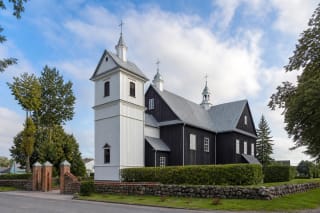
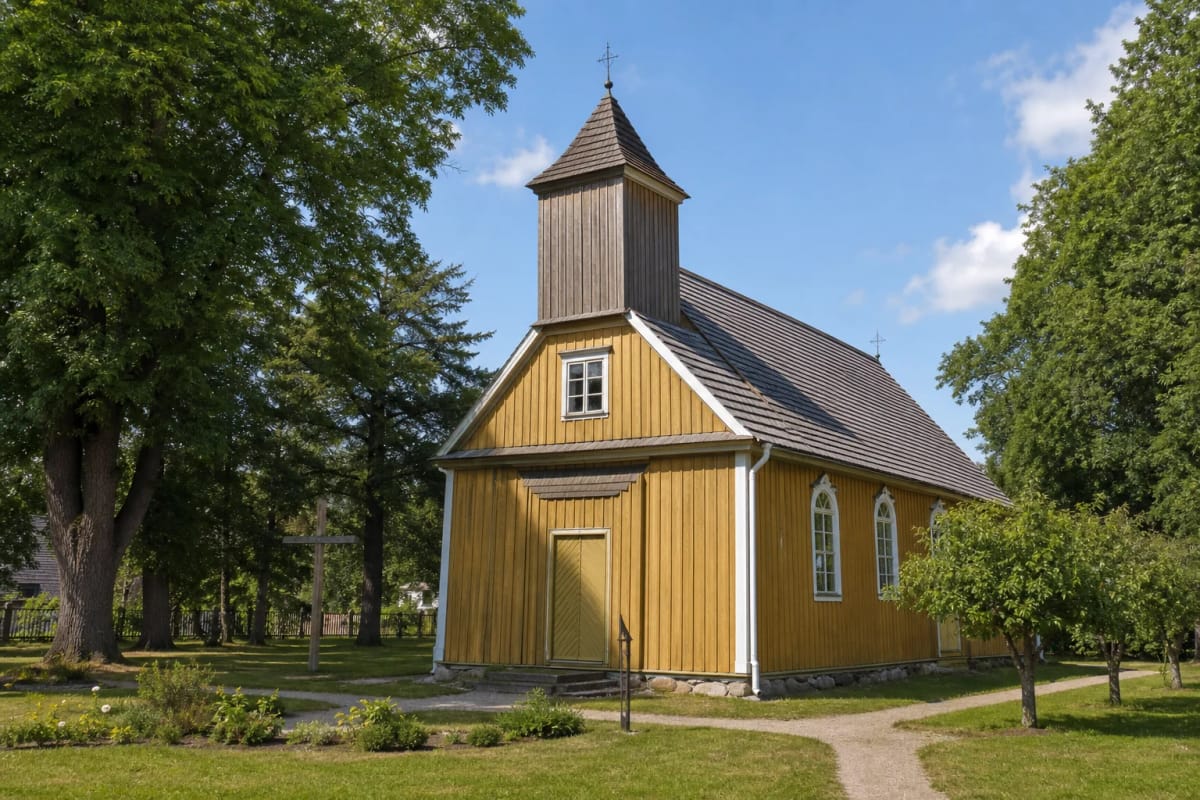
Seda St John Nepomuk Church is a small eighteenth-century wooden church in a bend of the Varduva River, in the western part of Seda. Locals call it the small church, distinguishing it from the famous great church of Seda standing only a few hundred metres away.
It is a modest but authentic example of Samogitian wooden folk sacred architecture. The two Seda churches should not be confused: claims such as largest or most ornate belong to the great church, while this one is its more intimate, smaller neighbour.
A landowner's votive chapel
The church has an unusual origin. In 1781 Seda landowner Benediktas Jonas Nepomukas Adomavičius and his wife built a wooden chapel and dedicated it to his name saint, St John Nepomuk. Some sources identify the founder as a field hetman of the army of the Grand Duchy of Lithuania.
In 1783 the chapel was rebuilt as a church: it was raised, widened, and given a small tower and sacristy. In 1793 it was consecrated by Tadas Juozapas Bukata, suffragan bishop of the Samogitian Diocese. A private votive chapel thus became one of Seda's churches.
Wooden folk architecture
The building is a small, single-nave hall church of log construction, with one small tower above the roof, an apse, and a sacristy. It is a typical eighteenth-century example of Samogitian wooden sacred architecture.
Science supports the construction date: dendrochronological analysis in 2021 found that the timber was felled in 1781-1782, matching the documented building history. The church is listed in the Register of Cultural Property.
Later history
In the nineteenth century, Latin-language courses were held at the church, giving it the nickname students' church. In 1899-1900 it was rebuilt using funds from one altarista priest; during the work, part of the raised walls and roof collapsed, so the church was rebuilt from the remaining sound timber.
During the Soviet period the church was turned into a warehouse and mill. It was returned to believers in 1988 and reconsecrated in 1989. Today it is a branch church with limited regular access.
Visiting
This is a filial church rather than a daily-open site, so it is usually closed and opened during events or by prior arrangement with the parish. The most convenient opportunity to enter is the Nepomukas Music Festival organised by the Seda Cultural Centre.
The exterior and the setting in the Varduva bend can be viewed at any time. It is worth combining the visit with the famous great Seda Church and other town and Mažeikiai-region sites.