- Place
- Žideikoniai area, Prienai District Municipality
- Region
- Nemunas Loops Regional Park
- Type
- conglomerate exposure
- Coordinates
- 54.61200, 24.07000
Ožkų pečius
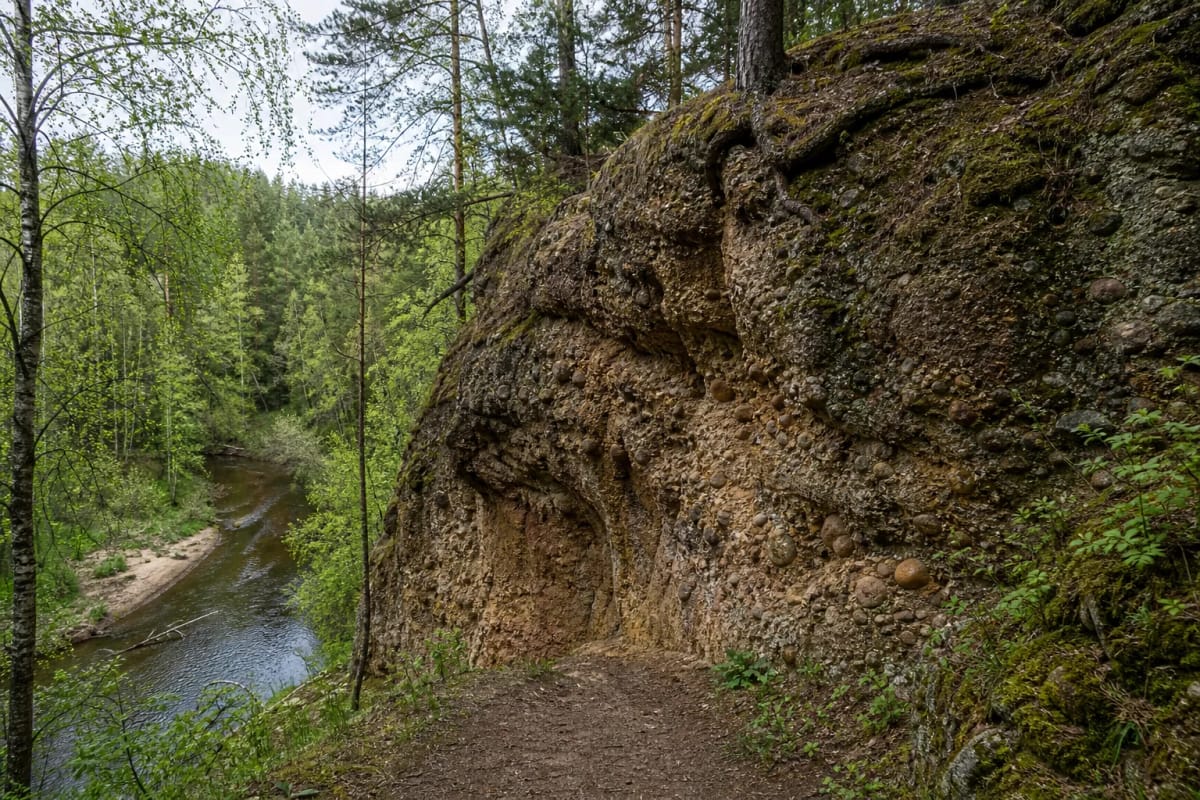
Conglomerate rock on the Verknė slope
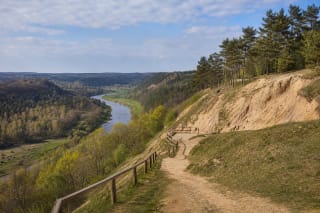
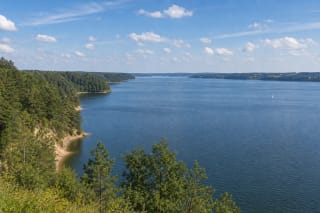
Ožkų Pečius is a geological natural heritage object and natural monument in the Verknė Landscape Reserve of Nemunas Loops Regional Park. VLE locates it in Prienai District, Jiezno eldership, about 0.3 km south of Žideikoniai, on the right slope of the Verknė near its confluence with the Nemunas.
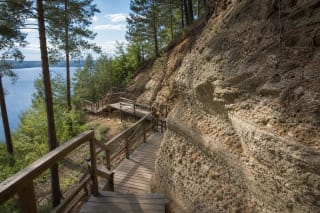
For visitors, this is not a conveniently built viewpoint but a specific geological formation in a steep valley slope. Plan to observe it safely from permitted places or from a water route, not to climb to the rock.
Dimensions and rock structure
VLE states that the conglomerate rock stands in an erosional bluff about 34 m high. The visible part of the rock is 6.12 m high, 4.9 m wide, and projects about 5.6 m from the slope.
The conglomerate formed when carbonate-rich groundwater cemented sand, gravel, pebbles, and boulders into a hard mass. As weaker moraine deposits eroded, the more resistant fragment remained protruding from the slope.
Erosion and constant change
Ožkų Pečius is not an unchanging stone block. Its visible part grows as erosion reveals new segments and shrinks when blocks break off and roll down. An erosion hollow forms at the foot.
Physical weathering, erosion, and visitor climbing damage the rock surface. Porous hollows, cracks, and niches look attractive from a distance, but they also show that the object is fragile.
Name stories
Local stories link the name with roe deer, called goats locally, said to have liked warming themselves by the sun-heated bluff. Another story mentions timber rafters bathing newcomers who were floating rafts for the first time near the rock.
These stories add a cultural layer, but the main value of Ožkų Pečius is geological: it is a rare and clear example of a conglomerate remnant in the Verknė valley.
How to visit safely
The best way to see Ožkų Pečius is while paddling the Verknė or from a safe, permitted observation place. Direct access to the bluff may be difficult, and climbing on the rock or at its foot is not recommended.
Do not damage the rock, climb for a photograph, or walk on steep slopes. This object is valuable when allowed to change naturally, not when turned into an improvised climbing site.