- Place
- Lenkimai, Skuodas District Municipality
- Region
- Samogitia
- Type
- masonry folk-architecture church with a bell tower and registered building complex
- Address
- S. Daukanto g. 65, Lenkimai, Skuodas District
- Coordinates
- 56.18830, 21.31600
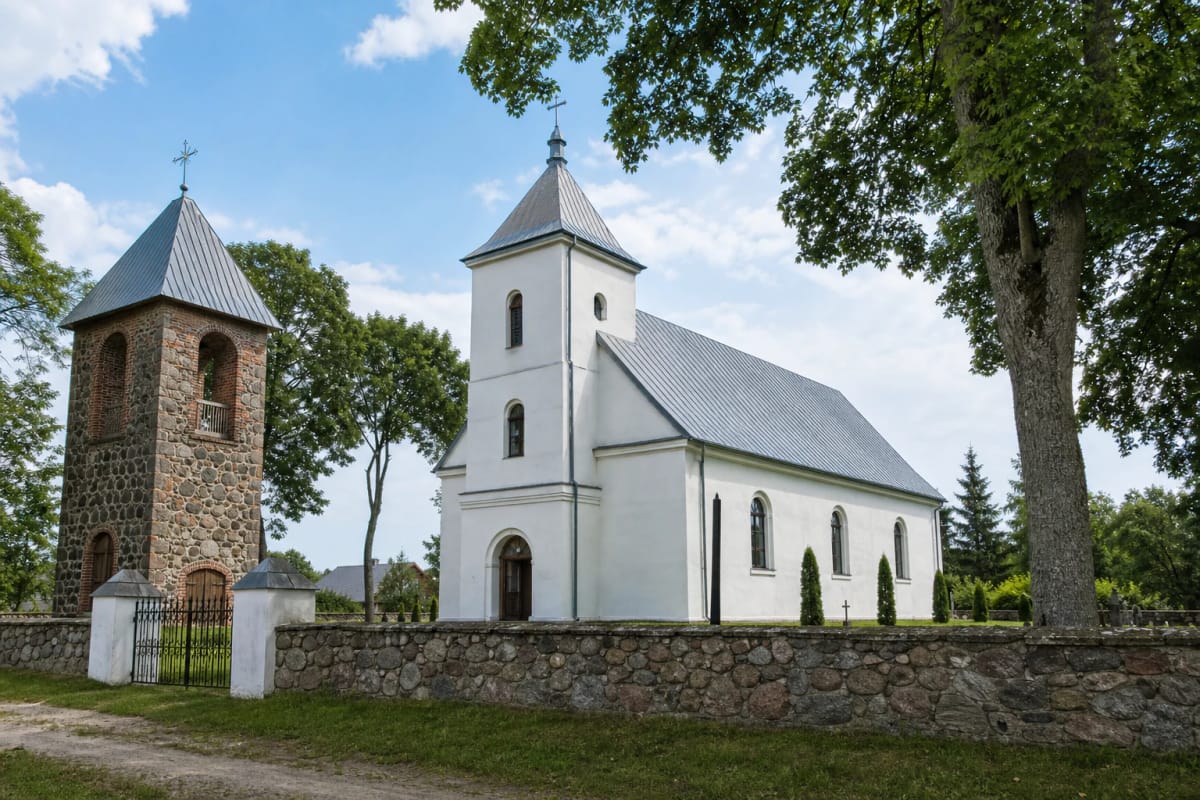
St Anne's Church in Lenkimai building complex
St Anne's Church in Lenkimai
St Anne's Church in Lenkimai stands in Lenkimai town, north-western Samogitia, Skuodas District, near the Latvian border. It is a masonry folk-architecture sanctuary whose forms show Gothic and Classicist features. Together with its bell tower and churchyard fence, it forms a state-protected building complex.
The place matters not only as sacred heritage but also as a memory site: the Lenkimai parish is closely linked with the biography of historian Simonas Daukantas.
Construction history
The first wooden church in Lenkimai was built in 1680. The masonry church, according to parish and municipal sources, was built in 1780-1816; in 1848 it was rebuilt and enlarged with a porch and tower. Bishop Aleksandras Beresnevičius consecrated it in 1881.
The dates need care because sources differ slightly: the encyclopedia dates the present church to 1848, while the parish treats 1848 as a reconstruction. The most precise wording is therefore to speak of construction in 1780-1816 and reconstruction in 1848.
The building complex
Lenkimai Church is not a single building but a registered building complex. It consists of the church itself, a stone-and-brick masonry bell tower in the churchyard, and a fieldstone churchyard fence with gates. The whole complex was entered in the Register of Cultural Values in 2004 as regional-significance heritage.
The church is built of brick, plastered, and whitewashed. The presbytery and organ loft are covered with vaults, while the rest of the space has a wooden ceiling supported by eight masonry columns. Inside are four altars and old organs.
The Simonas Daukantas trace
The church is closely connected with historian and educator Simonas Daukantas. Daukantas was born nearby in Kalviai village and was baptized in Lenkimai parish in 1793. Lenkimai is therefore his baptism place, while the birthplace is a separate site.
There is more to the link: Daukantas' mother Kotryna was buried in the churchyard cemetery in 1847, and support for the church is attributed to the historian, including the furnishing of the high altar and donated paintings. A monument to Simonas Daukantas was unveiled in Lenkimai square in 1993.
How to visit Lenkimai Church
The church combines well with a Skuodas-region route and Simonas Daukantas memory sites. Usually 30-45 minutes is enough to see the church, bell tower, and churchyard; it is worth looking for the grave of Daukantas' mother.
It is an active parish church, so entry is generally free and visits are best aligned with service times. During research, the exact Mass and visiting schedule was recommended to be checked through the official Telšiai Diocese or parish page.