

- Genre
- Stone legend
- Source status
- mythological local tradition
- Motifs
- footprint in stone, devil, Mary, healing water, altar
Great Vištytis Stone, Wondrous Stone, Footprinted Stone
The Legend of Vištytis Stone
Near Vištytis stands a stone whose upper surface has a hollow called a footprint. Some said the devil stepped there, angered at the town or intending to hurl the stone at a church. Others understood the same mark as the footprint of the Blessed Virgin Mary.
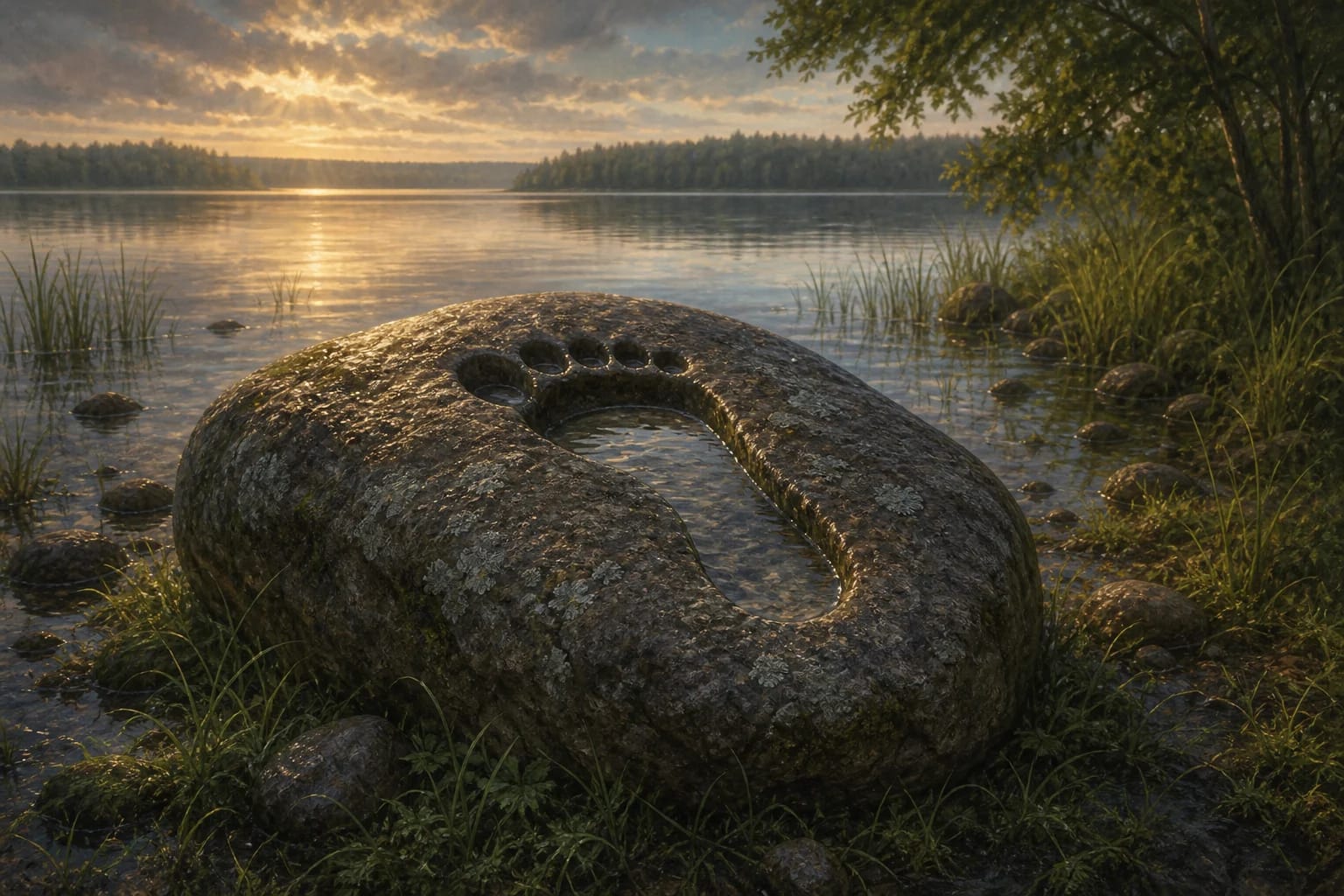
Rainwater that gathered in the hollow seemed special to people. They washed with it, preserved it, and came to the stone asking for health or grace. In older stories the stone is also remembered as an altar on which sacred fire once burned.
The legend joins several memories: pagan fire, Christian procession, the sign left by the devil, and healing water. Because of that, Vištytis Stone seems not only large but multilayered.
Interpretation of the Vištytis Stone Legend
A footprint in stone is one of the strongest signs of mythological landscape. It suggests that a supernatural being not only appeared but physically left a trace.
At Vištytis, the same sign has different meanings. If it is the devil's foot, the place speaks of danger and the defeat of an evil force. If it is Mary's foot, it becomes a sign of grace and intercession.
The healing-water motif helps explain why people came to the stone not only to look. They performed an action here: drew water, washed, prayed, and remembered.
History of the Vištytis Stone Legend
VLE and protected-territory sources describe Vištytis Stone as one of Lithuania's largest boulders, with a hollow called Devil's Foot and with traditions of healing water and an altar of the old faith.
It is mentioned that in the eighteenth century the stone was called the Stone of the Most Holy Trinity, and that around the nineteenth century believers' processions took place there. This shows how older reverence for the place was rewritten in Christian language.
The legend of Vištytis Stone is therefore not one simple plot. It is a place where footprint, fire, water, and procession motifs live together.
Vištytis Stone is one of Lithuania's largest boulders; the hollow on top, called Devil's Foot, belongs to the sacred-place tradition of footprinted and bowl stones. Lithuanian place legends are collected in Žemės atmintis: Lietuvių liaudies padavimai (1999) and classified in Bronislava Kerbelytė's catalogue, vol. 3 (2002).