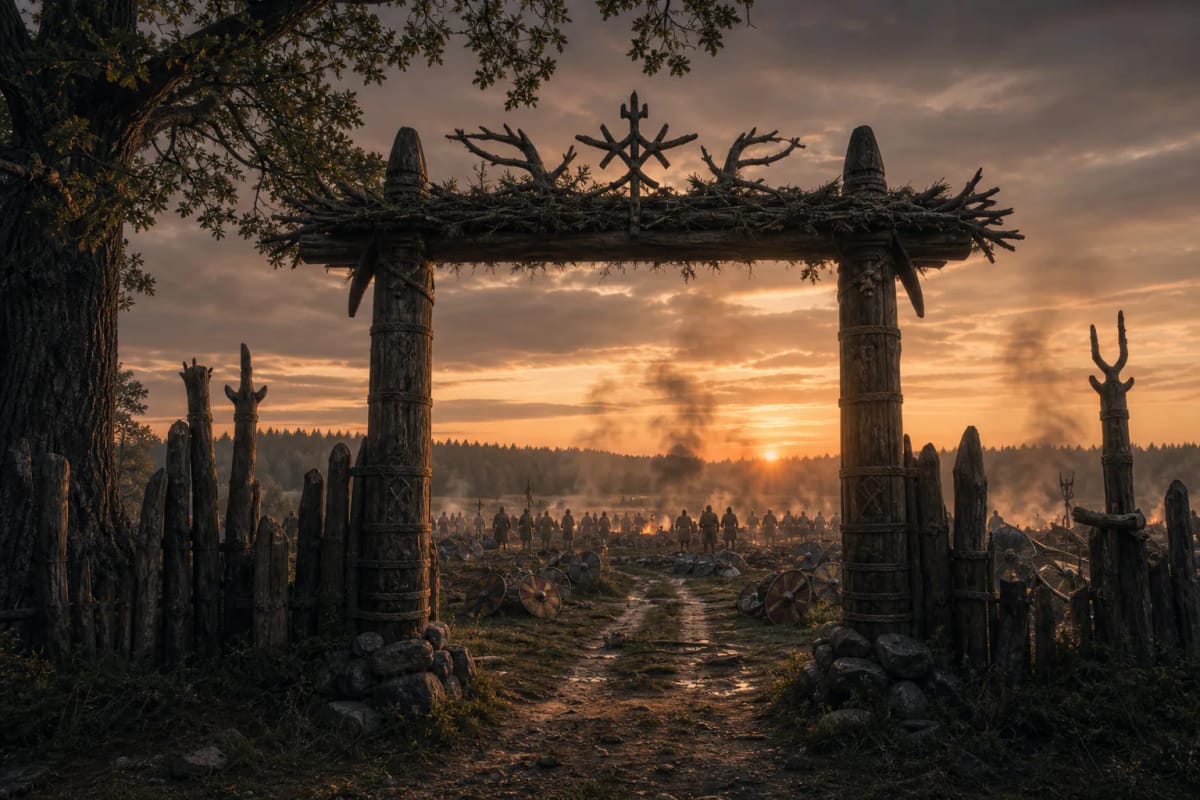
- Genre
- Literary historical legend
- Source status
- literary tradition
- Motifs
- sacred gates, temple of Milda, Voruta, Fricas Darbutas, Sword-Brothers, historical legend
Legend of Šventavartė, Šventavartė in Vienuolis' legends
The legend
Šventavartė is an Antanas Vienuolis legend set in 1236, in the time of Mindaugas. In it, the Livonian Sword-Brothers' master Volkwin breaks a truce with Mindaugas and gathers European nobles and knights to take and destroy Voruta.
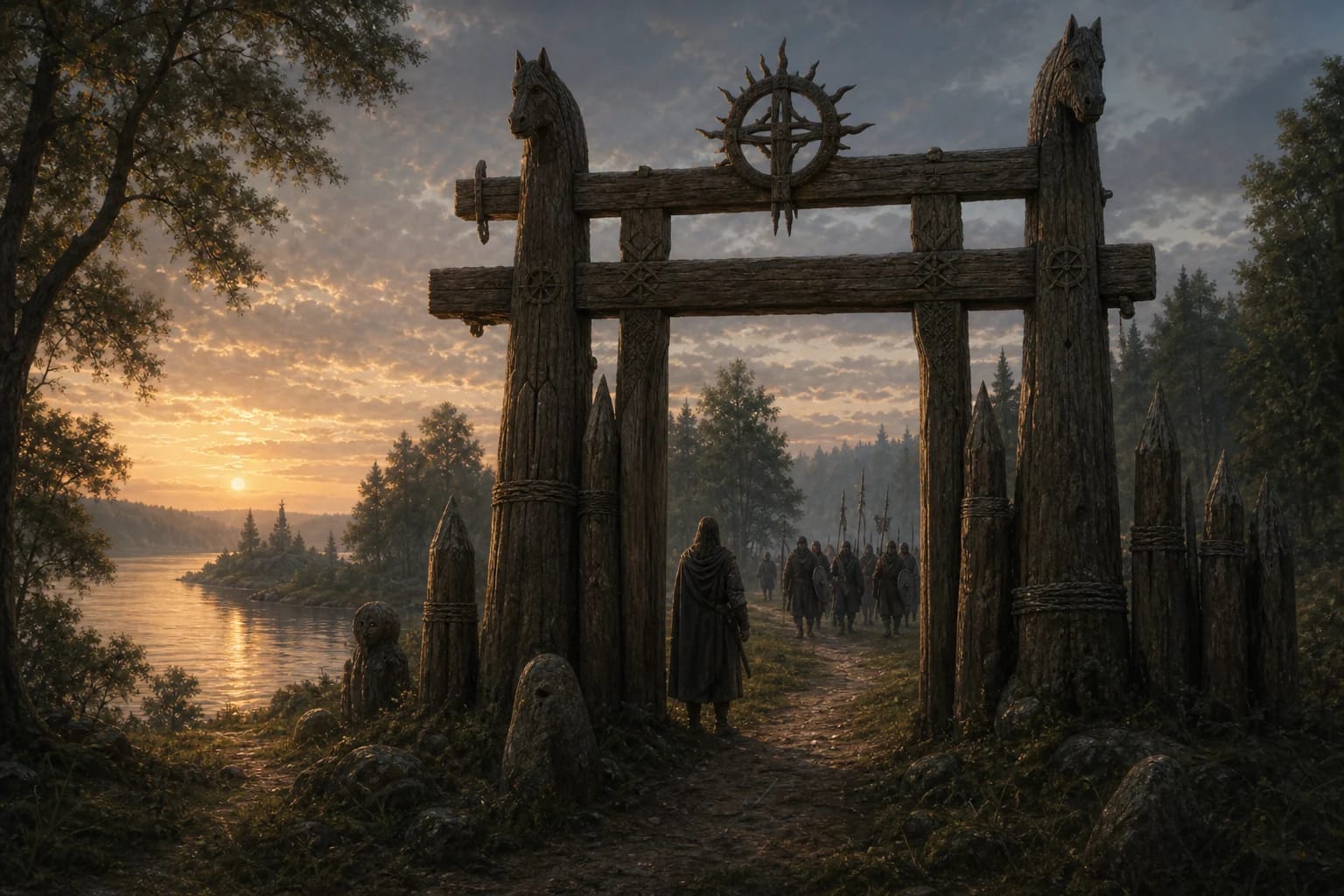
The army rests by Lake Rubikiai. On one island stands a temple of the goddess Milda, entered only through special sacred gates and guarded day and night by priestesses and a krivis. These sacred gates give the legend its title, Šventavartė.
Among the campaigners is a Lithuanian hostage, Fricas Darbutas, born Algis Darbautas, baptized and raised by the Sword-Brothers. When the soldiers attack the island and burn the temple, he recognizes his own family and childhood land.
In this way Vienuolis' narrative turns the sacred gates into a fateful boundary: through them a person passes not into everyday life but into a confrontation with their own origin, faith, and a duel of vengeance and conscience.
Interpretation: what does Šventavartė mean?
In folklore and symbolism, gates often mean passage. In Šventavartė the passage is intensified by the word sacred. These are not neutral gates but a boundary where action gains larger meaning.
If we read the story against the memory of battle, the gates become a threshold into sacrifice or historical fate. Through them one passes from private life into the community's history.
The legend also shows how Vienuolis created legend texts: he did not merely record place tales but shaped historical and local images literarily.
It is important not to present Šventavartė as a widely attested folk plot. Its strength is literary: a concentrated image, a solemn mood, and a sense of the boundary of history.
History and source status
Šventavartė is an Antanas Vienuolis legend, included in his collection „Legendos. Apsakymai. Apysaka“ (Legends. Stories. A Novella). Its source status therefore differs from, for example, the chronicle tradition of Gediminas' dream or the popular literary tradition of Jūratė: this is clearly authored literature, not a widely attested folk plot.
Vienuolis often drew on the material of place legends, legends, and local memory, but his texts are authorial creations. He builds the narrative by freely weaving together historical names and an invented plot, so any retelling of the page must be original and clearly state its literary basis.
The historical background and the literary plot in Šventavartė are clearly distinct. The real Battle of Saulė (Šiauliai) took place on 22 September 1236, when the Samogitians, led by Duke Vykintas, defeated the Order of the Sword-Brothers; the Order's master Volkewin (Volkevinas) was killed in it, and one of the crusader leaders was Count Heinrich von Dannenberg. Vienuolis borrows these real names and the year 1236 but moves the action to Mindaugas' capital Voruta and Lake Rubikiai with the temple of the goddess Milda — this is literary fiction that should not be read as a document of the battle or of the times of Mindaugas.
Why include this legend
Šventavartė broadens the legends section beyond the most familiar Vilnius and coastal stories. It shows that symbols, especially gates and thresholds, can be as important as named heroes.
It also connects legend with the wider symbolism of road, gate, and threshold found in songs, customs, and narrative folklore.