- Category
- Plants of Maidenhood and Weddings
- Domain
- Maidenhood, virginity, youth, weddings, rue garden, wreath, Lithuanianness
- Source status
- well attested
green rue, little rue, rue wreath, Ruta graveolens
What is rue in Lithuanian culture?
Rue is the clearest Lithuanian plant of maidenhood and one of the most important national symbols. The Visuotinė Lietuvių enciklopedija notes that rue is most fully meaningful in Lithuanian oral folk creation: songs, sutartinės, counting rhymes, tales, legends, and riddles. No other plant is sung so often in Lithuanian songs.
Rue must be understood not only as a plant but as a sign. Green rue and the rue wreath traditionally mean a girl's youth, virginity, and virtue, while their loss or replacement marks a life transition: the passage from maidenhood into a wife's lot.
Rue as a sign of maidenhood and virginity
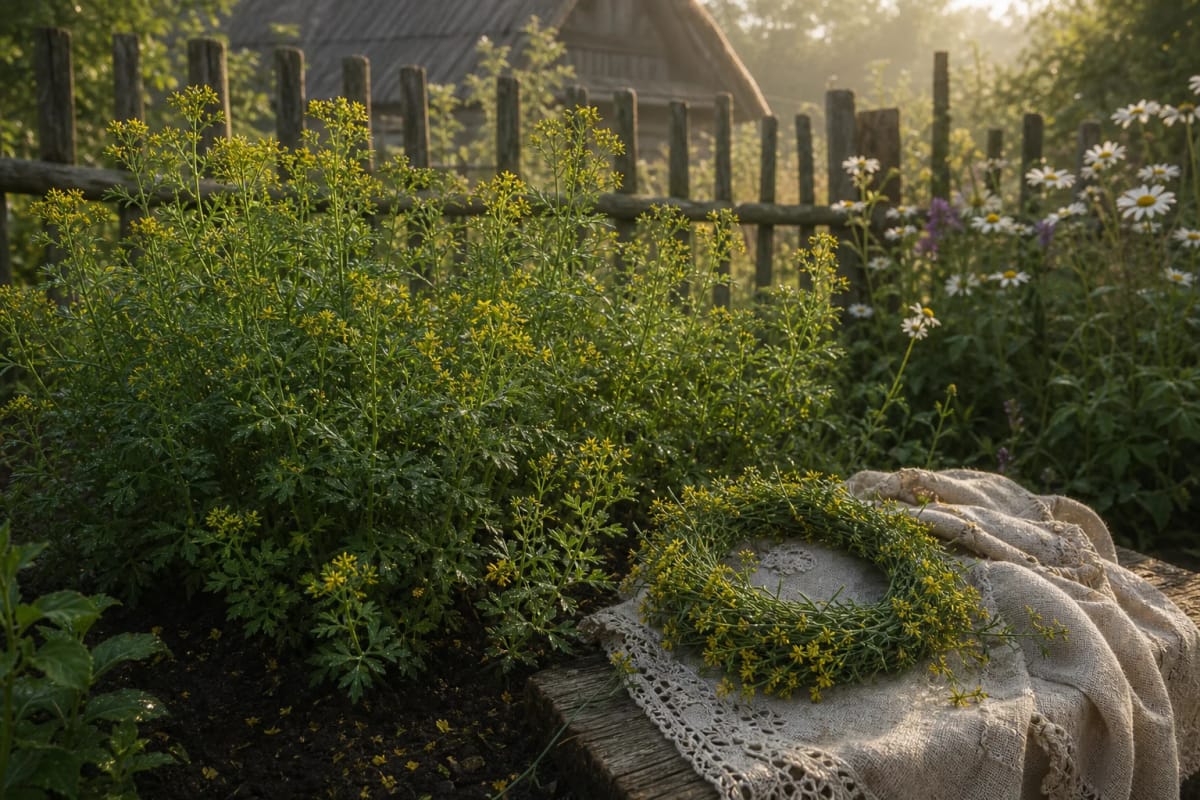
The central meaning of rue is maidenhood and virginity. Green, unwithered rue in songs becomes a sign of a girl's purity and youth, while the rue wreath is a visible sign of virginity worn by an unmarried girl.
For this reason images of loss are also attached to rue. When a song says that a girl loses her wreath, finds it moldy, or that a young man has fed her rue to horses, it speaks not about botany but about lost maidenhood. This symbolic layer makes rue one of the most sensitive signs in Lithuanian songs.
The rue garden: a girl's world
The rue garden in songs is a special space of the girl, often placed by the window, near a pine grove, or in the yard. A green rue garden marks the carefree youth of the maiden: she sows and weeds rue and urges it to grow and stay green because she herself is still too young for cares.
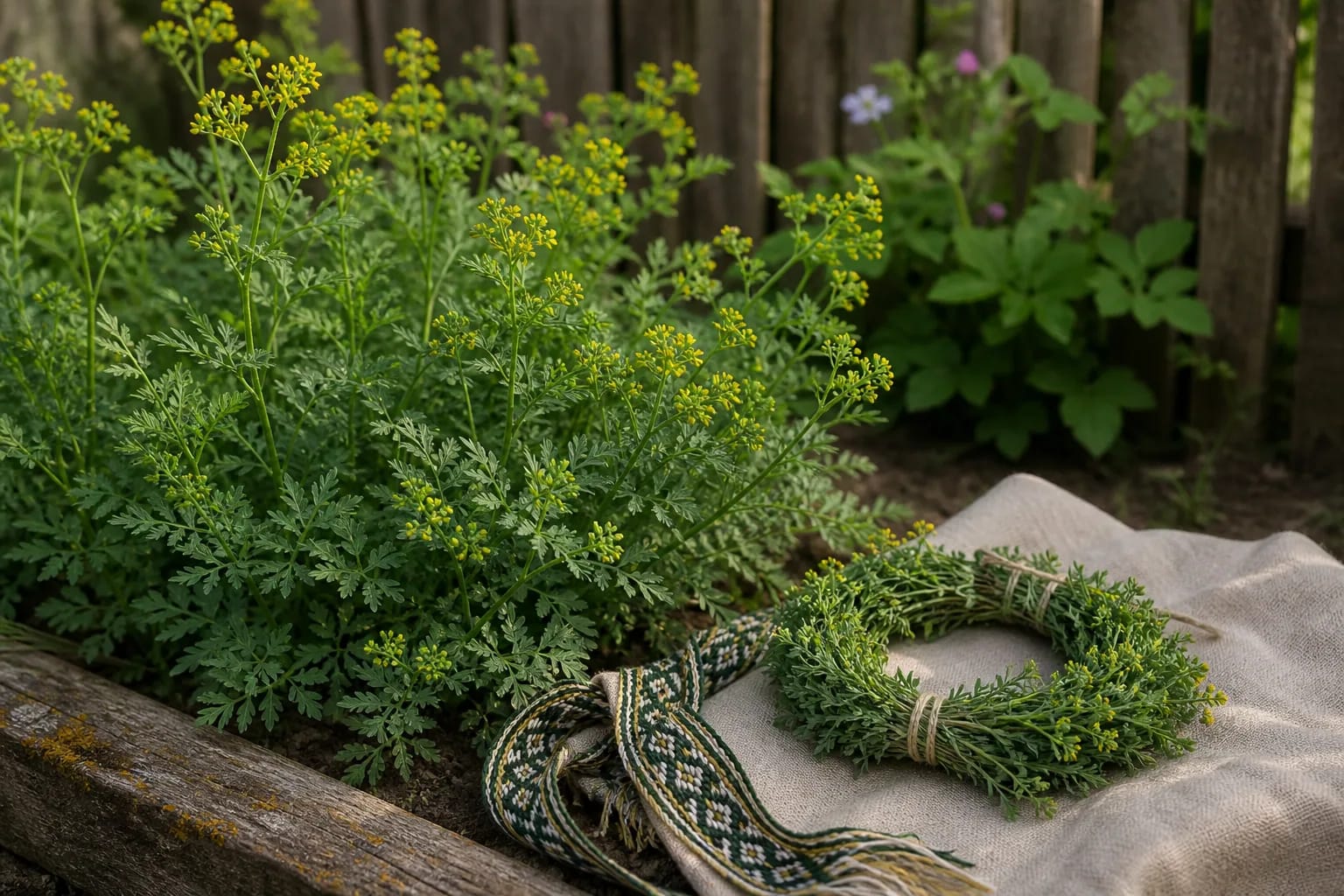
The Encyclopedia of Lithuania Minor notes that the rue garden also means the duration of maidenhood: rue will stay green and flourish until the mother sends her daughter from home. The garden also becomes a place of consolation: the girl picks rue, weeps while weaving a wreath, or walks through the garden carrying it.
The rue wreath in weddings and nuvainikavimas
Weddings are the most important setting for rue symbolism. The bride went to the church ceremony wearing a rue wreath, and one of the most meaningful ritual moments was nuvainikavimas, the removal of the rue wreath and the placing of a married woman's head covering, such as a nuometas or cap.
This transition is accompanied by song words, for example those recorded in the nineteenth century by Otto Glagau: the green braids are unfastened and the rue wreath is lifted away. In songs, a young man's wish to burn the green rue wreath also marks the end of carefree maiden days. The rue wreath is therefore not only adornment; it is a sign of maidenhood deliberately removed at marriage.
Rue in wedding customs of Lithuania Minor
Rue customs are especially richly described in Lithuania Minor. In the seventeenth century, Erhard Wagner saw weddings in the Insterburg and Ragnit districts where the chief groomsman struck the door three times with a staff wrapped in rue while asking for the bride, and bridesmaids adorned themselves with rue. Matas Pretorijus described a matchmaker arriving with a staff decorated with a rue bouquet.
The Encyclopedia of Lithuania Minor states that the bride's wagon, the palagas, was densely decorated with rue wreaths; horses were also adorned with rue, and before sitting in the wagon the bride put on rue wreaths. After the church ceremony, in the storehouse, her wreaths were removed and a nuometas bought by the groom was placed on her. A rue wreath was pinned to the groom as well, and the couple drank from a cup twined with rue.
Rue in songs and sutartinės
In songs rue is almost always accompanied by the fixed epithet green, as in the image of a green rue bush. Rue also became a refrain word woven into song choruses, for example in lines where flax is spun, rūta, by the seashore, rūta. This shows how deeply the plant entered the very language of song.
Relations between young man and maiden are often sung through images of rue and horse: the young man rides past the rue garden and breaks a rue branch, or the horse tramples the rue. Rue also enters death motifs: a young man drowns while trying to rescue a rue wreath fallen into water and asks to be buried in the rue garden. Such images show that in songs rue joins love, maidenhood, and fate.
Rue in funerals and rites of passage
Rue accompanied a person not only at weddings. The Encyclopedia of Lithuania Minor notes that a young unmarried woman who died was laid out in bridal clothing with a rue wreath, as if symbolically giving her the wedding she had not had in life. Rue thus joins the thresholds of marriage and death.
Rue also mattered in other rites of passage. At confirmation, boys pinned a sprig of rue to the lapel, while girls wove rue into their braids or placed it between the pages of a hymnbook. Rue therefore marked the most important thresholds in a young person's life.
Rue in folk art and folk medicine
Rue is also a frequent folk-art motif. VLE notes that from the sixteenth to eighteenth centuries rue branches and leaf patterns began to decorate dowry chests, furniture, textiles, clothing, Easter eggs, and women's handiwork. The sign of maidenhood moved from garden and song into everyday objects.
Rue was used in folk medicine as well: decoctions of green or dried rue were drunk for pains in the stomach, heart, kidneys, or bladder, and rue was also given to cows. One fact is often left unsaid but matters: all species of rue are poisonous, and their sap causes skin inflammation. The ritual power of rue stands beside the real danger of the plant.
Why did rue become a sign of Lithuanianness?
It is striking that rue is not native to Lithuania. It comes from the Mediterranean region and has been cultivated in Lithuanian gardens since the mid-sixteenth century. Yet over several centuries it became perhaps the clearest Lithuanian symbol of maidenhood and national identity.
This is a good example of how a plant of foreign origin can become one's own cultural sign. Rue took root not because of botany alone, but because of the meanings given to it by songs, wedding customs, and the symbolism of the girl's garden. That is why it remains the strongest Lithuanian image of maidenhood today.