- Category
- Plants of Death and Souls
- Domain
- Sleep, death, souls of the dead, Kūčios, fertility, abundance of seeds
- Source status
- folkloric
opium poppy, poppy milk, sleep herb
What does the poppy mean?
In Lithuanian tradition the poppy is a plant of sleep, quiet, death, and contact with the souls of the dead. At the same time, because of its countless tiny seeds, it also means abundance, fertility, and descendants.
This double meaning, death and life, is not accidental. The plant's own qualities point toward both themes: the power of sleep and forgetfulness, and the almost boundless abundance of seed.
The Visuotinė Lietuvių enciklopedija notes that the poppy has a special place in mythology and was already treated in antiquity as a sacred plant of the gods. The Lithuanian layer fills that broader meaning with local customs, above all Kūčios.
The poppy as a plant of sleep and quiet
The poppy's link with sleep comes from the plant itself. Parts of the opium poppy, Papaver somniferum, contain alkaloids such as morphine and codeine, with sedative and sleep-inducing properties. The Latin species name somniferum means sleep-bearing.
For that reason folk imagination connected the poppy with peace, sleep, and falling silent. This gentle, soporific quality explains why the poppy belongs not to noisy festivities but to solemn rites of concentration and remembrance.
In traditional worldview, sleep is often a relative of death: both mark a temporary or final withdrawal from the everyday world. The sleep plant therefore naturally approaches the theme of death and vėlės.
Poppy, death, and ancestral souls
The poppy's link with the dead is clearest in the remembrance of ancestral souls. In Lithuanian custom poppies are associated with calm, sleep, and ancestors, so they appear where the living symbolically meet the dead.
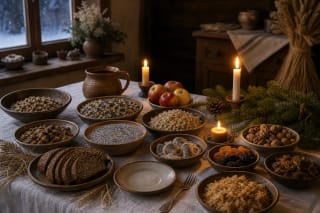
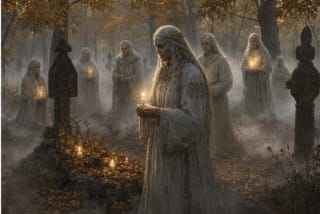
It was believed that at special moments of the year, especially on Kūčios, the souls of the dead returned to visit the home. A free place and some food were left at the table, including poppy dishes. The poppy becomes a bridge between the world of the living and the world of vėlės.
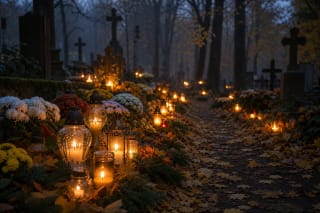
This custom connects the poppy with the wider Lithuanian honoring of the dead, most visible at Vėlinės. Here the poppy is not primarily a cemetery plant, but a sign on the household table inviting the dead to the shared supper.
Poppy milk and kūčiukai at Kūčios
The most important poppy custom is poppy milk with kūčiukai on the Kūčios table. Kūčiukai are small unleavened biscuits with poppy seeds, while poppy milk is made by crushing poppy seeds and steeping them with water and sometimes sweetener. The biscuits are soaked in this milk.
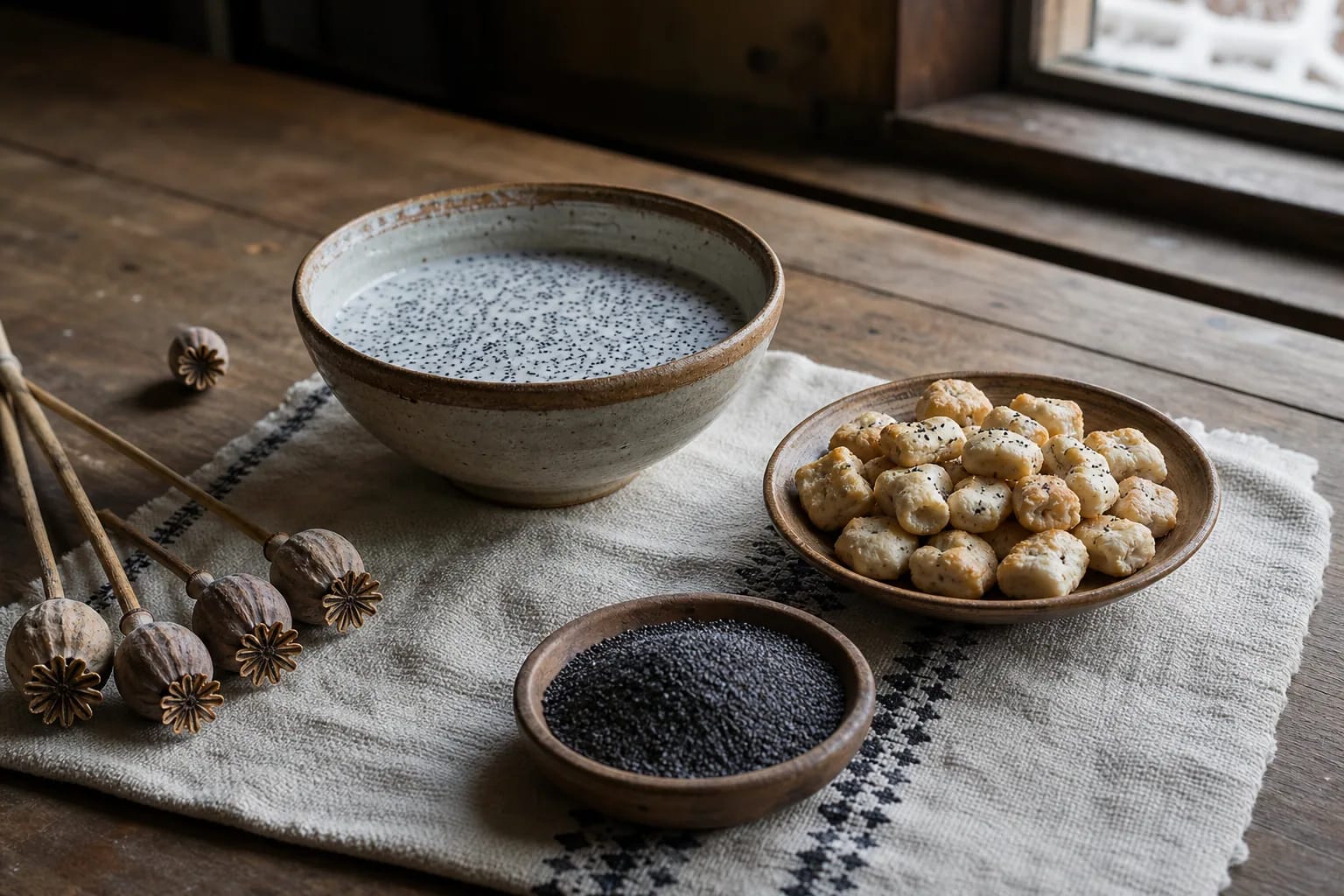
Poppy milk and kūčiukai are considered among the central signs of the Kūčios table. Among the twelve fasting dishes, poppies stand beside other plant foods such as grains, honey, mushrooms, and fish, because the Kūčios supper excludes meat and dairy.
Through this dish the poppy becomes a direct sign of the bond between living and dead: part of the Kūčios food is set aside for returning souls, so poppy milk is symbolically shared with ancestors. An everyday seed dish becomes a ritual hospitality offered to vėlės.
Poppy and fertility
The other pole of the poppy is fertility and abundance. A poppy capsule is filled with hundreds or thousands of tiny seeds. In traditional imagination, this abundance becomes a sign of descendants, harvest, and wealth.
The poppy therefore belongs near broader harvest and grain symbolism, where the seed means the continuity of life. A multitude of seeds is not only food but a promise that life will renew and multiply.
In this way the poppy joins what first seems contradictory: sleep, death, and vėlės with abundance, fertility, and new life. That joining of opposites is what makes it a rich mythological symbol.
Poppies and the devil's task
The abundance of poppy seeds also produced the motif of the impossible task. In folklore, a person trying to rid themselves of the devil or outwit him may order him to gather or count spilled poppy seeds, a task practically impossible to complete.
The logic is simple: poppy seeds are so small and numerous that no one can count them or pick them up one by one. The poppy therefore becomes a tool of human cleverness against a supernatural being.
This image belongs not to death symbolism but to protection and trickery. It should be read separately from Kūčios customs, even though both depend on the same feature of the poppy: its uncountable abundance of seed.
A foreign comparison: poppies on a grave against a restless dead person
A widespread story says that poppy seeds are scattered over a grave or the path to it so that a restless dead person, ghost, or vampire is forced to count them and cannot rise from the grave in time. This motif should be mentioned separately.
The custom primarily belongs to Slavic and some other Central and Eastern European traditions connected with the vampire-like revenant. In Lithuanian folklore, the vampire-type revenant is not a central figure, and the poppy-seed counting motif is linked mainly with the devil, not with a corpse in the grave.
For that reason, scattering poppies on a grave should not be presented as Lithuanian mythology. It is noted here only as a neighboring, foreign comparison that shows how the same image of innumerable poppy seeds was used in different cultures to control different beings.
How should the poppy be read today?
Today the poppy is best read through Kūčios: poppy milk and kūčiukai remain a living custom that joins family, sleep, quiet, and remembrance of ancestral souls at one table.
The strongest interpretation links the poppy with Kūčios and Vėlinės, grain and harvest symbolism, and the theme of vėlės. Then it remains a rich Lithuanian symbol, a plant of sleep, death, and abundance, not merely a baking ingredient. Foreign motifs such as grave scattering against vampires are better treated as comparisons, not as Lithuanian belief.