- Category
- Sky and movement signs
- Domain
- Turning ornament, movement, sun, wind, water whirl, textiles, Easter eggs
- Source status
- well attested
whirl sign, turning pattern, whirling ornament
What is the little whirl?
The little whirl is an ornamental sign of movement: it looks like a turning form, stream, wind, water vortex, or dynamic solar path. This motif helps explain that Lithuanian patterns often speak not through a static picture but through rhythm.
The little whirl may be an independent motif or part of the broader family of cross, sunburst, spiral, and swastika-type forms. For that reason it is important as a bridge between neutral ornament and mythological interpretation.
Movement as meaning
In Lithuanian folk art, repetition and direction create a sense of life. The little whirl does not so much depict one thing as show a principle of movement: turning, renewal, change, and transition.
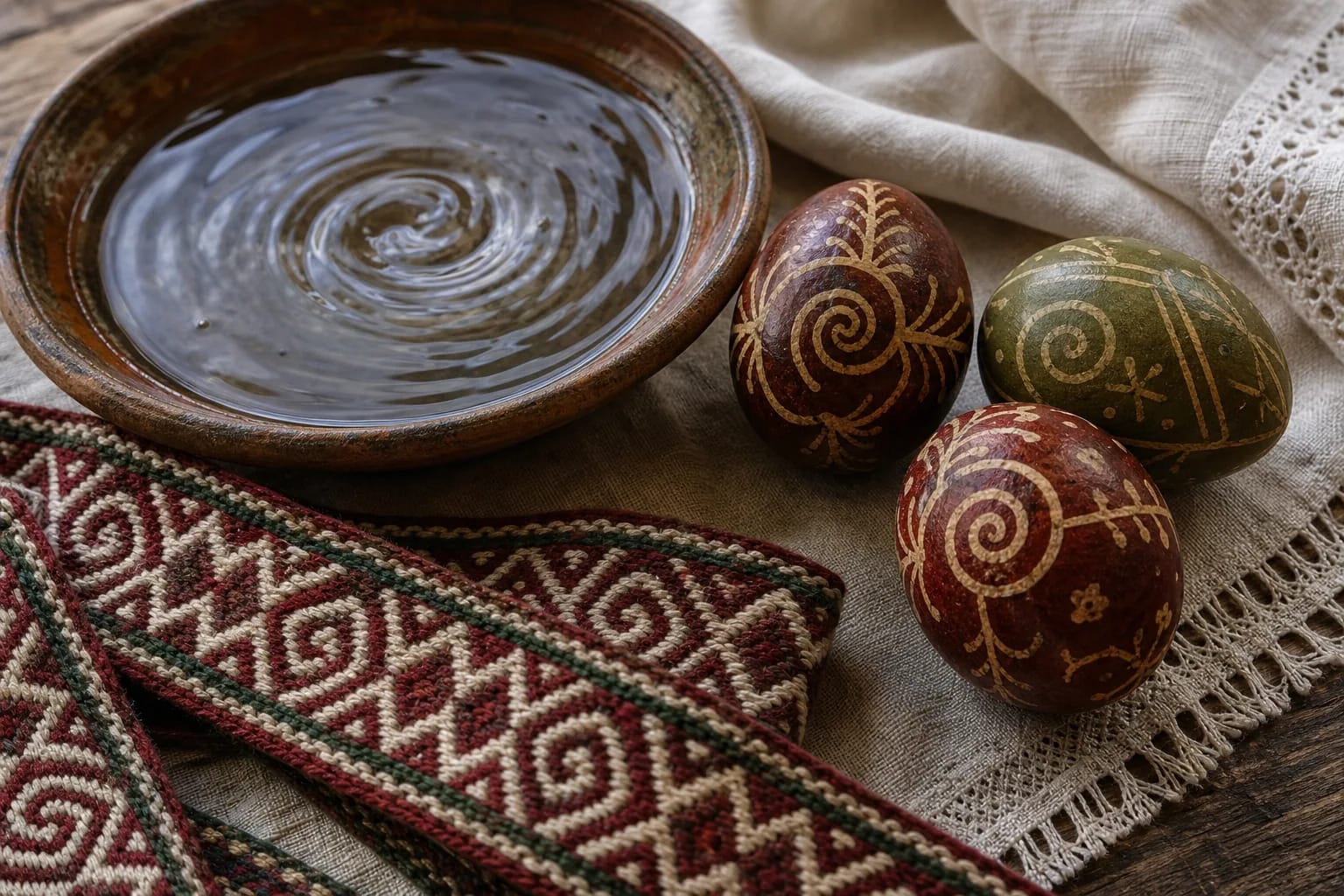
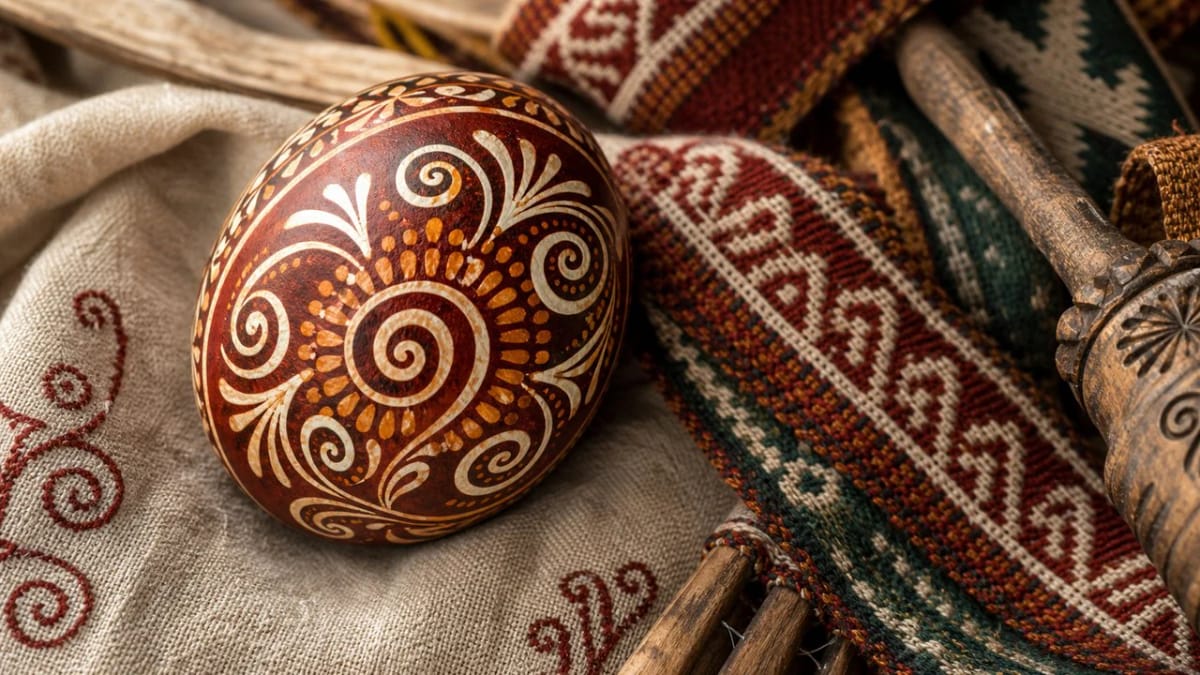
This movement may be connected with sun, wind, water, or fire. Often the little whirl is drawn as a rosette with curved rays turned in one direction, like a spinning wheel; this motif is especially characteristic of Easter eggs and distaffs, where the impression of turning emphasizes living rhythm. The exact meaning depends on the surface on which the sign appears.
The little whirl and sensitive signs
The little whirl page helps speak more carefully about swastika-type signs. Not every turning ornament should be called a Perkūnas or Fire Cross, but all of them belong to the field of movement and energy imagery.
The little whirl is therefore a safer and broader term when the goal is to describe visual action without overloading the sign with precise mythological dogma.
The little whirl in traditional ornament
The little whirl can be explored in decorated Easter eggs, sashes, and textiles. It explains how a simple graphic form can convey the annual cycle, vital rhythm, and the movement of the hand.
In contemporary design contexts, it is best to use the little whirl as a traditional Lithuanian pattern motif while keeping a clear reference to folk art rather than modern ideological interpretations.