- Category
- Perkūnas and Storm Signs
- Domain
- Lightning, Perkūnas, zigzag, storm, fire, protection, folk-art ornament
- Source status
- reconstructive
lightning pattern, Perkūnas' lightning, broken line, storm sign
What is the Lightning Sign?
The Lightning Sign is usually understood as a sharp broken line or zigzag that recalls storm lightning. In Lithuanian mythology, lightning is naturally connected with Perkūnas, thunder, and the force of heavenly order.
Still, not every zigzag is automatically a Lightning Sign. For that reason this page marks the source status as reconstructive: the form is familiar, but the specific mythological attribution depends on context.
Lightning and Perkūnas
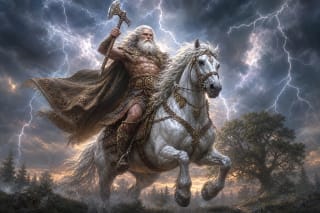
In Lithuanian mythology Perkūnas is the deity of thunder and lightning, so storm signs are often interpreted through his power. Lightning can mean a strike of justice, cleansing, punishment, or heavenly energy.

In ornaments this power is simplified into a line. A sharp, sudden sign conveys not detailed representation but motion and force.
Lightning, fire, and protection
Lightning is heavenly fire, so it stands close to the field of the Fire Cross and Perkūnas Cross. The Lightning Sign, however, remains linear: it cuts across the surface rather than rotating around a center.
When such a sign is used on borders, sashes, or building decoration, it may be read as protection from evil, chaos, or the danger of storm.
How not to overinterpret it
A good explanation of the lightning sign begins with form and object: where the sign appears, what material it is on, and what tradition it belongs to. Only then is it useful to speak about Perkūnas.
This prevents the mistake of declaring every broken line to be one fixed mythological sign.