- Category
- Sky and Fire Signs
- Domain
- Swastika-type ornament, Perkūnas, fire, lightning, cross, archaeology, folk art
- Source status
- reconstructive
Perkūnas sign, swastika-type sign, thunder cross, Baltic cross sign
What is the Perkūnas Cross?
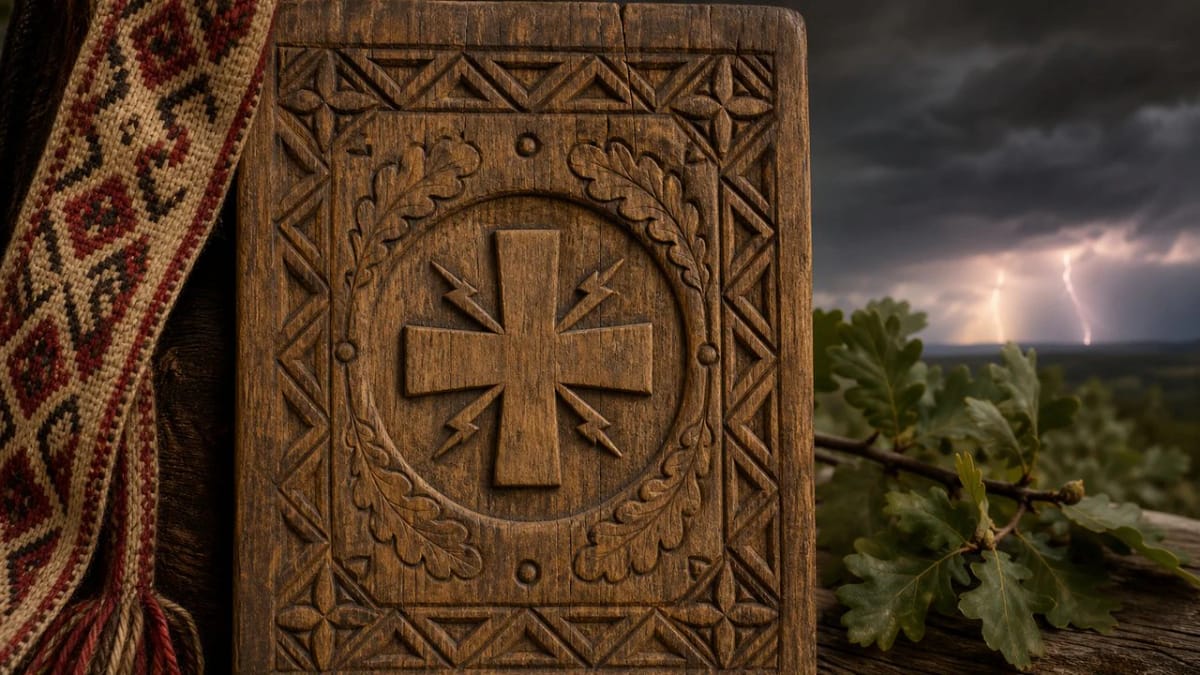
The Perkūnas Cross usually names a swastika-type, angularly rotating cross sign whose meaning is connected with thunder, lightning, fire, and heavenly power. In the Lithuanian context it is important to begin from the fact that the form is old, but the name is not equally attested in all sources.
Vykintas Vaitkevičius' study of the swastika in Lithuania shows that in finds from the thirteenth and fourteenth centuries the swastika is not merely a decorative sign. It is connected with the milieu of Perkūnas and the smith Kalvelis, and the researcher emphasizes its relation to the equal-armed cross, fire, and thunder.
How does it differ from the Fire Cross?
Visually the Perkūnas Cross and Fire Cross may be very close or even identical, because both are based on the rotating-cross form. The difference usually lies not in the drawing, but in the interpretation: the Perkūnas Cross emphasizes thunder and divine force, while the Fire Cross emphasizes fire, warmth, and vital energy.
For that reason these signs should be read together. They are not two completely isolated traditions, but closely related ways of interpreting the rotating cross.
Modern sensitivity
Swastika-type signs are sensitive today because of twentieth-century Nazism. The Lithuanian and Baltic context cannot be explained through Nazi symbolism, but modern public use must clearly identify the historical and folk-art setting.
Modern political uses do not by themselves explain the sign’s place in traditional ornament. An archaeological find, a folk-art object, and a political emblem each have a different historical context.
How should this sign be read in Lithuanian context?
In Lithuanian context the Perkūnas Cross is best understood as one possible interpretation of the rotating cross. The firmest part is the archaeological and folk-art presence of the motif; the more cautious part is the specific name and any single unified mythological doctrine.
This explanation keeps the sign in the Lithuanian symbols section while showing that the sources are more complex than a simple internet table.