- Category
- Sky and water beings
- Domain
- Sky, water, rain, Laumė, living sash, drawing up water
- Source status
- folklore
laumės juosta, laimės juosta, smakas, straublys, dangaus juosta, Dievo juosta
The rainbow as a mythical being
Today we understand the rainbow as an optical phenomenon, but in Lithuanian folklore it is a living, acting being. This is clearest from its names: most often it is called not vaivorykštė but laumės juosta, Laumė's sash, as if it were a piece of a mythical being's clothing. Folklorist Nijolė Laurinkienė has studied this image in greatest detail.
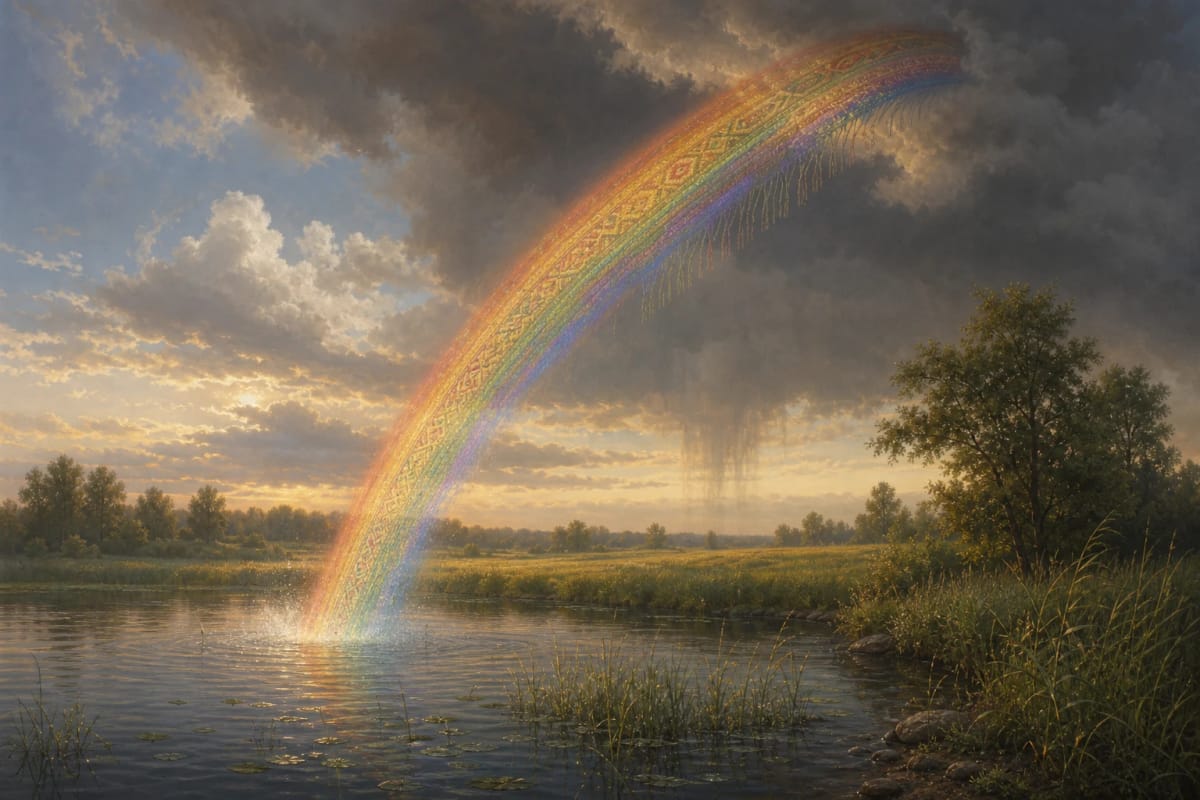
Rainbow mythology turns around one main idea: the rainbow is a mediator between earth and sky. With one end reaching water and the other the sky, it joins the two realms and transfers water through itself. In folklore, then, the rainbow is not only a beautiful sign but a mover of natural forces.
Names of the rainbow: Laumė's sash, smakas, straublys
The rainbow has many dialect names, and each reveals a different side of its image. The most widespread mythical name is laumės juosta, Laumė's sash, especially in Aukštaitija. It was recorded around 1680 in the Lithuanian-German dictionary of Friedrich Praetorius the Elder in the form Laumês Jůʃta. Because Laumė and Laima could be confused, people sometimes also said laimės juosta, Fortune's sash.
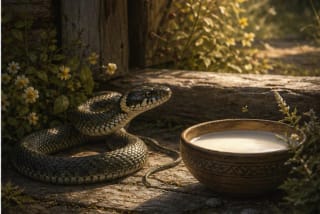
In Dzūkija the rainbow is called smakas, a Slavic loanword from Polish smok, meaning dragon and also pump, so the same word can mean both a fairy-tale dragon and the rainbow. Around Merkinė the name straublys is used, from the verb striaubti, to slurp or suck; in the Zarasai area, triaublė; in eastern Lithuania, drignė or dzigna. Christian layers are visible in names such as Dievo juosta, God's sash, dermės juosta, sash of covenant, and Adomo ir Ievos juosta, Adam and Eve's sash.
The rainbow drinking water
The most important and best-attested belief is that the rainbow drinks, sucks, or draws water from lakes, rivers, and the sea into the clouds, from which it later falls as rain. In this way it acts as a water pump between sky and earth, maintaining the rain cycle. It was recorded that when Laumė's sash sucks up water, the water even roars.
It was believed that the rainbow could draw in not only water but also whatever was in or near it: small fish, frogs, even livestock and people. Stories mention a lamb, calf, goats, or shepherd being pulled in and later falling down somewhere else; more rarely, a girl who came for water disappears and her colorful skirt supposedly becomes the rainbow. This shows how powerful and dangerous this being was imagined to be.
Smakas and straublys: the rainbow as a water dragon
The name smakas, dragon, for the rainbow is not accidental. In some stories it is directly identified with a many-headed water dragon that draws water through its heads and pulls in whatever comes near. In one legend, smakas has nine heads; Saint George holds it back, but unlike in wonder tales, he does not kill it.
The names straublys and triaublė emphasize the same sucking power: this is a being that slurps or drinks water as if through a long trunk. These images place the rainbow within worldwide rainbow-serpent imagery, known in many cultures, where the arc in the sky is understood as a huge water-drinking serpent or dragon.
Prohibitions and weather signs
It was forbidden to point at the rainbow with a finger, the same prohibition that applied to the Sun, Moon, and lightning. This shows that the rainbow was understood as a sacred being worthy of respect. Children were warned not to approach it, lest it draw them into a cloud.
The rainbow was also a weather sign. According to Libertas Klimka, its colors and position mattered: a brighter or greener sash promised more rain, a redder one wind; an eastern rainbow meant continuing rain, while a western or southern one meant clear weather. When one end of the rainbow rested on one lake and the other on another, it was understood as a sign that there would be no more rain.
The rainbow and Laumė
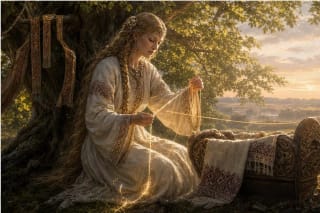
The rainbow is most closely connected with Laumė. It is called Laumė's sash because it is treated as a detail of Laumė's clothing, the fruit of her work, or her tool. In stories Laumės wash and weave: their colorful laundry, spread out in a meadow, rises into the sky as a colored sash, and a woven sash lifts into the heavens.

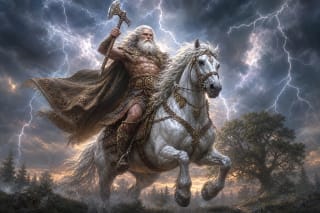
Laumė also uses the rainbow to lift water and to descend from the sky to earth to meet her beloved. Laurinkienė calls the rainbow a metonymy of Laumė: a sign through which Laumė herself appears. At the edges of the stories the storm god also flickers into view: in some variants the highest god, often associated with Perkūnas, punishes Laumė and her chthonic lover.
Where does the word vaivorykštė come from?
The word vaivorykštė is often wrongly explained as Vaivos rykštė, 'Vaiva's switch', as if it were the rod of a mythical Vaiva. Linguists Kazimieras Būga and Ernst Fraenkel reject this explanation. According to them, the word divides as vaivor- plus -ykštė, and the root vaivor- is reduplicated, coming from an Indo-European root meaning to bend or turn. Thus vaivorykštė literally means something bent, curved into an arc.
The Latvian name for the rainbow, varavīksne, has the same reduplicated root. Linguists also note that the abundance of names may have arisen from a prohibition against uttering the rainbow's true name, a feature typical of sacred or dangerous beings.
Is the rainbow a bridge? And one foreign belief
Although the rainbow joins earth and sky, in Lithuanian folklore it is not a bridge in the literal sense. The kind of bridge image known, for example, in Scandinavian mythology is not attested here. What is attested is the function of a mediator joining two realms, not a passable bridge, and that distinction matters for accurate reading.
It is also worth separating out one often repeated belief: that a person's sex changes after passing under the rainbow. This is a Bulgarian and South Slavic belief, not found in Lithuanian folklore; it does not appear in Laurinkienė's study or other Lithuanian sources. It should therefore be mentioned only as a foreign belief unrelated to Lithuanian tradition.