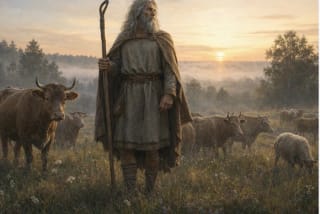
- Type
- God
- Domain
- Cattle protection according to Stryjkowski, with a name linked to sutverti, to form or create
- Source status
- late sources
Who is Sutvaras?
Sutvaras is a Lithuanian deity known from a sixteenth-century list of gods. Maciej Stryjkowski mentions Sotwaros in his list of Lithuanian and Samogitian gods, and W. E. J. Mannhardt and Vytautas Mažiulis reconstructed the Lithuanian form as Sutvaras.
Sutvaras belongs not to the high sky gods, but to the layer of farm and nature protectors. What makes him interesting is that the function stated in the source and the etymology of the reconstructed name lead in two different directions.
A cattle protector according to Stryjkowski
In the source itself, Stryjkowski's list, Sotwaros is described as a god who protects cattle. This places him among livestock-protecting figures, close to the shepherds' god Ganiklis and other farm deities.

The function makes sense in a peasant culture: cattle were wealth and the basis of livelihood, so their health and abundance could have a separate divine protector. This source statement is the primary and most reliable description of Sutvaras.
The name Sutvaras and the idea of forming
When reconstructing the name Sutvaras, researchers connect it with the verb sutverti, to create or form. Because of this etymology, some interpretations compare Sutvaras with ideas of creation, shaping, and order rather than only with cattle.
That is where the tension lies: the source function, cattle protection, and the name's meaning, forming or creating, do not coincide. This is a common problem with old god lists. Etymology can lead in a different direction than the recorded function, so the two must be kept separate.
How should such a deity be read?
Sutvaras is a good example of why mythology needs to distinguish three things: what the source says, what the name's etymology suggests, and what later interpretation adds. If these are mixed together, one can create a deity who was never actually attested.
The safest reading is to treat Sutvaras as a cattle-protecting god, as Stryjkowski states, while presenting the forming or creation link only as an etymological hypothesis. This avoids constructing an unsupported creator-god image.
Sutvaras today
Sutvaras helps show how carefully late lists of gods must be handled and how easily etymology can redirect a deity's image. He is methodologically important, even if modestly attested.
Sutvaras is best read together with Ganiklis and other farm deities. His primary, source-given domain is cattle protection, not world creation. The echo of sutverti remains interesting, but unproven.