
- Type
- God
- Domain
- Roads, journeys, crossroads, passages
- Source status
- attested in late sources
Kelių Dievas, Kielu Dziewos
Who is the God of Roads?
The God of Roads is a Lithuanian deity known from a sixteenth-century list of gods. Maciej Stryjkowski records him as Kielu Dziewos and assigns him to the field of roads and journeys: a guardian of movement, roads, and passages.
The God of Roads is not one of the high gods but one of the deities protecting concrete areas of life. His name states his function directly: kelias means a physical road, a journey, and a symbolic passage.
The road as liminal space
The road had special meaning in the Lithuanian worldview. It connected one's own space with foreign space, home with distance, life with death. The crossroads was considered an especially dangerous liminal place where spirits could appear.
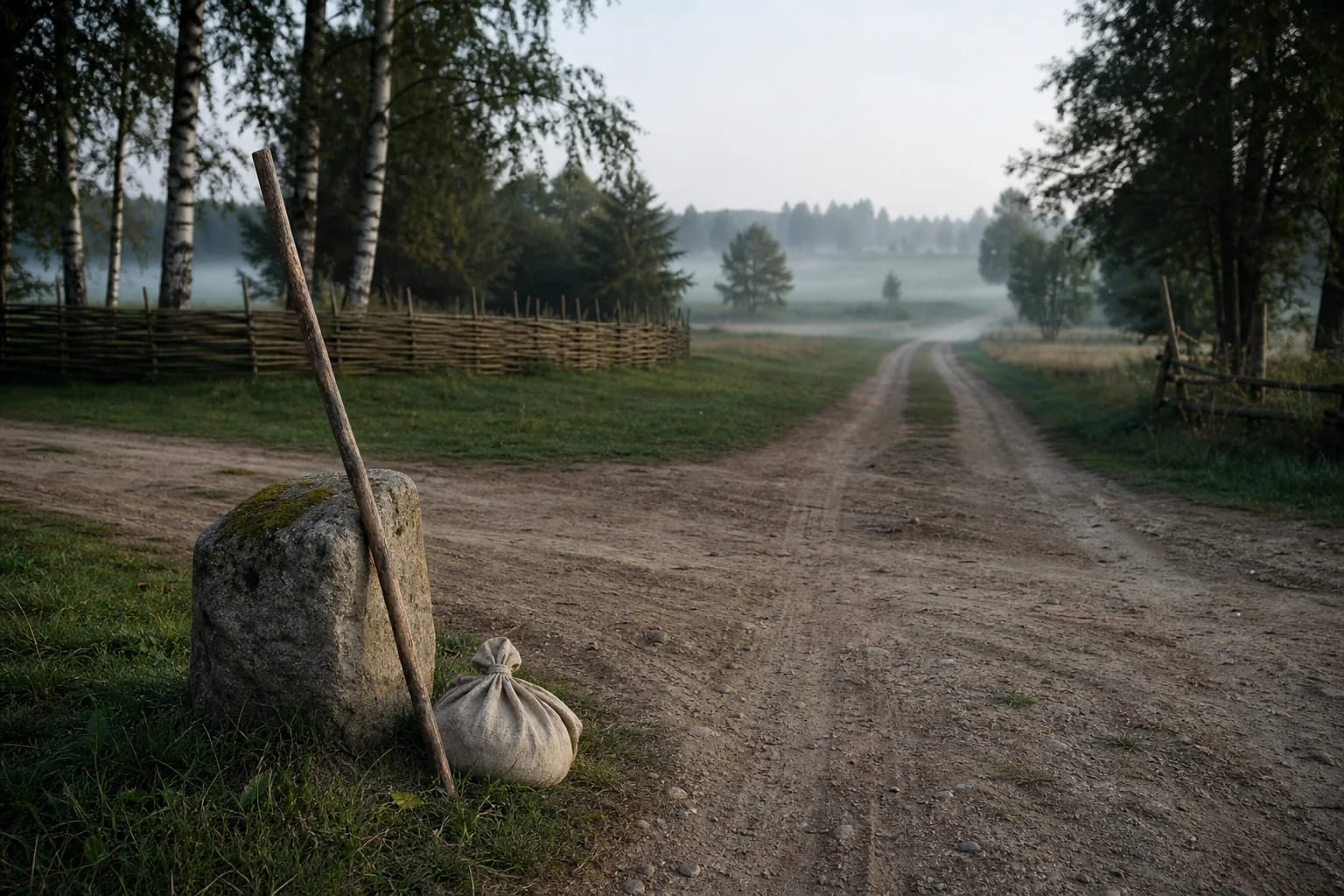
For that reason a guardian of the road mattered. Travel meant danger, and safe arrival and return had to be requested. The God of Roads embodies that need: he was to accompany the traveler and protect against dangers of the road.
The journey motif in folklore
Roads and journeys are vivid themes in Lithuanian folklore even without this specific divine name. Dievas, for example, often appears as a traveling old man who tests people's moral behavior, and many legends turn on encounters on a road or at a crossroads.
This helps place the God of Roads in a wider context. Even if we know him only from a brief notice, the sacred quality of the road is broadly attested in Lithuanian culture. The God of Roads is a concentrated name for that sacredness.
How should the God of Roads be read?
The God of Roads belongs among Stryjkowski-list names whose function is clear from the name itself. That makes him understandable, but it must also be admitted that no fuller narratives or ritual descriptions survive.
He should therefore be presented cautiously: as a guardian of journeys with a clear domain but no elaborated mythology. It is important not to exaggerate his role or attach invented traits to him.
The God of Roads today
The God of Roads helps explain the meaning of roads, journeys, and crossroads in Lithuanian culture. He reminds us that movement through space was not only practical but also symbolic, and was associated with danger.
The God of Roads is best read together with the symbolism of roads and boundaries in folklore and with Dievas as the old traveling man. In that context, his modest name gains wider meaning in the Lithuanian worldview.