- Place
- Ramygala, Panevėžys District Municipality
- Region
- Aukštaitija
- Type
- red-brick Neo-Gothic cruciform, three-nave, one-towered parish church
- Address
- 6 Bažnyčios Street, Ramygala
- Coordinates
- 55.51099, 24.30426
- Visit duration
- 30-60 minutes; longer if the interior and churchyard heritage can be seen
- Best time
- in daylight before or after the parish's listed Masses; no tourist opening hours are published
Ramygala Church, Ramygala Neo-Gothic Church, Ramygalos Šv. Jono Krikštytojo bažnyčia
A one-towered landmark in Ramygala's townscape
The Church of St John the Baptist stands in Ramygala, Panevėžys District, near the Upytė, a tributary of the Nevėžis. The parish's current contact address is 6 Bažnyčios Street. The historical paragraph on the Diocese of Panevėžys page also gives 14 Laisvės Square, so this is a source discrepancy rather than two different Ramygala churches. For visiting, use the current parish address and the exact Google Maps listing.
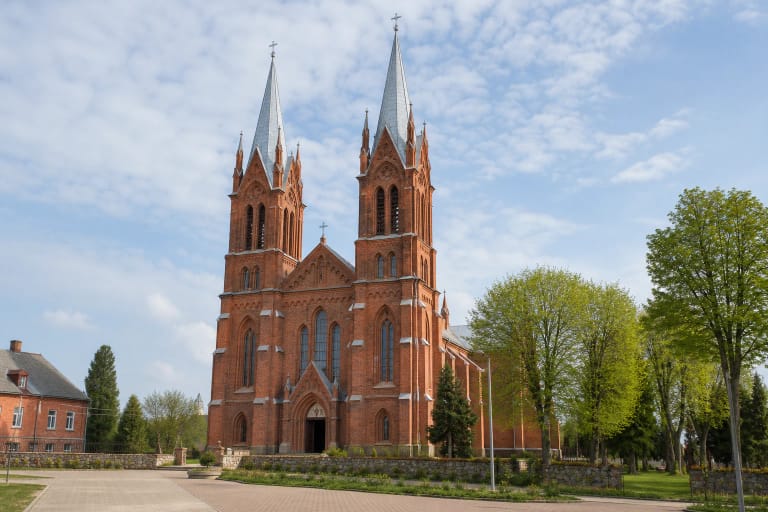
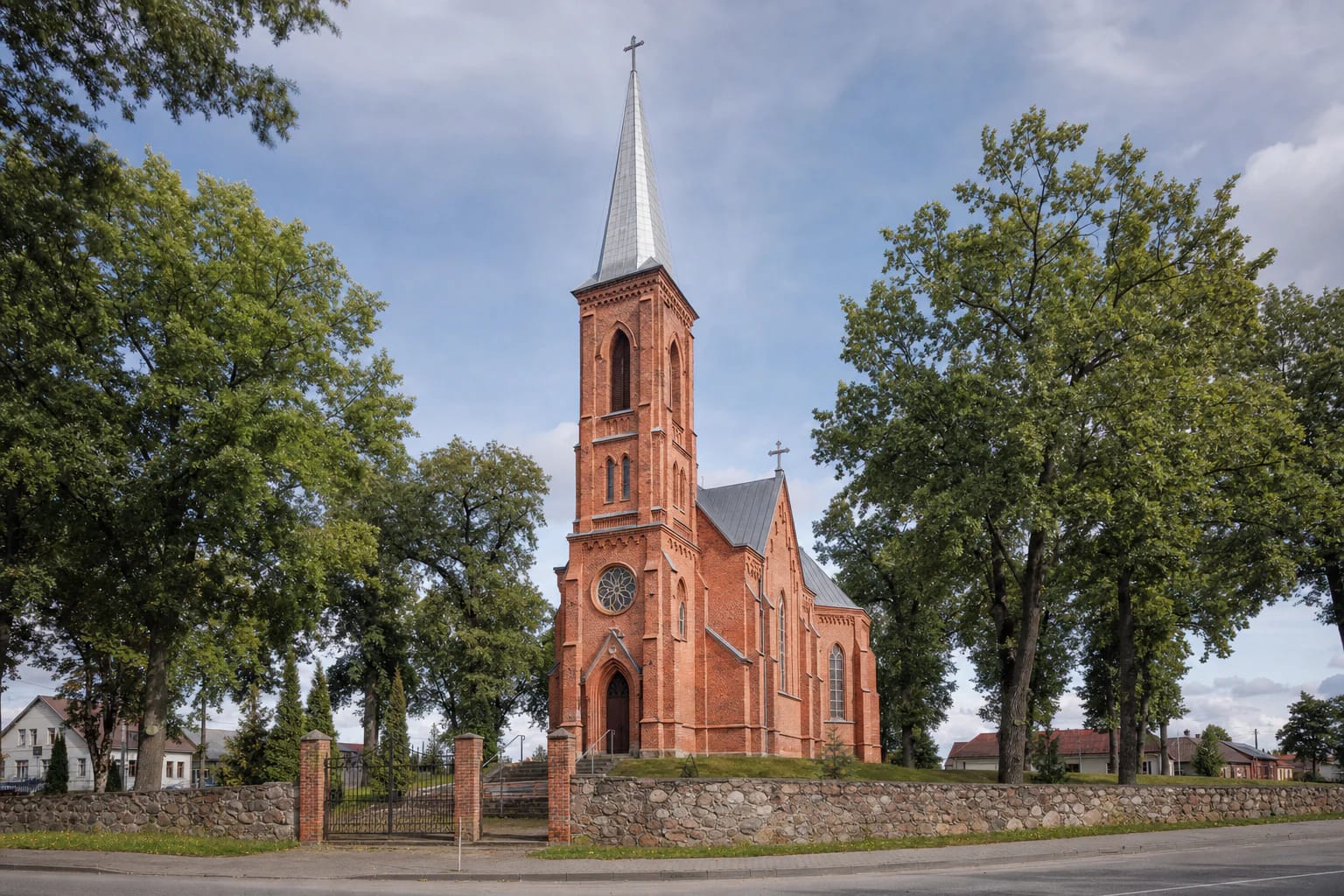
From a distance, the church is identified by its single main tower with a very tall spire, exposed red-brick masonry, and pointed openings. It is not a twin-towered church and has no separate churchyard belfry. The tower rises above the historic town fabric, while trees and low houses keep the setting at a small-town scale.
The coordinates 55.51099, 24.30426 mark the church site, not a surveyed doorstep. This is an honest site pin for navigation: use it together with the address and signs on arrival.
The parish and its wooden predecessors
The exact construction date of Ramygala's first church is unknown. VLE and the Diocese of Panevėžys place the first sanctuary between 1431 and 1500, while the district municipality gives about 1492. These should be read as different levels of precision within the same early history, not as one securely established year.
Sources mention an old, deteriorating church in 1674-1677. A fire in the middle of the eighteenth century destroyed the wooden sanctuary and badly damaged the town, after which a new wooden Church of St John the Baptist was built in 1781 through the efforts of Count Mykolas Tiškevičius. It had a thatched roof, five altars, and a ten-voice organ.
Local tradition says that the first church stood on a pagan romuva site. This is an important Ramygala memory tradition, but the research reviewed does not provide enough archaeological evidence to present it as established fact. Sources also differ over the Gombrovičiai family's role: some connect them with the earlier church's funding and burial vault, while others describe the present masonry church as a parishioner- and landowner-funded project.
Construction from 1897 to 1914 and the cautious Strandmann attribution
Priest Julius Norgėla began the present masonry church in 1897 according to a project attributed to Karl Eduard Strandmann. Local history and the Lituanistika summary place the main works in 1902-1907, while VLE dates the present building to 1902-1914. These dates fit if the concept, main construction, fitting-out, and final completion are kept distinct.
The church was completed and fitted out through parish and local landowners' donations. Priest Cezaris Jačinauskas arranged the interior, and Bishop Pranciškus Karevičius consecrated the church on 28 October 1914. The building's story is therefore also a story of a long community-funded construction process.
VLE, the municipality, and local historical sources directly name K. E. Strandmann. Heritage research nevertheless notes that the authorship of many churches attributed to Strandmann is not confirmed by surviving signed documents. Here the name is presented as a well-supported attribution, not as an unconditional proof of authorship.
Red-brick Neo-Gothic architecture and the churchyard
This is a red-brick Neo-Gothic, cruciform, three-nave, one-towered church. Local descriptions give approximately 48 metres in length and 24 metres across the transept, but these are not presented as a current geodetic survey. Brick masonry, tall buttresses, pointed-arch windows, and a steep metal roof create a vertical composition that remains proportionate to the town.
The main facade has a pointed-arch portal, a circular rose window above it, and a tall central tower. Pointed-arch openings and brick ornament repeat through the tower stages. One local study describes the original tower as 77 metres high, while other local descriptions give 70 metres; after the 1944 fire, the spire rebuilt in 1956 was about five metres lower. The sources do not establish one exact present height.
The churchyard is enclosed by a fieldstone wall with an iron gate and masonry gate pillars. VLE highlights a 1947 cross with sculptures and a two-storey wayside shrine with an ornamental cross and sculptures, dated to the late nineteenth or early twentieth century. These should be treated as distinct layers of the churchyard ensemble, while graves and closed areas should be left undisturbed.
Altars, organ, and the surviving bell story
The interior has six substantial piers and brick vaults. A documented local description mentions three oak altars decorated with Gothic pinnacles and small arches. The high altar has a variegated-marble mensa, a relief of the Last Supper on the antipendium, and a central relief of St John the Baptist baptising Jesus. The same description mentions wooden sculptures of St Stanislaus and St Casimir, with the Virgin Mary among angels above.
Research on the Ramygala organ states that organ builder Martynas Masalskis made a new 17-stop instrument using pipes from the older organ. It was first played on 16 July 1923, has mechanical action, and was repaired in 1986-1987. The research summary says that another repair was later needed, so do not promise a particular condition or a visitor demonstration.
A fire in the tower in July 1944 destroyed the spire, melted one older bell, and broke another when it fell onto the vaults. In 1947 the parish received a large bell brought from East Prussia and cast in 1522 by Heinrich von Schwichelt; it was installed in the rebuilt tower in 1956-1957. A mechanical tower clock, ordered in 1934 and brought to Ramygala in parts, was installed in 1956. These facts describe wartime and post-war damage to the present building, not to its wooden predecessors.
An active parish and a careful visiting plan
This is an active parish of the Diocese of Panevėžys, also serving chapels in Barklainiai, the Ramygala long-term care hospital, and Jotainiai. The diocesan page lists Mass at 09:30 on Sundays and 18:00 from Monday to Saturday. That page is not new, so verify the schedule before travelling by calling +370 45 592735 or writing to ramygalos.parapija@gmail.com.
The parish publishes no separate tourist hours, ticket price, guaranteed daily interior access, photography rules, or confirmed parking and accessibility plan. Plan the exterior and churchyard in daylight. Enter the church, approach the organ, or seek any possible underground space only when it is open and worship is not disturbed. Groups or visitors seeking a fuller tour should arrange it in advance.
On 15 July 2026, the exact Google Maps listing with Place ID ChIJz9Jtc86050YRofQh-FH251M showed a 4.8/5 rating. This is a mutable visitor average, not an official heritage assessment. The current listing is associated with 6 Bažnyčios Street, but because the historical diocesan description gives 14 Laisvės Square, use both the address and the coordinate when planning the journey.