- Place
- Kaunas City Municipality
- Region
- Kaunas
- Type
- late Renaissance Catholic hall church with Gothic features
- Address
- 1 A. Jakšto Street, 44279 Kaunas
- Coordinates
- 54.89766, 23.88534
- Visit duration
- 25-45 minutes for the church and exterior, if the interior is open
- Best time
- Sunday from 9:00 to 11:00, the opening window published by the official source; always check again before travelling
Kaunas Seminary Church, Holy Trinity Seminary Church, Kaunas Bernardine Holy Trinity Church
Which Holy Trinity Church This Page Covers
This page covers the Roman Catholic Holy Trinity Church, commonly called the Seminary Church, at 1 A. Jakšto Street on the northwestern corner of Town Hall Square. It is one separately registered component of the protected Holy Trinity Church, Bernardine Convent, and Priest Seminary ensemble: the whole complex has Cultural Heritage Register code 39052, while the church itself is 39053. The focus here is therefore the sanctuary, not every closed seminary and former convent wing around it.
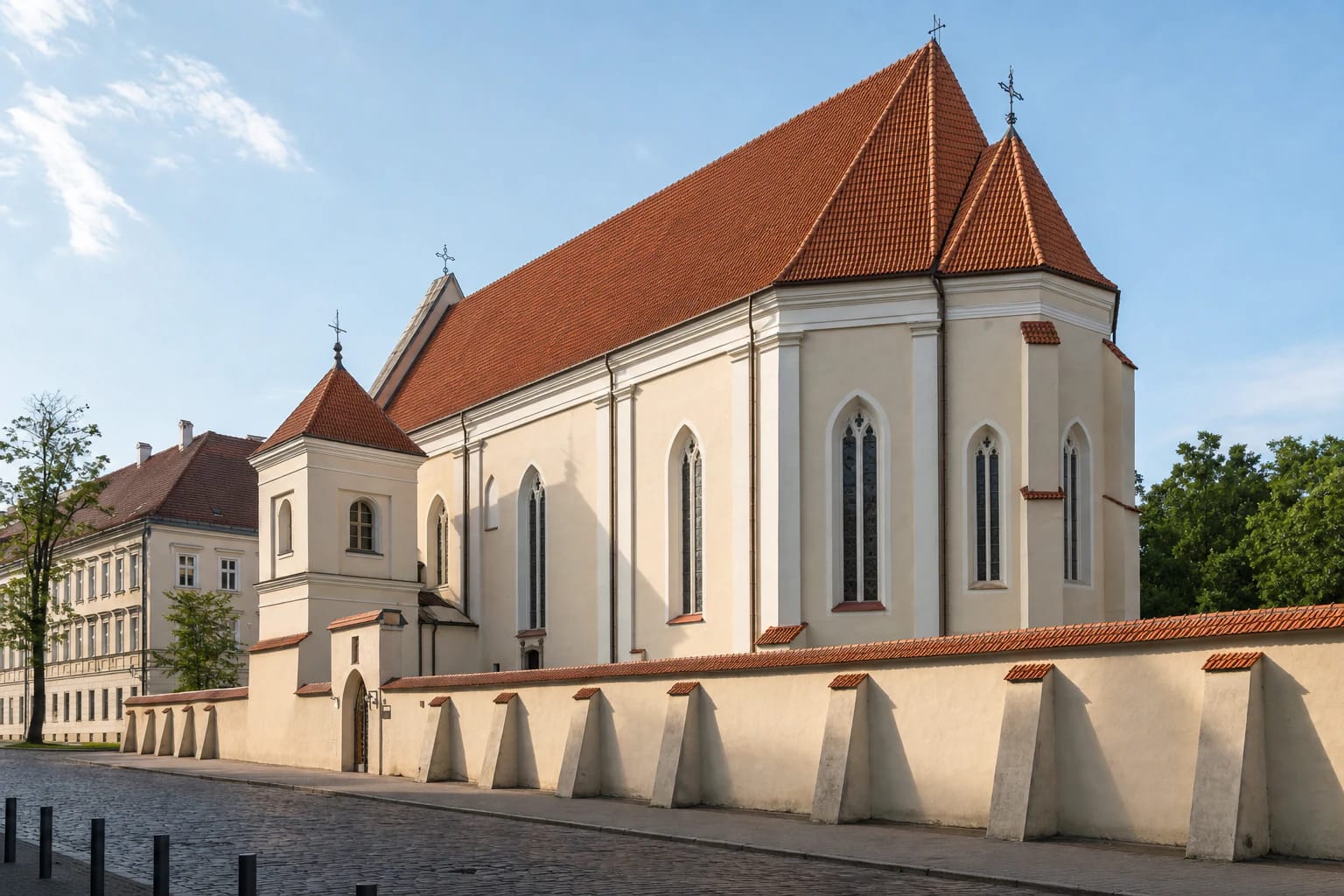
Nor should it be confused with Kaunas Evangelical Lutheran Holy Trinity Church on Muitinės Street or with churches of the same dedication elsewhere in Lithuania. From Town Hall Square, look for cream plaster, very high red-tiled roofs, a low entrance tower attached to the side, and the tall masonry wall following A. Jakšto Street.
Bernardine Nuns, the Masalskis Foundation, and the Seminary
A community of women following the Third Order of St Francis is recorded in Kaunas in 1589, and in 1595 it acquired the masonry house of Hanus Špilenas beside the former Market Square. Around 1617, Kaunas district marshal Aleksandras Masalskis and Apolonija Jasinskaitė-Masalskienė became patrons of the convent after their daughter Klara joined the Bernardine nuns. Their funding enabled construction of the present masonry church and a two-storey convent in 1624-1634 on earlier townspeople's plots; walls from some older houses were incorporated into the new buildings.
After damage during the mid-seventeenth-century wars and fires, the church was repaired and reconsecrated by Konstanty Kazimierz Brzostowski, Bishop of Vilnius, on 12 August 1703. The Russian imperial authorities closed the Bernardine convent in 1864 and dispersed the sisters. The western part of the complex then received the Samogitian diocesan seminary transferred from Varniai, while the church became parochial. This turning point explains why a seventeenth-century Bernardine sanctuary is now best known as the Seminary Church.
A Renaissance Building Shaped by Gothic Tradition
The plastered masonry church is a rectangular, three-aisled hall. Three pairs of slender piers carry barrel vaults articulated by diamond and star patterns of ribs. Pointed windows, buttresses, and rib designs continue the Gothic tradition, while symmetrical niches, pilasters, and the restrained ordering of the elevations belong to the late Renaissance.
One unusual visitor detail is the main western front: it has no conventional central doorway, only an arched window where one might expect an entrance. Visitors enter through the portal in the low bell tower attached to the south side, framed by a triple stepped arch beneath a classical triangular pediment. Walking along A. Jakšto Street reveals the high nave roof, tower, apse, perimeter wall, and seminary wings from several building periods in one view.
From a Lost Baroque Interior to Modern Sacred Art
Into the twentieth century, the church retained an elaborate Baroque and Rococo interior that eventually contained nine altars enriched with carving and sculpture. After the Salesians took over the parish in 1938, architect Mykolas Songaila reorganised the altars in 1939-1940 to make room for more pews. The church served seminary needs after the war, was closed in 1962, transferred to the city in 1963, and became a library book store. Its historic Baroque interior was then irreversibly dispersed or destroyed.
The church returned to the seminary in 1978, was restored to a design by architect Birutė Kugevičienė, and was rededicated by Bishop Liudvikas Povilonis on 17 February 1982. Today's principal features include the minimalist three-altar ensemble by Ignas Kvašys and Tolijus Meilūnas, a fresco by Antanas Kmieliauskas, and stained glass made by Ignas Meidus in 1982-1985 around themes of the Trinity, Eucharist, Virgin Mary, and St Joseph. Two seventeenth-century paintings of Our Lady, Comforter of the Afflicted, and St Joseph survive from the Bernardine interior. Seminarians rescued the Marian image after the closure, and it returned to public veneration after conservation in 1983.
Sunday Visiting and the Exact Map Listing
The Archdiocese of Kaunas lists this as a non-parish rectorate church open on Sundays from 9:00 to 11:00, with Mass at 10:00 and confessions from 9:30 to 10:00. Official sources publish neither separate daily sightseeing hours nor a museum admission price. Schedules and exceptions can change, so check the official page or contact the seminary office before travelling, and avoid interrupting the liturgy during services.
The coordinates 54.897658, 23.885339 mark the church within the ensemble rather than guaranteeing that every door is open. Its main doorway is in the side tower, but official sources provide no detailed confirmed step-free route, so visitors with specific access requirements should contact the seminary in advance. On 15 July 2026, the exact Google Maps listing was rated 4.8/5 and had place ID ChIJS8vmY0oj50YRWnZvSG6sAPE; using the ID helps avoid selecting another Holy Trinity church.