
A Wolf Runs Across the Reaping Strip lyrics and meaning
Bėga vilkas per barą,
Rūta žalioja.
Kur tu bėgi, vilkeli?
Rūta žalioja.
Bėgu jauną bernelį
Per rugius vaduoti.
Rūta žalioja.
Bėga vilkas per barą,
Rūta žalioja.
Variant from the Slaviūnas collection (SlS III-1726, a four-voice rye-harvest sutartinė, recorded 1936 in Rupiniai)
Pirmoji pora:
Bėga vilkas per barą.
Vesk, vilkeli, tiesiai barelį.
Atvesk, vilkeli, jauną bernelį.
Antroji pora (atsako litanijos būdu):
Rūta žalioja!
Rūta žalioja!
View illustration
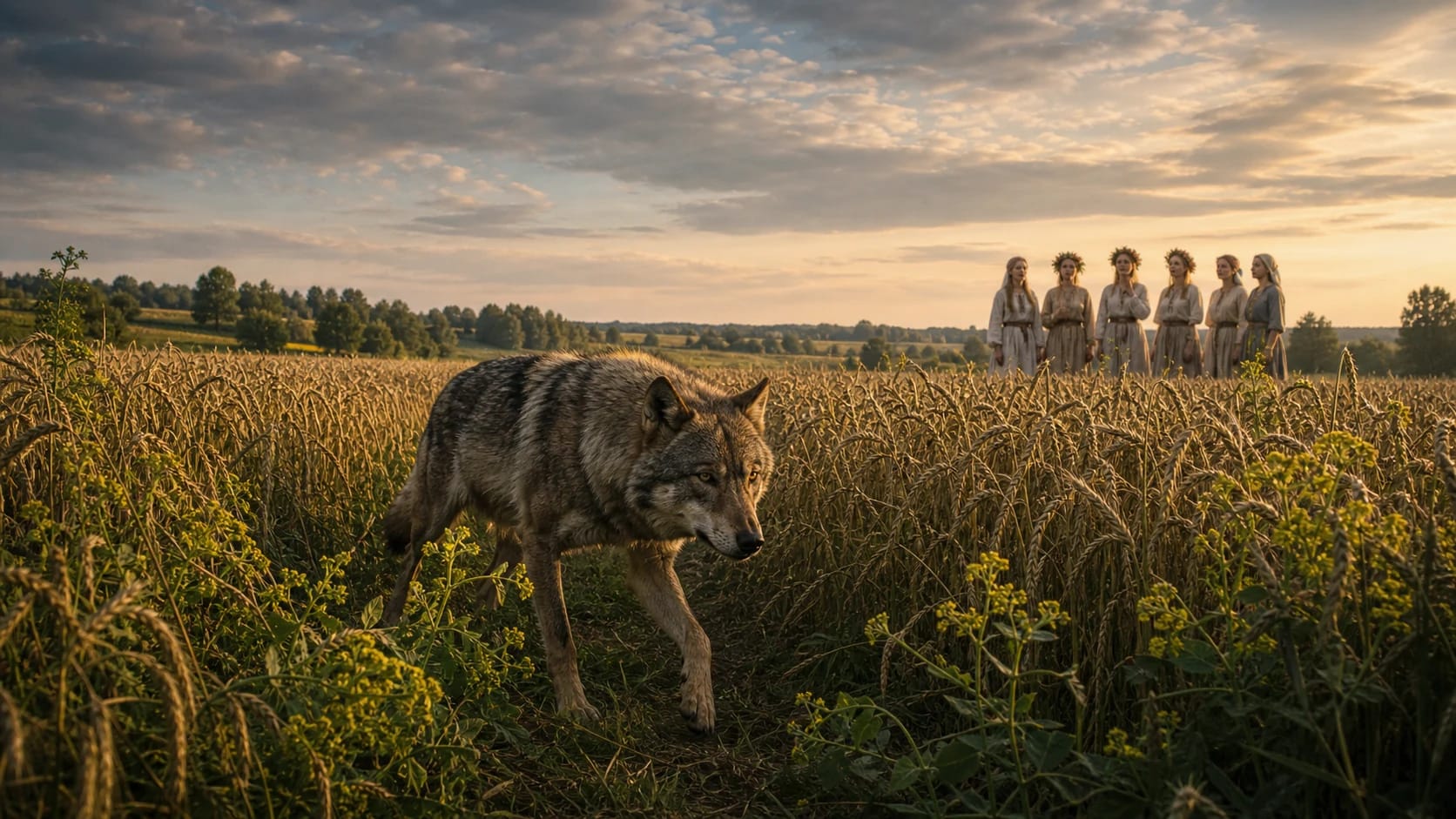
A Wolf Runs Across the Reaping Strip: sutartinė interpretation
Baras here is a narrow strip of rye or field. The wolf running across it moves the song out of calm agricultural space into a field of tension. The wolf may be danger, but also a bearer of news.
The refrain "Rūta žalioja" sets the wolf's wild movement against the green, culturally ordered steadiness of rue. The sutartinė therefore sounds like a short scene about the boundary between the wild world and the human community.
A second reading begins with the source's term ruginė: this is a work song for rye harvest. The wolf here does not ravage; he "rescues the young man through the rye." Such a wolf is closer to a field spirit or guardian than to a predator. He leads the young man out of the rye strip, as if helping him cross a boundary of labor and maturity. Rue in sutartinės marks a girl's purity and honor, so the refrain "Rue is green" also links this harvest sutartinė to wedding and youth-maturity layers. The rye field becomes a place where work, a couple, and communal order meet.
A Wolf Runs Across the Reaping Strip: symbols and phrases
- Wolf
- A figure of wild force and boundary. In this rye-harvest sutartinė, he does not tear apart but "rescues" the young man, acting as a field guardian or mediator.
- Baras
- A strip of rye harvest work, the section a reaper cuts. It gives the song its agricultural space.
- Rūta žalioja
- The refrain of the second pair. Rue marks a girl's purity, honor, and green constancy.
- Keturinė ruginė
- A rye-harvest sutartinė sung alternately by two pairs, in a litany-like manner.
A Wolf Runs Across the Reaping Strip: sutartinė history
In Slaviūnas' collection, "Bėga vilkas per barą" is listed as volume III, no. 1726 and marked as a "keturinė ruginė": a rye-harvest sutartinė sung alternately by two pairs. According to the metadata, in 1936 in Rupinai (Kazitiškis area, then Švenčionys county, now Ignalina district), it was sung by Marė Čirikienė (75) with the younger Veronika and Galena Čirikytė. J. Aidulis wrote down the text, and J. Jurga wrote down the melody (LTR 926(20)). The manuscript note says that the second pair answers "in the manner of a litany" with the refrain "Rūta žalioja."
The archaic variant clearly shows the structure of a keturinė sutartinė: one pair carries the semantic text about the wolf and the young man, while the other pair enters alternately with the refrain. On the site, this dialogue has been joined into a more continuous line.
Sources
- Z. Slaviūnas. Sutartinės, vols. 1-3 (1958-1959)
- Zenonas Slaviūnas sutartinės collection, LTR 926(20) (sutartines.info)
- D. Račiūnaitė-Vyčinienė. Sutartinės: Lithuanian Polyphonic Songs (2002)
A Wolf Runs Across the Reaping Strip: sources
A Wolf Runs Across the Reaping Strip: frequently asked questions
What does "baras" mean?
It is a strip of rye harvest work, the section cut by a reaper. In the song it places the wolf's movement inside an agricultural setting.
Is the wolf evil here?
No. In the source, the wolf "rescues the young man through the rye," so he acts more like a field guardian or mediator than a predator.
Why is this a ruginė sutartinė?
Slaviūnas' metadata marks it as a keturinė ruginė: a rye-harvest work song.
A Wolf Runs Across the Reaping Strip: how is it sung?
By two pairs alternately: one pair carries the meaningful text, while the other responds in litany fashion with "Rūta žalioja."
Where and when was it recorded?
In 1936 in Rupinai, now in Ignalina district, from Marė Čirikienė and the Čirikytė women; J. Aidulis recorded the text and J. Jurga the melody.
Where can the primary entry be found?
The most reliable reference is Slaviūnas' electronic book, volume III, no. 1726 (LTR 926(20)).