
The Willow Was Green lyrics and meaning
Žilvytis žaliavo,
Čiūto rūto.
Žilvytis žaliavo,
Čiūto rūto.
Tėvučio pakluonėj,
Čiūto rūto.
Tėvučio pakluonėj,
Čiūto rūto.
Išeik gi, tėvuti,
Čiūto rūto.
Išeik gi, tėvuti,
Čiūto rūto.
Žilvyčio lankytų,
Čiūto rūto.
Žilvyčio lankytų,
Čiūto rūto.
Ar žalias žilvytis,
Čiūto rūto?
Ar tankios šakelės,
Čiūto rūto?
Ar tiesus liemenis,
Čiūto rūto?
Nukirsime tave,
Čiūto rūto.
Trumpaisiais rasteliais,
Čiūto rūto.
Trumpaisiais rasteliais,
Čiūto rūto.
View illustration
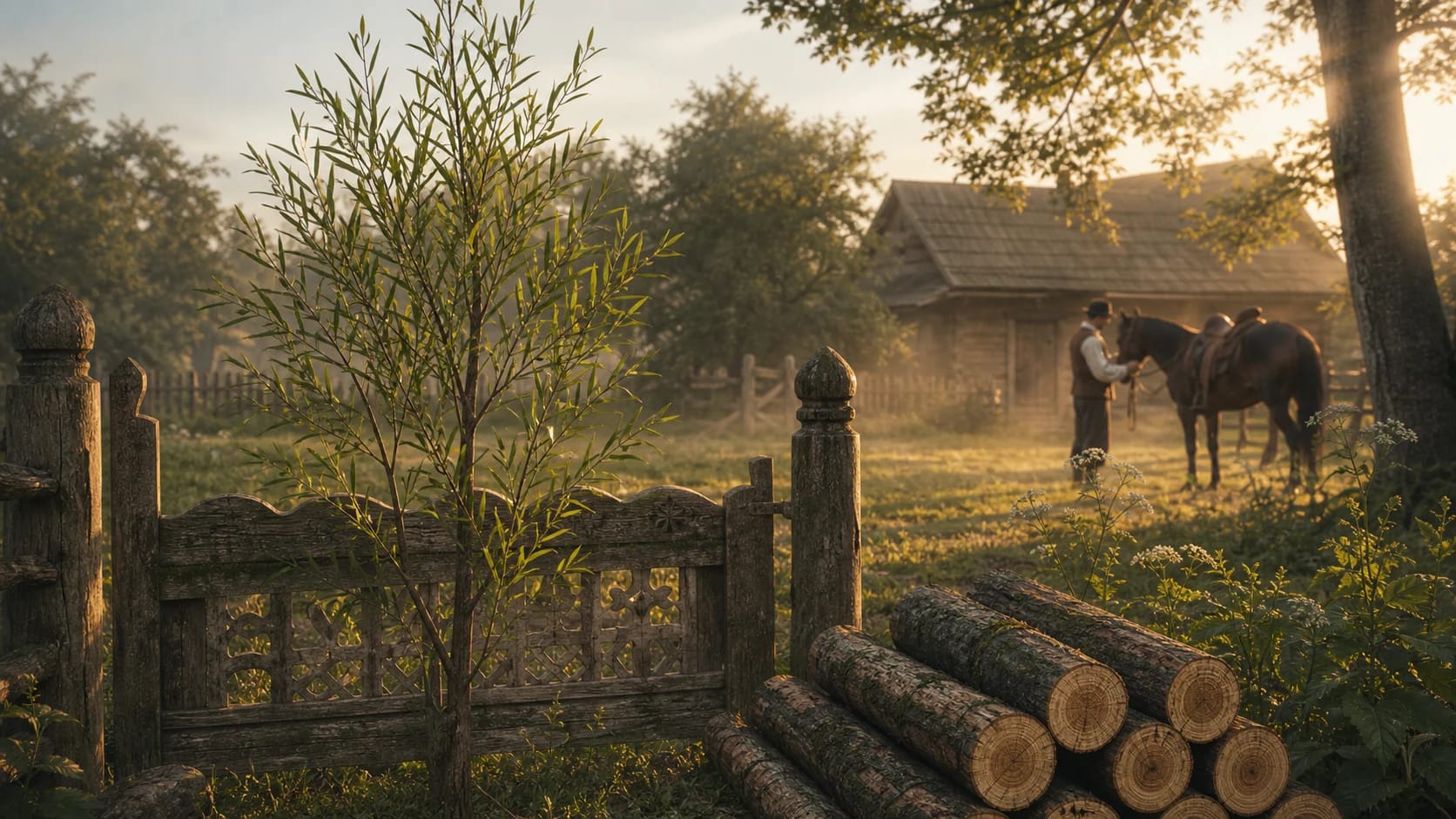
The Willow Was Green: sutartinė interpretation
The žilvytis is a living, green tree growing by the father's barnyard. The questions about its greenness, dense branches, and straight trunk sound like an inspection before cutting. The song therefore joins beauty with the inevitability of being cut down.
The tree can also be read as the figure of a young person: green, straight, growing within the home space, but already being drawn toward another purpose. The refrain "čiūto rūto" gives this transition a calm, cyclical pulse.
A second reading focuses on the willow growing specifically "by father's barnyard" and being inspected before cutting: is it green, are the branches dense, is the trunk straight? This closely resembles the inspection of a girl in her parents' home, when matchmakers and guests evaluate a bride much as the tree is evaluated here. In this reading, "we will cut you" means the taking of the girl from her father's house: marriage, a passage from growth into another life role. The identity between tree and human being belongs to an old layer of Lithuanian song, so the žilvytis here may be not only a shrub but also the young girl or boy being "cut" from childhood home into adult life.
The Willow Was Green: symbols and phrases
- Žilvytis
- A young green willow-like shrub, linked with flexibility, growth, and the boundary of home; it can also figure a young person.
- Father's barnyard edge
- The edge of the homestead where the tree belongs to the family space, like a girl growing in her parents' home.
- Inspection: green, dense, straight
- The tree is assessed before cutting, recalling the inspection of a bride in her parents' house.
- Cutting into short logs
- The passage from growing tree to logs can signify a girl being taken from home, marriage, or the transformation of maturity.
The Willow Was Green: sutartinė history
"Žilvytis žaliavo" has a rich family of variants in Slaviūnas (III-1499, III-1500, and others). Variant III-1499 was sung in 1935 by the same Taujėnai and Siesikai rural-district singers as "Aguona": Teresė Dirsienė, Marijona Smetonienė, Morta Jasikonienė, and Karolina Masiulienė. The text was written down by J. Dovydaitis, and Jadvyga Čiurlionytė transcribed the melody from the record (LTR pl. 278(1)). The singers noted that the sutartinė was "builinė," played on panpipes made from cow-parsnip stems; a sound recording survives, so the song can be learned not only from text but also from its sound.
The žilvytis, a willow-like shrub, is connected in sutartinės with the yard, gates, a young person, and tree-cutting motifs. Sutartinės flourished in north-eastern Aukštaitija from the sixteenth to the nineteenth century; in 2010 they were inscribed on UNESCO's Representative List of the Intangible Cultural Heritage of Humanity.
Sources
- Z. Slaviūnas. Sutartinės, vols. 1-3 (1958-1959), III-1499
- Zenonas Slaviūnas sutartinės collection, LTR pl. 278(1) (sutartines.info)
- D. Račiūnaitė-Vyčinienė. Sutartinės: Lithuanian Polyphonic Songs (2002)
The Willow Was Green: sources
The Willow Was Green: frequently asked questions
Why do some sources write "žilvytis" and others "žilvitis"?
Variant spellings occur in the Slaviūnas database; the more usual form is "žilvytis."
What does the žilvytis symbolize?
Young, flexible, green growth within the home space, and in a deeper reading a girl or boy growing in the parents' house.
Why is the tree going to be cut?
The inspection and cutting can signify a girl being taken from her father's home through marriage, or a broader passage into adulthood.
The Willow Was Green: who sang this sutartinė?
In 1935 it was sung by the same Taujėnai and Siesikai singers as "Aguona"; J. Dovydaitis wrote down the text and J. Čiurlionytė transcribed the melody.
Is there an audio recording?
Yes. It is a "builinė" sutartinė connected with panpipes, and the LLTI MP3 link is included in the source list.