
Go, Little Goat, to the Water lyrics and meaning
Aik, oželi, vandenia,
Aik, oželi, vandenia.
Bijau vilko girioje,
Bijau vilko girioje.
Vilkas oželį pagavo,
Kaulus žemėn paliko.
Iš kaulų liepos išaugo,
Iš liepų kanklės suskambo.
Suskambo kanklės vestuvėj,
Aik, oželi, vandenia.
Variant from the Slaviūnas collection (SlS III-1774, recorded by A. Žąsinas, Panevėžys district)
— Aik, oželi, vandenia,
Oželėli, vandenia.
— Bijau pikta vilka.
— Nebijok vilka, su kojala sutrepsenk,
Su rageliu pabarškenk.
— Kad aš ėjau kelaliu,
Susitikau tijūną.
Man tijūnas — labą dieną.
Aš tijūnui kuoka.
Subyrėja į kaulalius.
Aš parnešiau namolėlia,
Ir pakasiau pas upelį,
Ir išdygo dvi liepelės,
Trečia sedulėla.
Pasidirbau konklalius
Ir nuėjau ant veselių,
Ant berniukų karščia,
Ant mergaičių džiaugsma.
View illustration
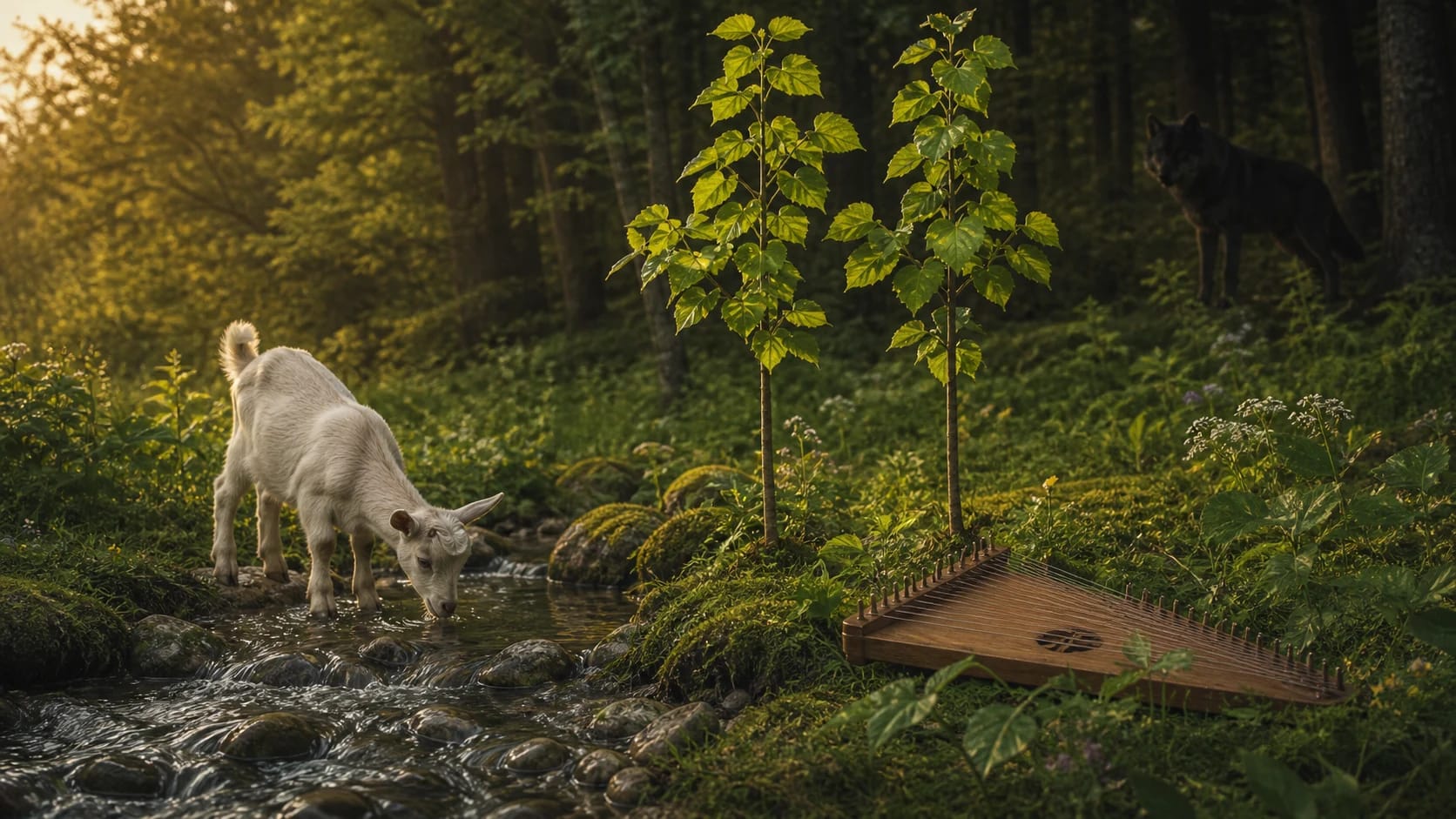
Go, Little Goat, to the Water: sutartinė interpretation
At first glance this is a tale inside a song. The little goat fears the wolf, and the wolf's violence becomes not an ending, but new matter: from bones grow lindens, from lindens come kanklės, and the kanklės sound at a wedding.
That chain shows an archaic logic of transformation. Animal, tree, instrument, and feast are not separate worlds; the song lets one pass into another. It belongs to the wider "singing bone" or "instrument from remains" motif: death becomes music.
A second reading follows the Slaviūnas variant, where the threat is not the wolf but the tijūnas, the manor overseer and a figure of serfdom-era authority. The singer kills him with a club, buries him, and trees growing from his remains become kanklės for a wedding. The text can be read as social satire from the age of serfdom and as a reversal of roles: in song, the powerless peasant overcomes the oppressor, and the oppressor's remains are turned into an instrument of communal joy. The comic goat-and-wolf frame becomes a cover for an older image of defense and transformation.
Go, Little Goat, to the Water: symbols and phrases
- Little goat
- A comic and vulnerable figure drawn into a dangerous journey toward water.
- Wolf / tijūnas
- The figure of threat: in the smoother version, a wolf; in the archaic one, the manor steward, a sign of serfdom-era authority.
- Lindens and dogwood
- Trees that grow from remains and become the material for instruments.
- Kanklės
- The Lithuanian zither-like instrument that is born from transformation in the song: death becomes music.
Go, Little Goat, to the Water: sutartinė history
"Aik, oželi, vandenia" is listed in Slaviūnas' collection as volume III, no. 1774. According to the metadata, it was written down in Panevėžys county by A. Žąsinas (manuscript LMD I 372a(21)), and the manuscript itself calls the song a sutartinė. A reliable classification as dvejinė, trejinė, or keturinė is not given, so on the site it is placed among "other and unspecified" sutartinės.
It is important that the site text is a smoother retelling, while the variant printed by Slaviūnas tells a different and much sharper story: the little goat is urged not to fear the wolf; on the way the singer meets a tijūnas, a manor steward, kills him with a club, buries him by a stream, and from there linden trees and a dogwood grow. Kanklės are made from them and carried to weddings to gladden the people. The text shows how far an archaic sutartinė variant can stand from a later, polished form.
Sources
- Z. Slaviūnas. Sutartinės, vols. 1-3 (1958-1959)
- Zenonas Slaviūnas sutartinės collection, LMD I 372a(21) (sutartines.info)
- D. Račiūnaitė-Vyčinienė. Sutartinės: Lithuanian Polyphonic Songs (2002)
Go, Little Goat, to the Water: sources
Go, Little Goat, to the Water: frequently asked questions
Why is the category "other"?
The source identifies it as a sutartinė, but the research did not establish reliably whether it is a dvejinė, trejinė, or keturinė.
How does the Slaviūnas variant differ from the site text?
In the archaic variant, the central violent encounter is with a tijūnas, a manor steward. The singer kills him with a club; trees and kanklės grow from his remains. It is sharp social satire.
What does "aik" mean?
It is a dialectal form close to standard Lithuanian "eik," meaning "go." It preserves the color of the source language.
Why do trees grow from bones or remains?
This is a transformation motif common in tales and archaic song imagination: death passes into plant, and plant into music.
Who is a tijūnas?
A tijūnas is a manor steward or overseer, a representative of serfdom-era authority. In the archaic variant he is the target of satire.
Is this a serious or comic sutartinė?
It has comic elements and archaic seriousness; in the Slaviūnas variant it also carries social satire. The cyclical chain lets laughter and transformation work together.