
Little Cuckoo in the Orchard lyrics and meaning
Gegutytė sodi,
Sodi, sodi.
Gegutytė kukavo
Žaliam sodely.
Sodi, sodi,
Gegutytė sodi.
Kukavo, kukavo,
Sodelį budino.
Variant from the Slaviūnas collection (SlS III-1541, recorded by A. Sabaliauskas c. 1911 in Savučiai)
Gegutyte sodi,
Sodely kukavo.
Gegute sodi,
Sodi kukavo.
View illustration
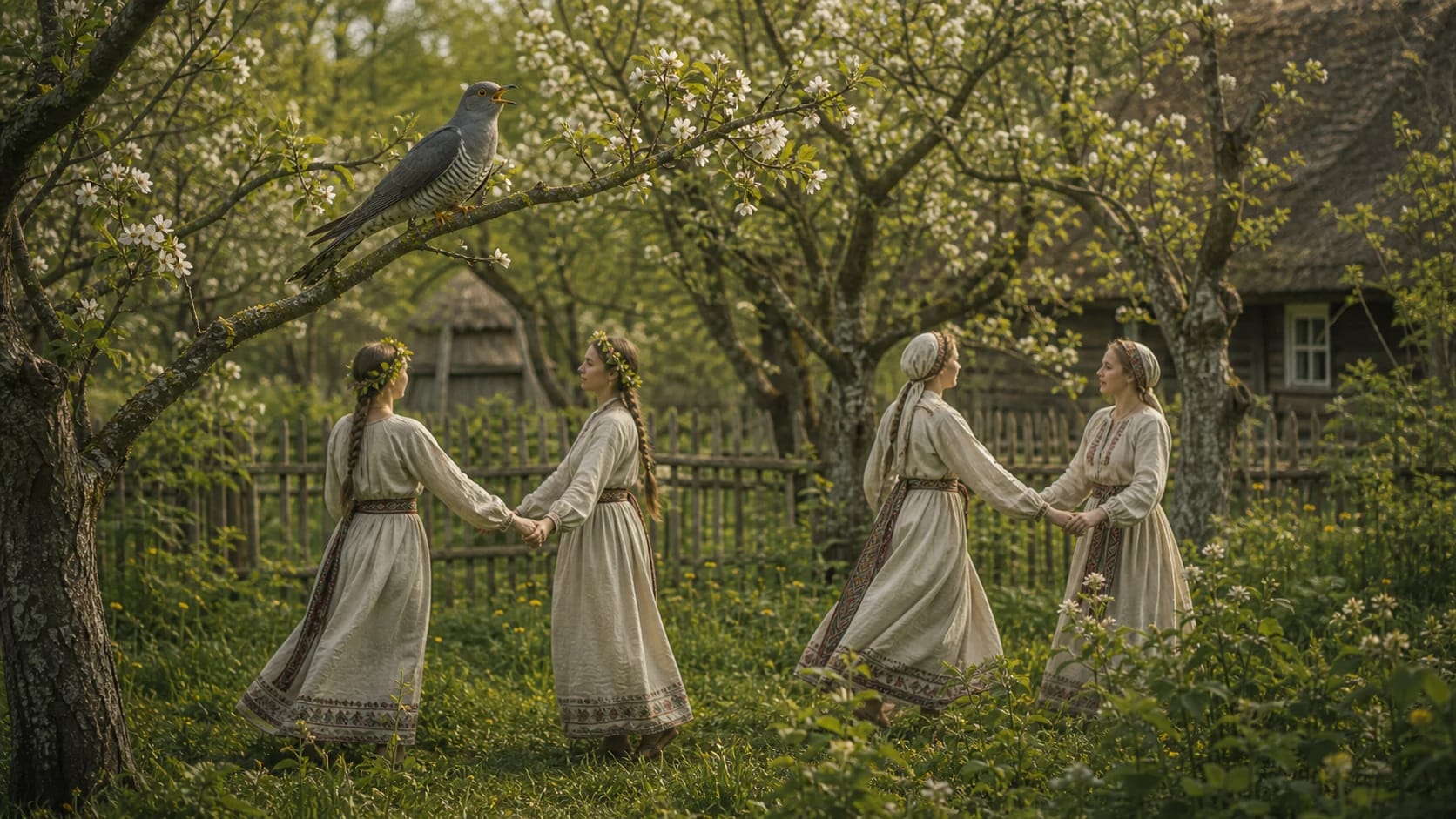
Little Cuckoo in the Orchard: sutartinė interpretation
In Lithuanian songs the cuckoo often announces longing, orphanhood, or spring. Here it is compressed into a very short orchard image. That makes sound more important than plot: the cuckoo's call merges with the singers' voices.
The orchard is a tended, culturally shaped space of nature. The cuckoo brings a wild voice into it, so the sutartinė joins the home sphere with the bird of the forest.
A second reading starts from the Slaviūnas variant in which the cuckoo "wakes the orchard." This is an image of spring awakening, close to calendar rites in which a bird's voice marks nature's renewal. In Lithuanian belief the cuckoo is an omen-bearing bird: people divined by its call how many years they had left to live, and it is sometimes linked with the voice of a dead mother or ancestors. When Sabaliauskas' note is added, saying that the sutartinė was danced with alternating pairs, the piece can be read as a spring round-game in which bird voice, dance, and polyphony together "wake" both the orchard and the community into a new cycle of life.
Little Cuckoo in the Orchard: symbols and phrases
- Little cuckoo
- A bird of spring, longing, and omen; its voice easily becomes the musical structure of the song.
- Orchard
- A tended home space of nature where the bird's voice becomes the sound of the community.
- "Waking the orchard"
- The cuckoo's call awakens the orchard, an image of spring renewal and calendar ritual.
- Dance circle
- Sabaliauskas' note describes the sutartinė as danced with alternating pairs, a form of round-game.
Little Cuckoo in the Orchard: sutartinė history
"Gegutytė sodi" has at least two entries in volume III of Slaviūnas' collection. Variant III-1541 was recorded around 1911 in Savučiai (Vabalninkas parish, Biržai county) by the priest and folklorist Adolfas Sabaliauskas, one of the earliest collectors of sutartinės, from the 25-year-old Alzbieta Paliulienė-Gaidelytė. The entry is classified among keturinės and instrumental, skudučiai-related sutartinės, and the note beside the text says that one singer leads, another responds, and they dance while singing. This shows that the sutartinė was not only sung but danced.
The title form "sodi" is archaic and vocable-like: it can at once recall the word for an orchard or garden and function as a rhythmic refrain. The Biržai-Vabalninkas area, like Taujėnai, is one of the most important sutartinė regions in northeastern Aukštaitija.
Sources
- Z. Slaviūnas, Sutartinės, vols. 1-3 (1958-1959)
- A. Sabaliauskas, collections of sutartinės and other songs (early twentieth century)
- Zenonas Slaviūnas sutartinė collection (sutartines.info)
Little Cuckoo in the Orchard: sources
Little Cuckoo in the Orchard: frequently asked questions
What does "sodi" mean?
It can work both as a word recalling an orchard or garden and as a refrain syllable. Such double function is common in sutartinės.
Why is the cuckoo important?
In Lithuanian songs the cuckoo carries meanings of longing, spring, and omen; people also used its call for divination.
Was this sutartinė danced?
Yes. A. Sabaliauskas' note says that one singer leads, another responds, and they dance while singing.
Little Cuckoo in the Orchard: who recorded it?
Around 1911 in Savučiai, Biržai county, A. Sabaliauskas recorded it from Alzbieta Paliulienė-Gaidelytė.
Little Cuckoo in the Orchard: why is the text so short?
Short sutartinė texts are repeated and interwoven by voices, so their musical form is richer than their verbal length suggests.
Why is it placed among keturinės?
The Slaviūnas entry classifies this sutartinė among keturinės and also connects it with instrumental performance.