
Clover, Little Clover lyrics and meaning
Dobilio, dobilėli,
Dobilio, dobilėli.
Kas ten pučia per girelę?
Dobilio, dobilėli.
Vėjas pučia per girelę,
Dobilio, dobilėli.
Kas ten joja per laukelį?
Dobilio, dobilėli.
Jaunas brolis per laukelį,
Dobilio, dobilėli.
Variant from the Slaviūnas collection (SlS II-601, recorded 1925 in Vepriai)
Dobilio, dobilėli, dobilio.
Ko girelė ūžė, dobilio?
Dobilio, dobilėli, dobilio.
Užtat giria ūžė, dobilio,
Dobilio, dobilėli, dobilio,
Kad vėjelis pūtė, dobilio.
View illustration
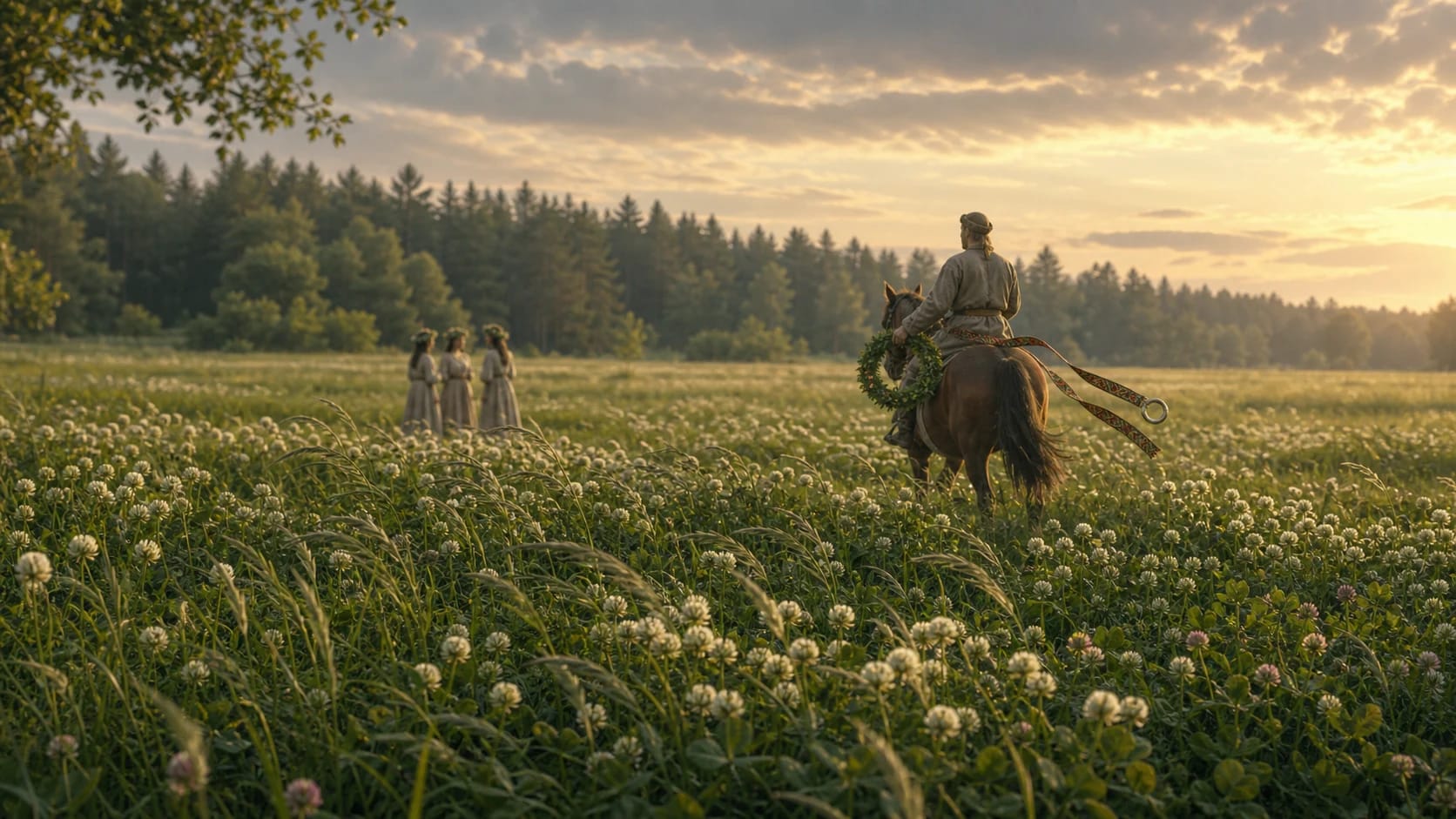
Clover, Little Clover: sutartinė interpretation
Clover in the song is a green plant of earth and good fortune. The refrain "dobilio, dobilėli" gives the voices a firm rhythmic support and lets the short question lines sound like an observation of nature.
When travel or rider motifs appear in variants, clover becomes more than a meadow plant. It joins the home field to a broader road of human movement.
A second interpretation focuses on the Vepriai variant, which is a pure nature question-and-answer, almost a riddle: "Why did the little forest roar? Because the little wind blew." Sutartinės researchers regard such dialogic structure as archaic: the song does not narrate, but, like an incantation, names the order of the world and its causes. Clover, especially as a three-leaf plant, is associated in folk tradition with luck, abundance, and lush growth. Its constantly repeated name may therefore be not only a sonorous refrain, but also a word calling fertility and life. The polyphony itself becomes a sonic image of wind and forest-roar: the voices "roar" like the forest.
Clover, Little Clover: symbols and phrases
- Clover
- A green field plant associated with life, good fortune, abundance, and the rhythm of the song.
- Wind through the little forest
- A movement in nature answered by the voices of the sutartinė; in the riddle variant, it explains why the forest roars.
- Young brother
- A figure of travel or family presence in the site's variant.
- Refrain "dobilio"
- The repeated sound acts as a link between voices and may also be a word calling life and good fortune.
Clover, Little Clover: sutartinė history
"Dobilio, dobilėli" has several entries in Slaviūnas' collection: volume II, no. 601 and variants in volume III, no. 1258. This points not to a single fixed text, but to a living family of sutartinės with the same clover refrain. The II-601 variant was written down in 1925 in Vepriai (Ukmergė county) by Pr. Pauliukonis from the 47-year-old Felicija Terasienė (LTR 734(44)); it is classified as a trejinė and as a song about nature. In this variant, the song turns around a riddle: why did the little forest roar? The answer is that the wind was blowing.
Another version, reflected in the site's text, adds travel and rider imagery: a young brother rides across the little field. The surviving LLTI sound recording makes this sutartinė especially valuable, because it lets listeners check not only the words but also the interweaving of the voices.
Sources
- Z. Slaviūnas. Sutartinės, vols. 1-3 (1958-1959)
- Zenonas Slaviūnas sutartinės collection, LTR 734(44) (sutartines.info)
- D. Račiūnaitė-Vyčinienė. Sutartinės: Lithuanian Polyphonic Songs (2002)
Clover, Little Clover: sources
Clover, Little Clover: frequently asked questions
Why is clover so common in sutartinės?
Clover is short, sonorous, green, and symbolically linked with luck and abundance, which makes it well suited to a refrain.
Are there several variants of this sutartinė?
Yes. Slaviūnas includes the II-601 nature-riddle variant and III-1258 travel variants, and LLTI also has a sound recording.
Who recorded the II-601 variant?
Pr. Pauliukonis recorded it in 1925 in Vepriai from Felicija Terasienė (LTR 734(44)).
What do the nature questions mean?
They let the song move by a riddle principle: asking what blows, what roars, or who rides through space. This is an archaic sutartinė structure.
Clover, Little Clover: is this a trejinė?
Yes. The main Slaviūnas entries are classified as trejinės.
Where can the melody be heard?
A link to the LLTI sound recording is given in the source list on the Lithuanian page.