
Aglala, Tall One, Laduto lyrics and meaning
Aglala aukštuola, laduto,
Aglala aukštuola, laduto.
Ko tu aukšta užaugai, laduto?
Ko tu miške išlapojai, laduto?
Gegutėlė ten kukavo, laduto,
Lakštingala ten giedojo, laduto.
Aglala aukštuola, laduto,
Laduto, laduto.
Variant from the Slaviūnas collection (SlS II-648, recorded 1932 in Taujėnai)
Aglala aukštuola, laduto,
Kam praaugai, laduto tuto,
Kam pradužėjai, laduto?
Visas girias paukšteliai, laduto tuto,
Visas girias medeliai, laduto,
Visas pilkas gegutes, laduto tuto,
Visas girias lakštingalas, laduto.
View illustration
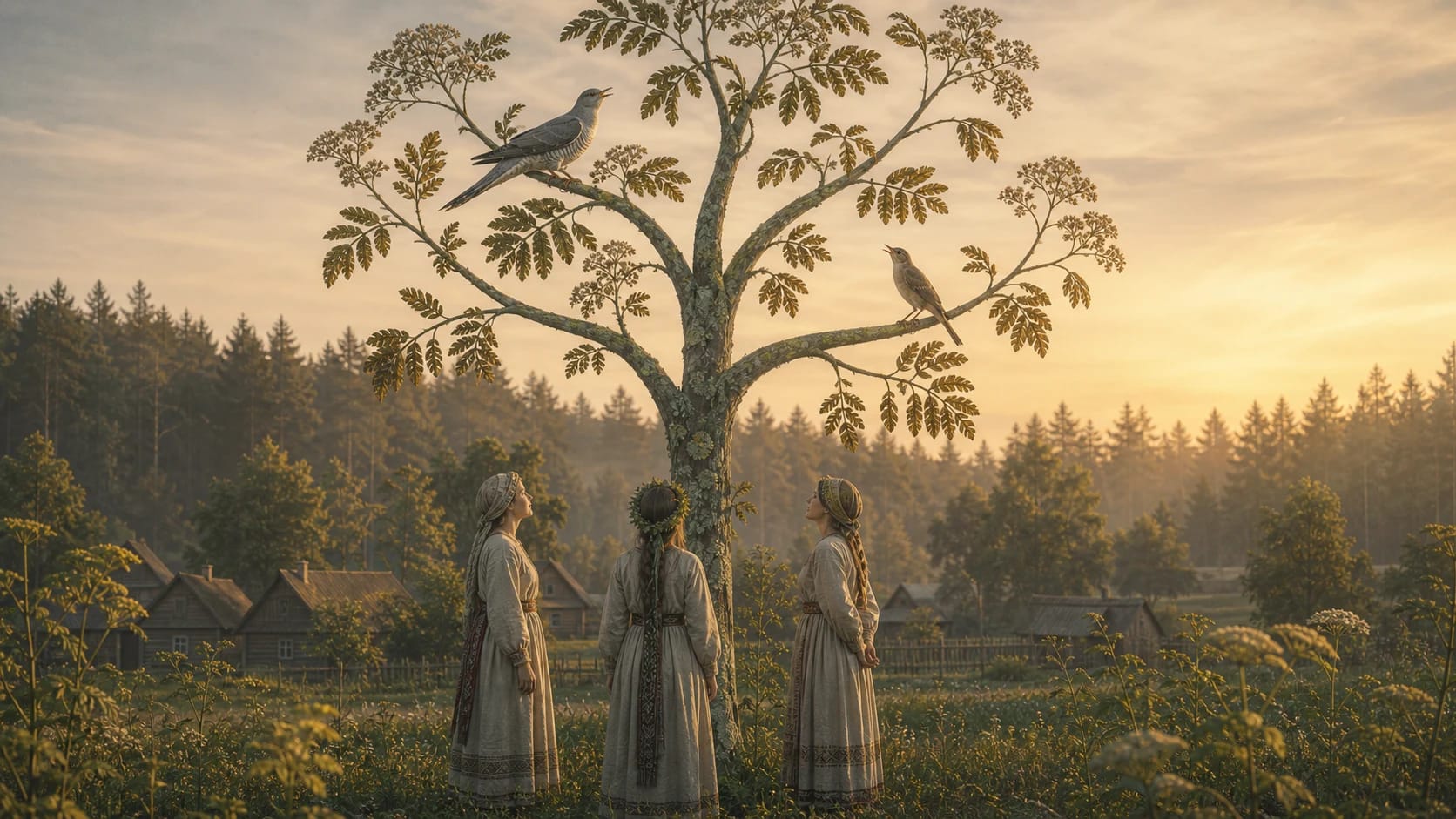
Aglala, Tall One, Laduto: sutartinė interpretation
Aukštuola can be understood as a tall figure: a plant, a tree, or a young woman imagined in elevated form. Birds gather around it: the cuckoo and the nightingale. Both birds carry strong vocal associations in Lithuanian song, so they belong naturally to the sound-world of a sutartinė.
"Laduto" works here as a sonic axis. It sustains the pulse of the voices and lets the short image-lines unfold through repetition rather than through narrative.
Another reading comes from the more archaic variant recorded by Slaviūnas. There the tree is asked why it has grown above others and spread out, and the answer is that it is full of "all the forest": little birds, trees, grey cuckoos, and nightingales. That image can be read as a world-tree motif: one tall fir gathers beneath it the whole forest and all its voices. Sutartinės scholar Daiva Račiūnaitė-Vyčinienė stresses that beneath an everyday sutartinė image there is often an older ritual or mythical layer. The "tall tree" here may therefore be heard not only as a girl-image, but also as a sign of cosmic order and concentrated life.
Aglala, Tall One, Laduto: symbols and phrases
- Aglala
- A rare opening vocable. Its force is primarily rhythmic and sonic.
- Aukštuola
- A tall figure that may be linked with a tree, a plant, or an elevated girl-image; in the archaic variant, it approaches the world-tree motif.
- Cuckoo
- A bird of spring, longing, and voice, frequent in Lithuanian songs.
- Nightingale
- A symbol of singing and beautiful voice, well suited to the sound-poetics of sutartinės.
Aglala, Tall One, Laduto: sutartinė history
"Aglala aukštuola, laduto" is listed in Slaviūnas' collection as volume II, no. 648, a trejinė, and is assigned to family songs. According to the collection metadata, K. Tolušis wrote it down in 1932 in Taujėnai (Ukmergė county, now Ukmergė district) from the 60-year-old singer Alžbieta Rubliauskienė; the text is preserved in the Lithuanian Folklore Archives (LTR 398(29)). The Taujėnai-Užulėnis area is one of the richest sutartinės regions in northeastern Aukštaitija. According to VLE, sutartinės survived longest in this region, in some places still into the second half of the twentieth century.
The opening of the title has the character of rare words and vocables, so its meaning cannot be translated directly. Sutartinės of this kind remind us that vocables are not a "meaningless addition": they carry rhythm, the meeting of voices, and sometimes an older poetic memory whose sense is no longer clear.
Sources
- Z. Slaviūnas. Sutartinės, vols. 1-3 (1958-1959)
- Zenonas Slaviūnas sutartinės collection, LTR 398(29) (sutartines.info)
- D. Račiūnaitė-Vyčinienė. Sutartinės: Lithuanian Polyphonic Songs (2002)
Aglala, Tall One, Laduto: sources
Aglala, Tall One, Laduto: frequently asked questions
What does "Aglala" mean?
It has no precise translatable meaning. It functions as a vocable, important for rhythm and for the sound of the sutartinė.
What is an "aukštuola"?
The word points to a tall figure or plant. In the song it is safest to treat it as a poetic, not everyday, name.
Why is "laduto" repeated?
It is a refrain syllable that sustains the weaving of voices. In sutartinės, such syllables are part of the structure.
Aglala, Tall One, Laduto: how is the Slaviūnas variant different?
The 1932 Taujėnai variant asks why the tree has grown so high and spread out, then answers with an image of the whole forest's birds, trees, cuckoos, and nightingales. It is close to a world-tree image.
Aglala, Tall One, Laduto: is this a trejinė?
Yes. The Slaviūnas entry (SlS II-648) identifies it as a trejinė and a family song.
Aglala, Tall One, Laduto: why is the text so short?
The power of many sutartinės lies not in long storytelling, but in interlocking voices, refrains, and repetition.