
- Genre
- Tall tale and comic tale
- Source status
- variant tradition
- Motifs
- lying contest, impossible events, storytellers' competition, hyperbole, comedy
The Two Liars, Du melagiu, Du melagiai
The tale
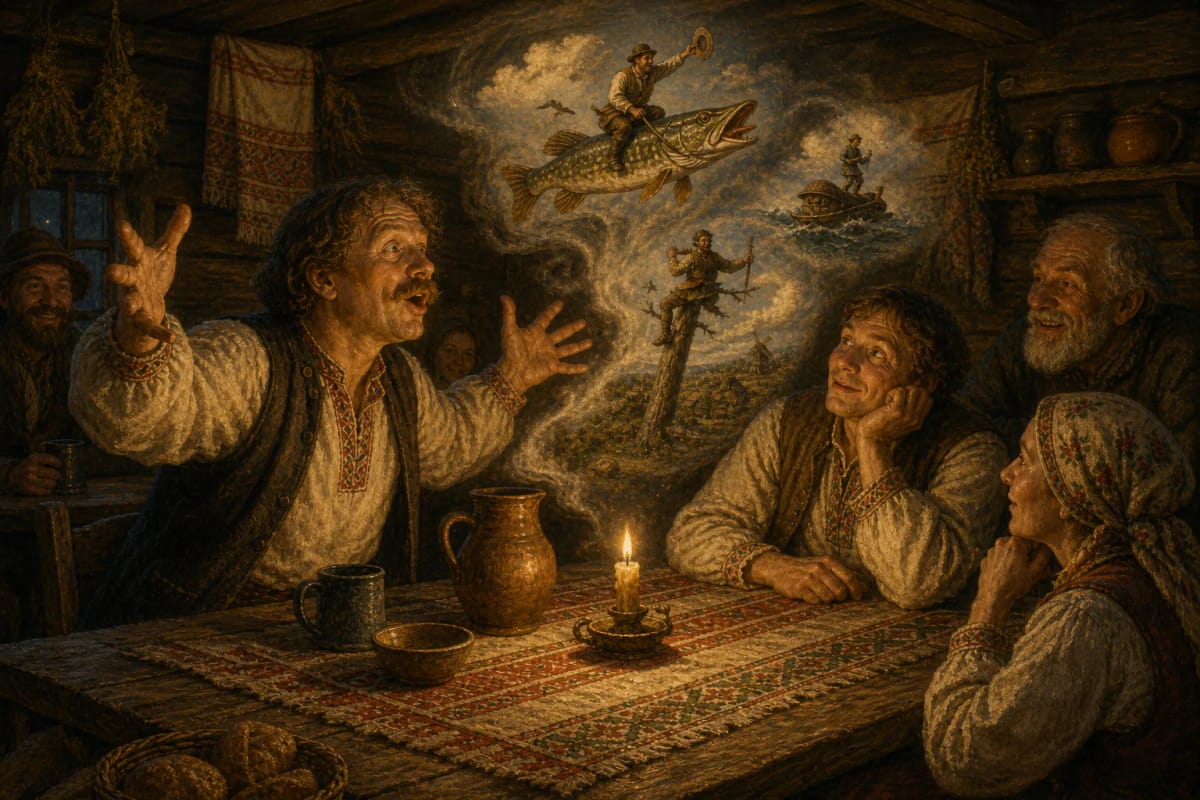
Two liars, or two storytellers, meet and want to prove who can lie better. They begin telling stories that no one could possibly take as true.
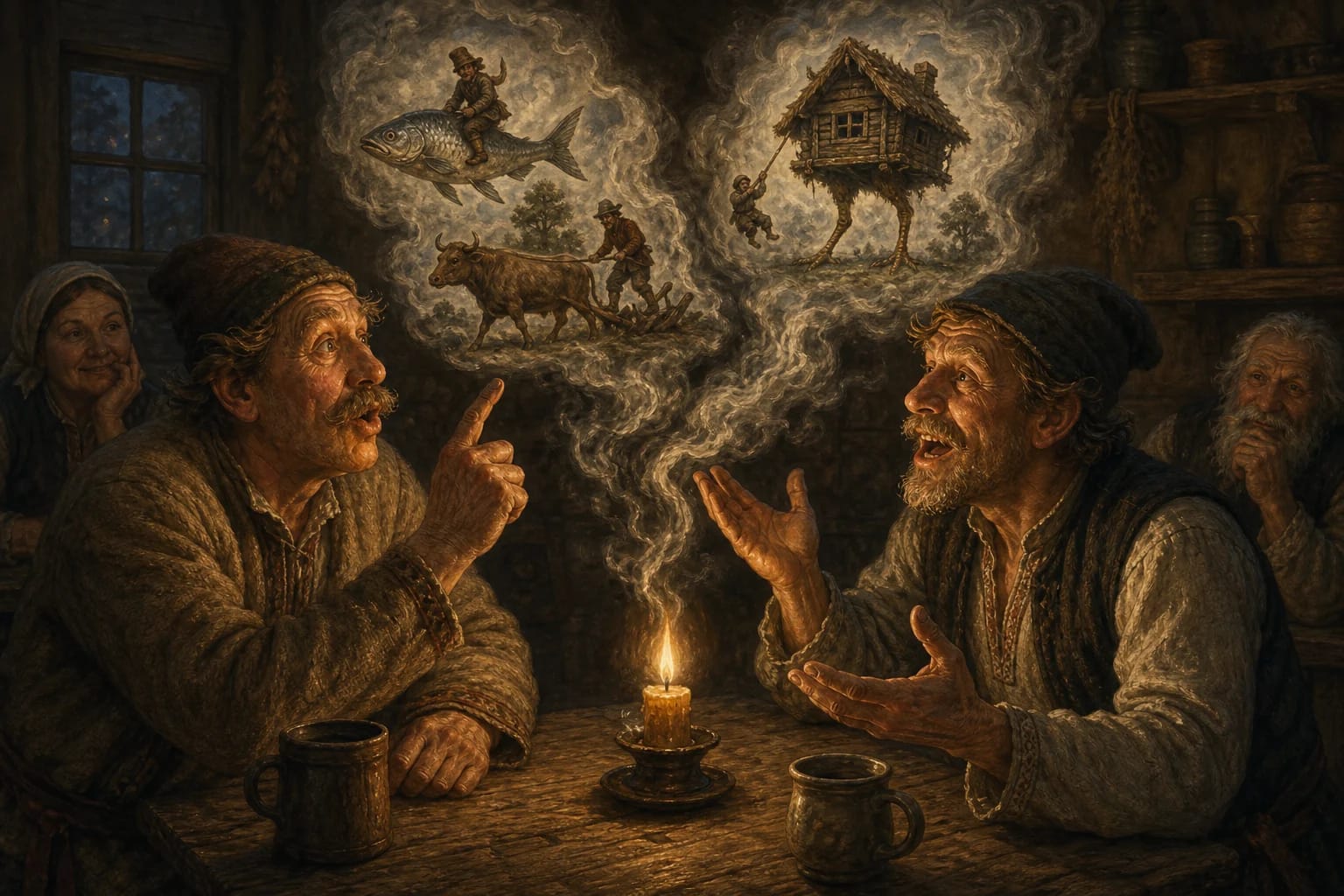
One lie chases another: enormous objects, impossible animals, strange journeys, and natural laws turned upside down. Each storyteller must outdo the previous one.
The ending often matters less as moral judgment than as a comic stopping point. Either the winner tells a lie that cannot be topped, or the listener understands that the whole tale is a game with impossibility.
Interpretation
A tall tale is not meant to deceive the listener. On the contrary, the listener knows from the start that it is not true and enjoys the excess of imagination.
The two liars compete in verbal creativity. What is valued here is not factual truth, but the ability to create a striking, funny, and increasingly impossible world.
Such tales reveal the playful side of folklore: a tale does not always teach directly; it can train language, humor, and imagination.
History and variants
Tall tales and lying tales are widely known in many traditions. Lithuanian variants often draw on village imagery, work settings, and absurdly enlarged everyday objects.
There is no exact date of creation. The tale belongs to an oral tradition of play and laughter.
In the classification used by Visuotinė Lietuvių enciklopedija, this is a lying tale. In the international Aarne-Thompson-Uther system, a contest between two liars is ATU 1920, "Lying Contest," known across Europe. Lithuanian variants are described in Bronislava Kerbelytė's catalogue of narrative folklore (1999-2002).
What makes this page distinct
It focuses not on the general category of tall tales but on the specific traditional title "Du melagiu," helping cover a long-tail search phrase.