
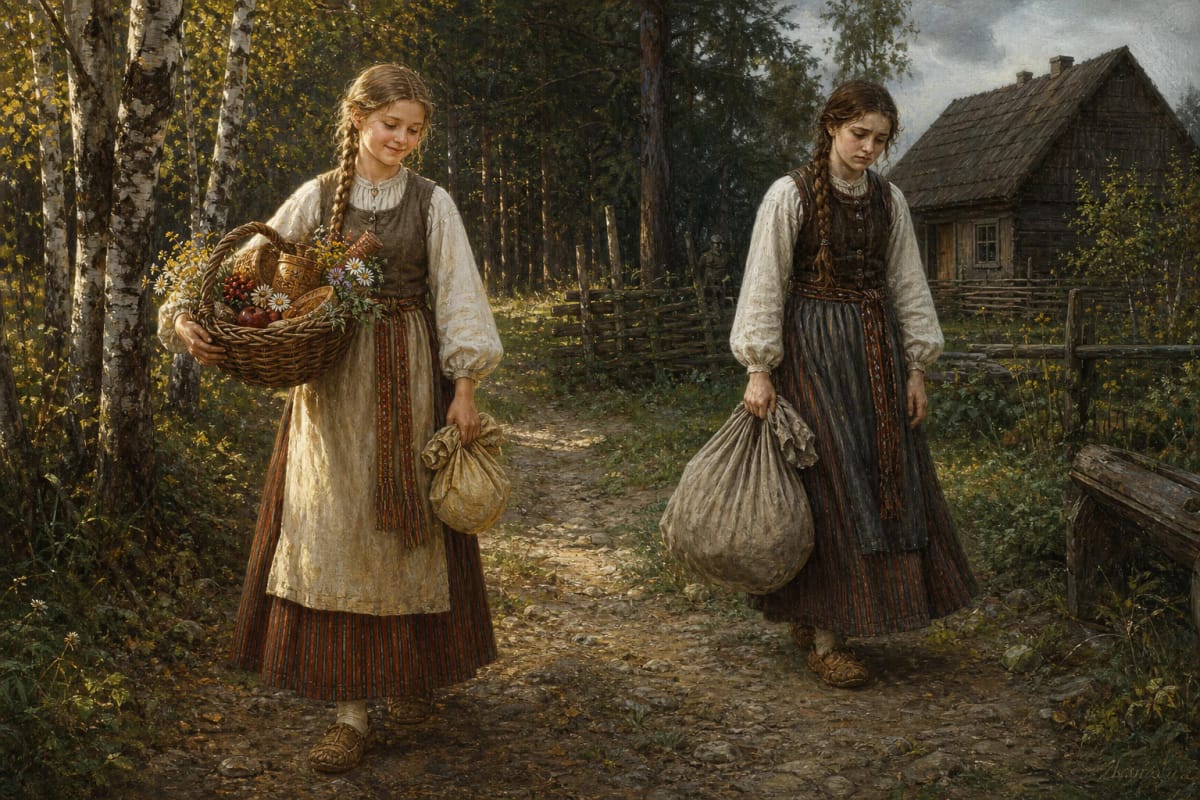
- Genre
- Domestic-wonder orphan tale
- Source status
- variant tradition
- Motifs
- two girls, gifts, stepmother, kindness and pride, just punishment
The Orphan Girl and the Stepmother's Daughter Receive Gifts, The Orphan Girl and the Stepmother's Daughter
The tale
The orphan girl is sent to perform hard work or travel to a strange place. Along the way she behaves politely toward old people, animals, objects, or nature beings. For this she receives gifts that may at first seem simple but later prove valuable.
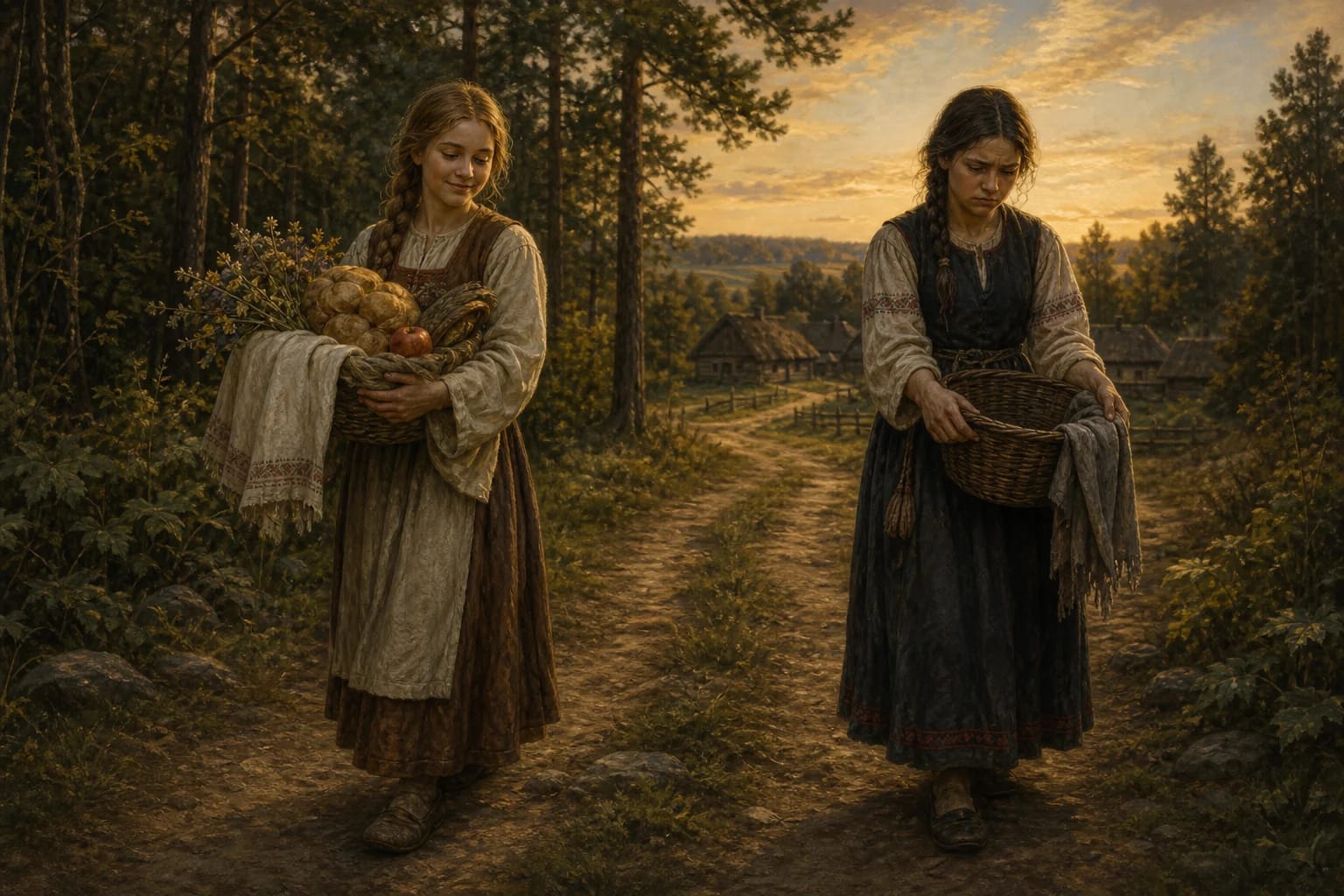
Seeing the orphan's success, the stepmother sends her own daughter to repeat the journey. But the stepmother's daughter is lazy, mocks others, refuses to help, and wants only the gift without the effort.
In the ending both girls receive what they have created through their own behavior: the orphan receives good gifts, while the stepmother's daughter receives shame, punishment, or an empty reward. The tale restores justice through a symmetrical comparison.
Interpretation
The tale works as a clear moral structure. Two girls walk a similar road, but their behavior differs, and so does the result.
The gift is not accidental luck. It is recognized goodness: the tale-world sees what the stepmother does not see at home.
The stepmother's daughter's punishment is not merely revenge. It shows that outward imitation does not work if a person does not take on the meaning of the behavior.
History and variants
This plot is close to international tales about the good and bad girls, gifts, and punishments. In Lithuanian variants it often takes on details of village work, travel, and the stepmother's household.
In the international Aarne-Thompson-Uther system, this is ATU 480, "The Kind and the Unkind Girls," one of the most widespread tale types in the world. Famous parallels include the Brothers Grimm "Mother Holle" (Frau Holle, KHM 24) and Charles Perrault's "The Fairies" (Les Fées). Lithuanian variants are described in Bronislava Kerbelytė's catalogue of narrative folklore (1999-2002); the giver is often an old woman, spring being, or forest being, and the reward depends on the girl's kindness along the road.
There is no exact date of creation. The tale was transmitted as an instructive but vivid story about the consequences of behavior.
The contrast between the orphan and the stepmother's daughter
In this tale two girls walk a similar road, but their behavior and gifts differ completely. This contrast clearly shows how the tale understands kindness, diligence, pride, and just reward.