
- Genre
- Animal tale
- Source status
- variant tradition
- Motifs
- a request for fire, two abductions, a sung call for help, the cat’s music, the rooster’s revival
The Little Cat, the Rooster, and the Fox, The Rooster and the Fox, Katinėlis, gaidelis ir lapė
The tale: an editorial retelling
An old man and an old woman kept a cat and a rooster. One day they went to a fair, leaving bacon and groats at home. The rooster took the groats, and the cat took the bacon. When the couple returned, they drove both animals out.
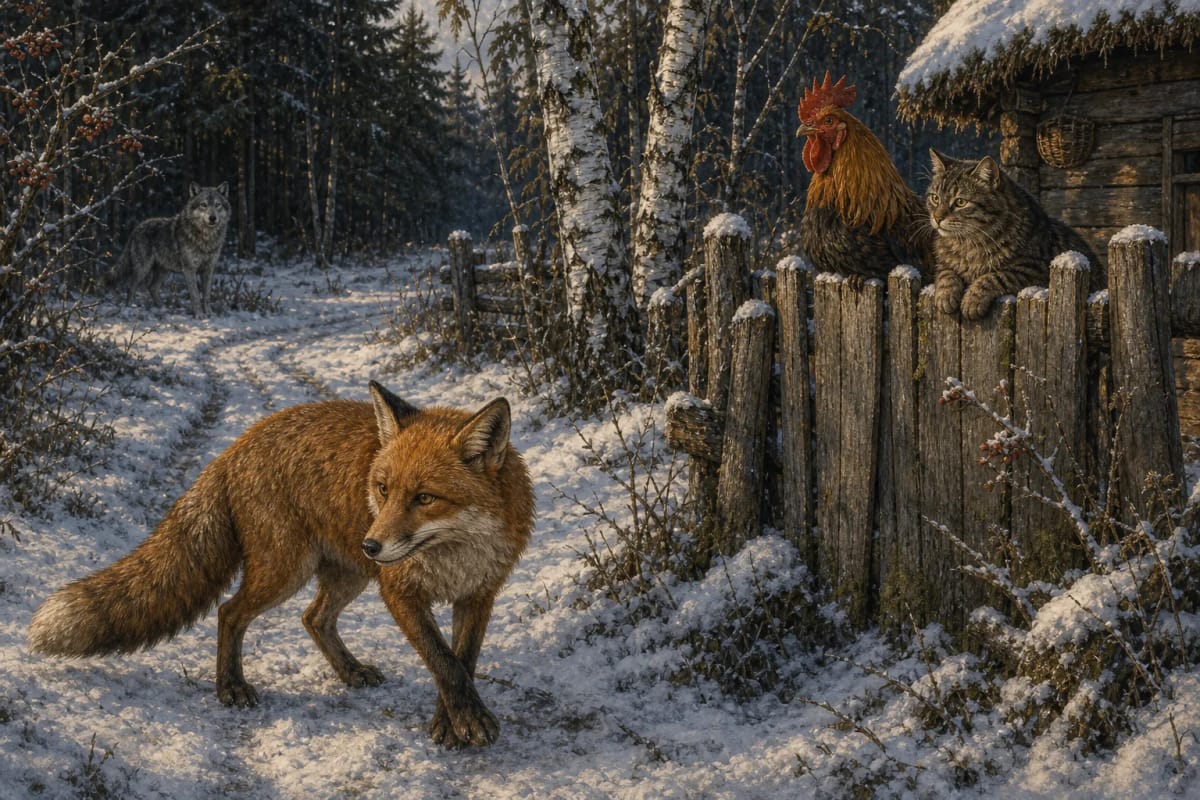
The cat and the rooster went into the forest and built a little hut. The rooster stayed to look after their home, while the cat brought food. When he returned, the cat called through the door, “Open up, little rooster! I have brought a bird.” The rooster let him in, they ate together, and the cat went out again.
A fox listened and learned how they lived. While the cat was away, she came to the hut and asked the rooster to open the door: she needed some fire. The rooster opened up and offered her some, but the fox seized him instead and carried him away. The rooster sang this call for help:
Little cat, my brother,
Oh, I have been carried away
Into the high hills,
Into the low valleys.
The cat heard him, came running and knocked the fox to the ground. He took the rooster back home and warned him, “Do not open the door to her again!”
But the fox returned to ask for fire. This time the rooster told her to take it herself. “Just give me a single glowing ember,” she pleaded. As soon as he opened the door a little, she seized him and carried him away again. Once more the rooster sang:
Little cat, my brother,
Oh, I have been carried away
Into the high hills,
Into the low valleys.
This time the cat had gone too far away to hear him. The fox carried the rooster home to her own hut and boiled him.
The cat returned to find his friend gone. He made himself a large fiddle, a small drum and a little club. Taking them with him, he went beyond a hill near the foxes’ home and began to play. In his song, pipes went “doo, doo”, fiddles went “tir, lir, lir”, and drums went “boom, boom, boom”.
One of the fox’s daughters heard the music and thought there was an evening gathering nearby. She asked her mother if she could go and see who was dancing and playing. Her mother told her to wash, dress up and go. When the young fox reached the other side of the hill, the cat struck her on the forehead with his club and killed her.
The cat began playing again. Another daughter wanted to join the gathering. Her mother sent her off washed and dressed, but the cat killed her too. He kept playing until all the fox’s daughters had come out, one after another, and he had killed them all.
When her daughters failed to return, the fox herself went to see where they were dancing. The cat killed her as well. Then he entered the foxes’ hut and found the boiled rooster.
The cat tossed the rooster over his head and shoulder. Suddenly the rooster stood up alive and crowed, “Cock-a-doodle-doo!”
The recorded version and its songs
This original retelling follows no. 28 in Lietuvių tautosaka (Lithuanian Folklore), volume III (1965), pp. 96–98. The note on p. 664 identifies the storyteller as sixty-three-year-old Marija Lelkiūtė-Povilaitienė, originally from Ramoškos (Ščedrovščizna), in the Jurgelionys area of Šalčininkai district. The tale was recorded in Vilnius in 1958: P. Jokimaitienė recorded the text and B. Uginčius the melodies. The text and melody reference is LTR 3118(136).
The rooster’s four lines above are an original English translation of the meaning, not lyrics adapted to the recorded melody. The Lithuanian text preserves the forms “Katinule broliukas”, “aukštuosna kalnuosna” and “žemuosna lobuosna”: the call addresses the cat as a brother and names high hills and low valleys. The edition provides separate notated melodies for the rooster’s plea and the cat’s musical passage. The cat’s song is paraphrased here. This page does not reproduce an audio recording or a musical score.
The narrative follows this particular version throughout: a request for fire, two abductions, the second call going unheard, the deaths of the foxes and the rooster’s revival. It does not combine several versions, and the ending has not been softened into a straightforward rescue from the fox’s clutches.
Telling and discussing the tale
Consider the ending before reading this version to children: the rooster is boiled, and the fox and her daughters are killed. If you choose a different ending for your listeners, explain that you are adapting the tale.
Listeners can repeat the four lines of the plea at both abductions. The English lines can be spoken aloud; they are not a singable adaptation of the source melody. If you invent a tune, identify it as your own. Discuss why the same call brings help the first time but fails the second time. The cat’s music also draws listeners towards it, but into a trap.