

- Genre
- Domestic and comic tale
- Source status
- variant tradition
- Motifs
- peasant, cleverness, master, social satire, wordplay
The Clever Peasant, Gudrus valstietis
The tale
A peasant finds himself in a situation where a lord, judge, rich neighbor, or other more powerful person stands against him. At first glance he is weaker, because he has neither authority nor wealth.
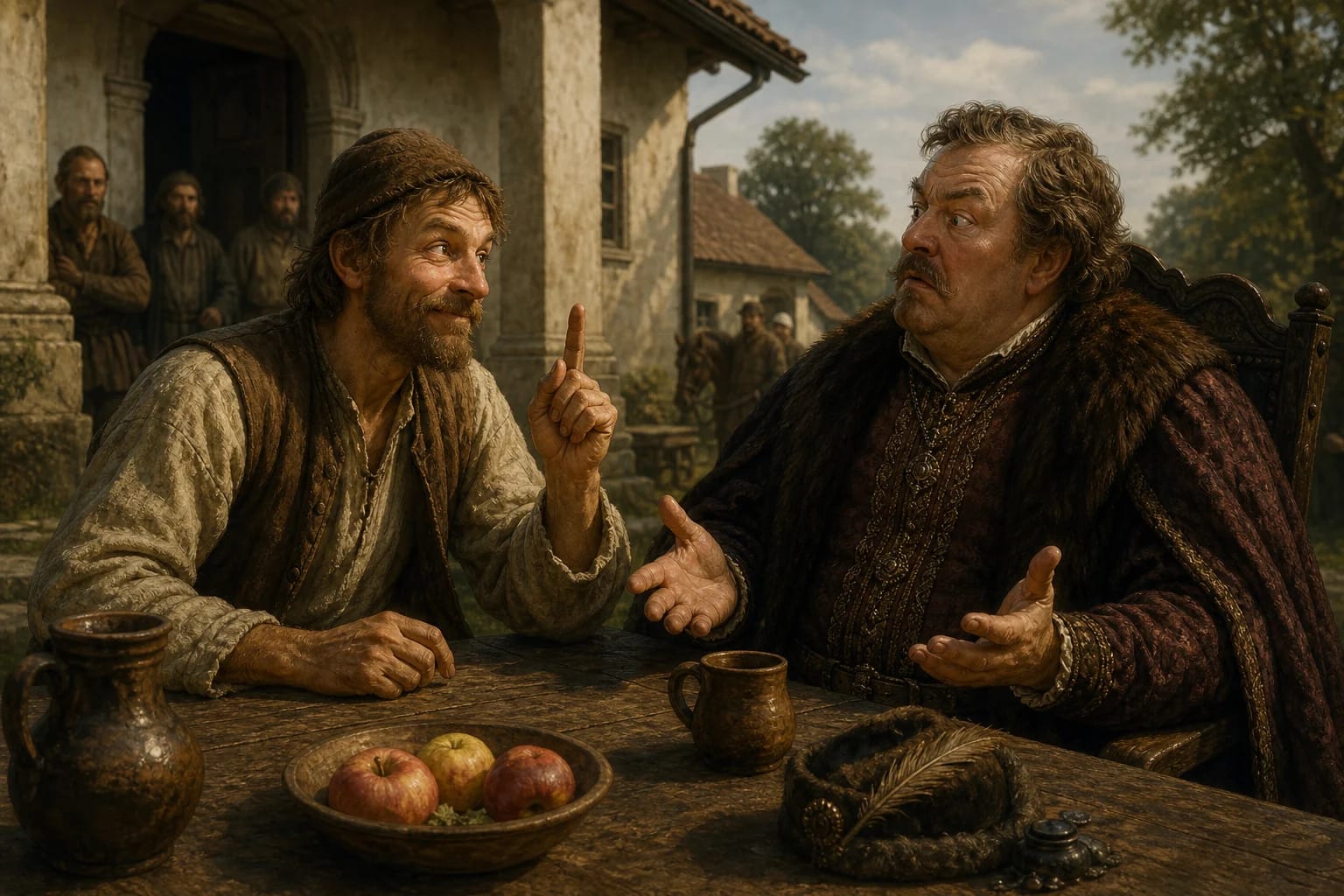
Yet the peasant notices a gap in an agreement, question, or accusation. He answers in such a way that the stronger person becomes trapped by his own words.
In the ending the peasant gets out of trouble or even wins. The laughter comes from seeing an ordinary person prove wiser than someone who thought himself superior.
Interpretation
Clever-peasant tales work as social satire. Authority is not automatically identified with wisdom.
The peasant's weapon is language. He does not remake the world by force, but uses words, rules, and the logic of the situation with precision.
Such tales help explain the function of folk humor: laughter allows social hierarchy to be overturned, at least within the story.
History and variants
Clever-peasant plots have no single date and no single text. They were told as domestic, comic, and novella-like tales.
The opponent and task change across variants, but the basic structure remains: the weaker character wins by exactness of mind.
In the classification used by Visuotinė Lietuvių enciklopedija, such works belong to domestic and novella tales. In the international Aarne-Thompson-Uther system, plots about a clever person outwitting authority or wealth form part of the novella-tale group ATU 850-999, including ATU 921, "The King and the Peasant's Son," and ATU 875, "The Clever Peasant Girl." Lithuanian variants are described in the catalogues of Jonas Balys (1936) and Bronislava Kerbelytė (1999-2002).
Why the page is valuable
It covers a broad phrase about the clever peasant and connects tales about farmhands, masters, courts, devils, and social satire.