
- Genre
- Stone legend
- Source status
- variant folklore tradition
- Motifs
- living stones, petrification, family, river, Mokienė
Mokas and Mokiukas, Mokai family legend, Sukiniai stones
The Legend of the Mokai Stones
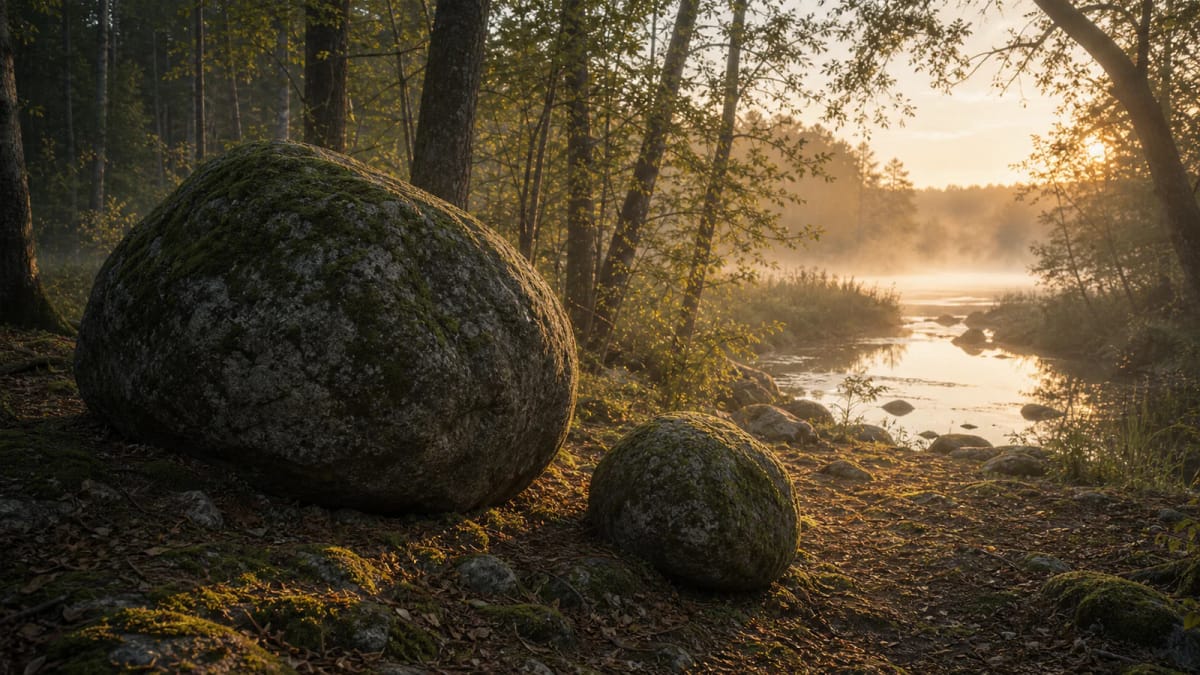
Old people said that Mokas was once not a stone but a living man, or the father of a stone family. He traveled with his wife Mokienė and his son Mokiukas until they came to water that had to be waded or crossed.
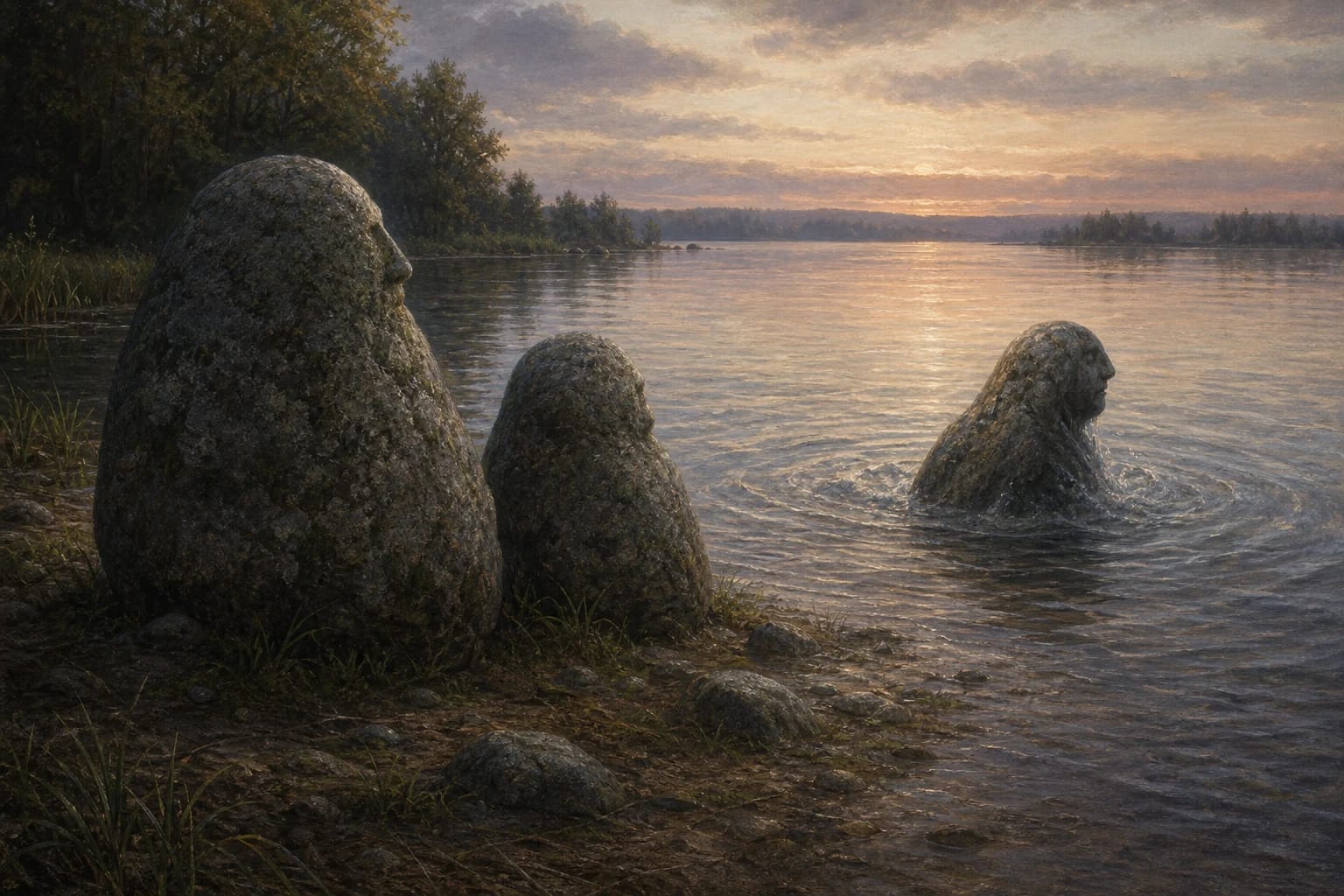
Mokas and his son reached the bank, but Mokienė drowned or remained in the depths of the lake. Then the family froze: father and son turned into stones on dry land, while the lost mother remained in the water, sometimes reminding people of herself through fishermen's nets or stories.
In other versions, Mokas is punished for people's laziness, stubbornness, or withdrawal from the new faith. Yet the core remains the same: in the legend, stones have life, kinship, and painful loss.
Interpreting the Mokai Stones Legend
The Mokai plot is one of the clearest examples of stones taking on human identity in Lithuanian legends. The boulder is not a dead object; it has a name, family connection, and biography.
Water acts as a boundary between worlds. Mokas and Mokiukas cross it; Mokienė does not. The stones on the bank and the invisible mother in the water explain why the landscape contains separate signs joined by one story.
The legend also speaks of fragments of memory: the large stone, the small stone, and the unseen Mokienė create a family image in which even what cannot be seen matters.
History of the Mokai Stones Legend
Lituanistika studies discuss Mokai stone legends as part of a broader tradition of stone-people. They repeatedly include motifs of a living stone family, swimming or crossing water, and a drowned wife.
VLE describes the Sukiniai stones Mokas and Moko Son as a geological and archaeological monument in Ukmergė District. Tourism and local-memory sources present other variants of the Mokai tradition as well, especially in Aukštaitija.
This page therefore presents the Mokai not as one place's single text, but as a recurring type of Lithuanian legend tied to specific stones.
The petrified-family motif, in which people or animals turn into stones, is the second great type of Lithuanian stone legends, alongside the devil-carried stone. The best-known Mokas and Moko Son, the Sukiniai stones in Ukmergė District, are protected as a geological and archaeological monument. Lithuanian place legends were collected in Žemės atmintis: Lietuvių liaudies padavimai (1999) and classified in Bronislava Kerbelytė's catalogue, volume 3 (2002).