- Genre
- Place-memory legend
- Source status
- chronicle and local tradition
- Motifs
- Pajauta, Pajauta Valley, Kernavė, place-name, woman, memory
Pajauta, Pajauta Valley, Kernavė's Pajauta
The legend
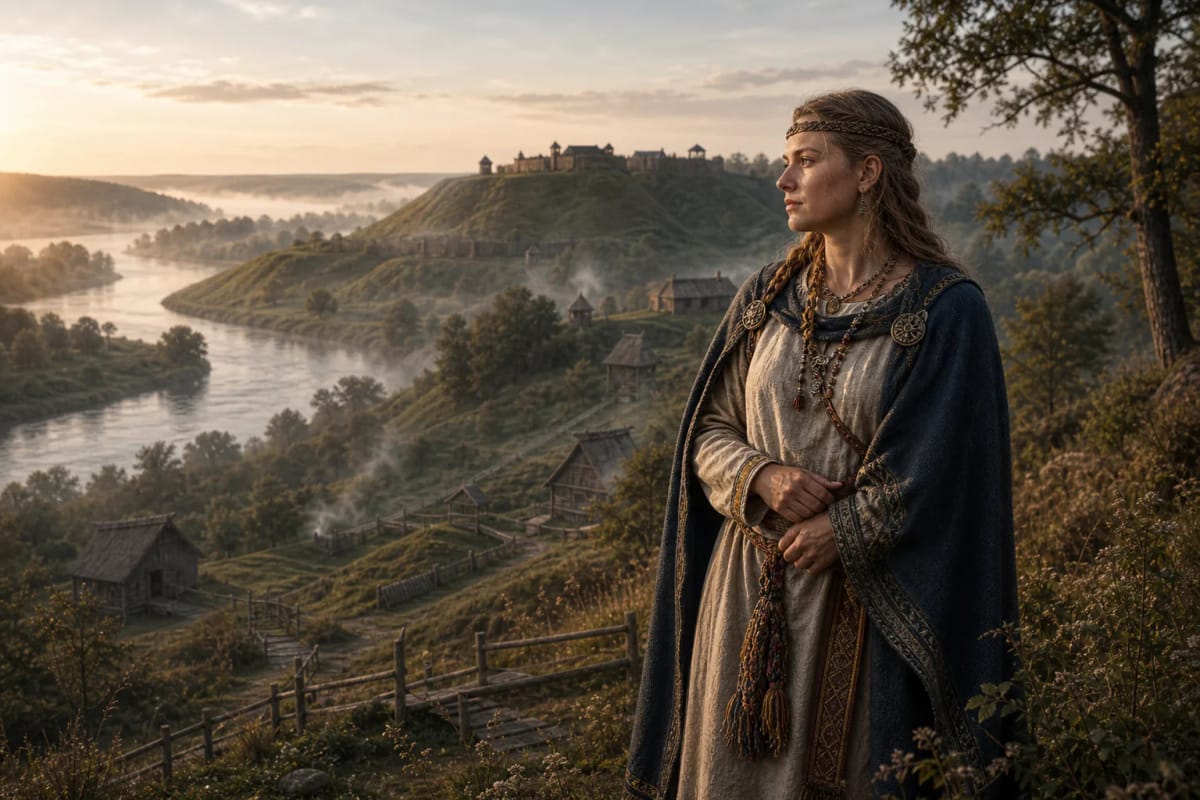
Pajauta's name is linked with the landscape of Kernavė and Pajauta Valley. In the field of stories she appears as a legendary woman whose name is written into the place.

Chronicle tradition presents Pajauta as a daughter of the legendary Duke Kernius; old authors disagreed about his descendants, since some attributed to him a daughter, Pajauta, and others a son, Živinbudas. The figure of Pajauta is most likely a genealogical detail created by sixteenth-century chroniclers and later expanded in the writings of Motiejus Strijkovskis and Albertas Kojelavičius-Vijūkas.
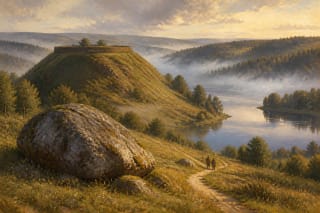
The Kernavė hillfort setting gives the name strong background. Pajauta Valley is not just a meadow; it is part of a landscape of old settlement, defence, and memory.
Interpretation: what does Pajauta mean?
Pajauta is a link between name and place. In such legends the main point is not a long adventure plot but the fact that a landscape receives a human face.
A female figure in the Kernavė story field matters because she softens a landscape otherwise dominated by founders, rulers, and hillforts. Through Pajauta, the valley can be read through name, life, and memory.
Pajauta Valley also shows how, in Lithuanian tradition, a place can preserve a story even when the plot itself has become very short. Sometimes a name is enough for a place to become a legend.
Modern visitors should not turn Pajauta into a precisely documented biography. She works as a legendary place-memory figure.
History and Kernavė context
Kernavė is one of Lithuania's most important archaeological places; in 2004 it was inscribed on the UNESCO World Heritage List under criteria (iii) and (iv), and VLE presents Kernavė as a significant Lithuanian centre of the thirteenth and fourteenth centuries. Pajauta Valley is part of that wider cultural landscape.
Historically, the valley is not only a legendary name. Sources describe it as the area where Kernavė's lower town developed near the ducal residence. This gives the place a real medieval context, while Pajauta remains a legendary name layer.
Local museum and tourist tradition presents Pajauta Valley as an important element of the Kernavė landscape. This shows that the legend works today not only in texts but also in the practice of visiting, education, and the perception of place.
Why this legend deserves its own page
Pajauta shows a different type of legend. There is no single dramatic heroic act; there is a named place that preserves memory.
She also keeps the Kernavė section from being only about rulers and hillforts, adding a woman's name and the valley's closeness to the landscape.